

Slow Growth vs. No Growth: How to Tell the Difference
Spoiler Alert: You Won’t Always Be Able To
Picture this: You finally made the leap and started your own blog. You write for it every day, and you’re putting in a ton of effort to make high-quality posts. You promote it on social media constantly. You’re building an email list that you hope will someday get you some sales for your digital products. You’ve done SEO research, narrowed down your niche, and mastered the art of consistently publishing.
You’re doing everything right, but you aren’t seeing results. In the beginning, you were running on excitement. After that, the occasional visits and comments on your posts were enough to keep you motivated. Now, it seems your traffic is dying down, and you feel stuck. You’re not sure how to get past this point. You’re doing what you’ve been doing since the start, but the numbers aren’t looking good.
Is it time to throw in the towel? Time to change up everything you’re doing and start over? Time to admit defeat and let the last of your motivation die?
Well, no. Not so fast.
The Art of Progress
Progress, contrary to what we’d like to think, hardly ever happens in a straight line.
When we think about the process of improvement, we generally imagine an upward trend. Maybe it’s curved a little bit, but it has a positive slope overall. The longer you do something, the better you get. The more work you put in, the better your results.
An actual progress line looks a bit more like a set of tracks for a roller coaster. When you start, you’ll make progress quickly, and you’ll imagine that this steep upward slope will continue throughout your journey.
You’ll be sorely mistaken.
Embracing the “Dip”
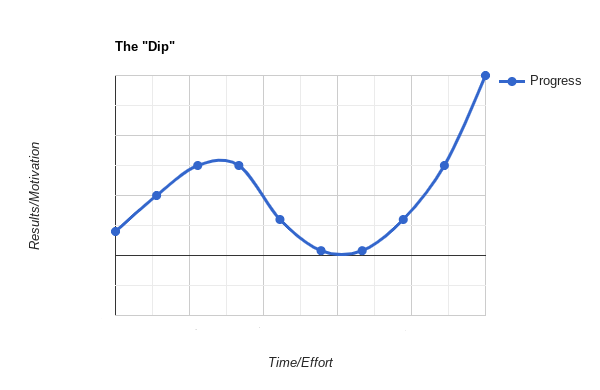
Seth Godin popularized the idea of the “dip” in his 2007 book The Dip: A Little Book That Teaches You When to Quit (and When to Stick). Essentially, Godin argues that every worthwhile pursuit eventually reaches a hard place, called a dip, where effort may be as high as ever, but results (and with them, motivation) plummet.
The dip can feel like the end. You were making so much progress before, but now it seems like everything has halted. No matter what you do, you’re not seeing the results you once did. It can be demoralizing.
What’s the good news? Well, if you look at that graph again (and try not to judge my graph-making skills), you’ll see that there’s a light at the end of the tunnel. People who make it through the dip are in it for the long haul. They come out the other end stronger than ever.
Your results aren’t out of reach, they’re just out of sight.
Knowing When to Quit
When you reach the dip, you have to make a very important decision: Are you going to keep going, or is it time to quit?
Despite its connotations, quitting isn’t always bad. It’s completely okay to decide that something isn’t for you. Maybe blogging isn’t all that you thought it was, or maybe you’ve lost interest in your niche.
Here are the important questions to ask yourself when making this decision:
- Is the goal promising? — If you started out with a strong goal that you know you can reach, it’s a good idea to push through the dip. You might lose a lot of your motivation, but keep your eyes on the process, not the destination. On the other hand, if your starting goal was far-fetched or unrealistic, maybe it’s time to make some adjustments.
- How badly do I want this? — Answering this question at a time of low motivation can be difficult. Remember where you started and where you hope to go. Remember what motivated you before, and ask yourself if it’s worth it. You’ll have to keep putting in work to get out of the dip. Are you willing to do that?
- Is this a long-term goal? — If you’ve reached the dip, you’re probably in the process of achieving a long-term goal. If you make it past this, you’re in it for the long haul (unless of course you decide to quit after the dip, but that’s less common). Think about what you hope to achieve in the long run. What’s your endgame?
After the Storm Comes the Sunrise
The concept of the “dip” isn’t an exact science. When you do something long enough, you’re likely to run into many dips along the way, usually before major successes or breakthroughs.
Embrace the low points. Let the process slow down sometimes. It doesn’t mean you’re doing anything wrong. Good things don’t always come steadily.
That being said, it’s completely normal to be frustrated when the dip happens. Talking about it is one thing, working through it is another.
Concluding Thoughts
There’s no quick fix for this. You can’t fast-forward through the dip, no matter how tempting it might be to try. There isn’t a proven method for solving the slow burn.
Still, I hope you can find some peace in knowing that it’s a natural part of the process. I certainly did.
If you enjoyed this article, please consider following me and reading some of my other work. If you want to go above and beyond, I’d love it if you would buy me a coffee to support my writing!
Thank you!