
Slouching Towards the Future
Did Yeats and Joan Didion predict our fate?
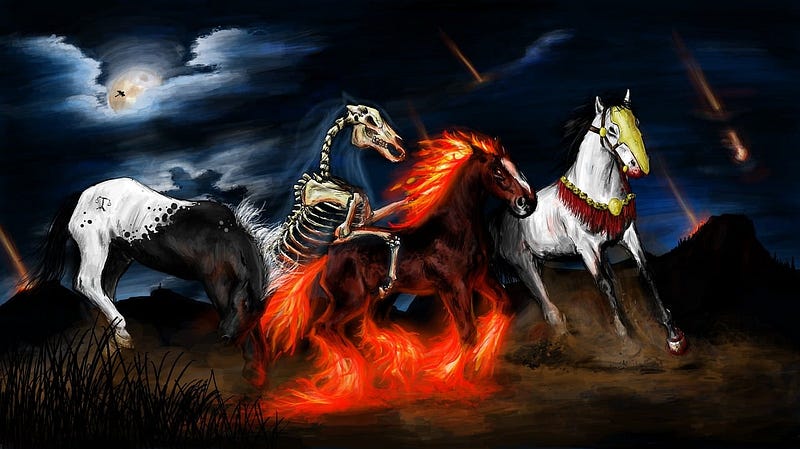
‘Things fall apart; the center cannot hold.’
This line by W.B. Yeats from his poem, “The Second Coming,” was written in 1919 shortly after the end of World War I. In two short stanzas, the poem paints a pitiless apocalyptic picture of a post-war world.
Small wonder the poet was feeling despair, surrounded as he was by chaos and a sea of lost souls. But it wasn’t just the European society of his day he saw collapsing.
For Yeats, anarchy was the ultimate fate of all societies.
Like many Americans of my generation, I came to Yeats by way of Joan Didion. Didion included Yeats’ poem on the fly page at the beginning of her first nonfiction book, “Slouching Towards Bethlehem.” This collection of essays put her on the map as one of the key writers of the “New Journalism” school of the 1960s and ‘70s.
Didion died in 2021, one of many authentic voices lost during a time when our country saw substantial crumbling to its center.
Hippies and hypocrisy
The title essay in her book is about her time in San Francisco in 1967 at the height of the counter-culture movement. “The center was not holding,” is her opening line, and she makes it clear she wasn’t just writing about Haight Street hippies.
Didion was chronicling the country’s fraying social fabric; San Francisco just happened to be “where the social hemorrhaging was showing up.”
The phrase pops up again as the title of a 2017 film about her life. The documentary “The Center Will Not Hold” was made by her nephew with her cooperation, and can be viewed on Netflix.
In the film, she gives a stark assessment of why she turned to writing about politics and hypocrisy in the ’80s. “American politics,” she said, “exists to maintain itself, with no relation to the rest of the country.”
True then, even truer today. Looking back, the decade of the ’80s was a golden era compared to today’s polarized political climate. How did we get here?
Moderates no more
Throughout America’s modern era the majority of the population has been in the center of the political spectrum. Conservatives were center right; liberals center left. Together they made up the country’s core of moderate voters. The differences between them, while real, weren’t insurmountable.
One side didn’t declare the other side an enemy of the people.
That was the old normal. The new normal burns moderates at the stake of hyper-partisanship. Instead of centrists, we have “independent voters” — a mysterious demographic whose views vacillate like a wacky inflatable tube man at a car dealership.
What little remains of our center is flanked by a growing fringe of far right and far left extremists. These are people who religiously follow a particular party or ideology with no regard as to what is morally right or factually true.
Flanking attacks are a basic military tactic, but the flanks aren’t supposed to chew away at their own core. America has become an ouroboros devouring itself. The center cannot hold.
Denialism
This polarization is chipping away at our democratic institutions. The January 6 attack on our Capitol by a mob of neo-fascists was disturbing on many levels, not least being that the mob was incited to violence by a sitting president.
While close elections are nothing new, before the 2020 election we never had a losing presidential candidate refuse to concede. More than 60 court challenges by the former president were thrown out of court due to lack of evidence by judges from across the political spectrum. The judicial system held fast — this time.
But according to polls, a significant segment of one party continues to hold to the fantasy that the election was fraudulent. Confidence in the electoral process is vital to a functioning democracy. Election denialism undermines this trust, and it’s difficult to see how we get it back with populist politicians continuing to spew misinformation.
The latest red flag is the ouster of House Speaker Kevin McCarthy — a historic first for this country that leaves the House mired in chaos. “If you want to know what it looks like when democracy is in trouble, this is what it looks like,” said Daniel Ziblatt, professor of government at Harvard University, as quoted in a recent Washington Post story. The center cannot hold.
Disorder and civil unrest
The pressure isn’t coming just from the right flank. Radical progressives on the left flank also contribute to polarization. Intolerance and disorder are harmful to a civil society, whether from the right or left.
Recent years have seen record levels of civil unrest. Protests against police brutality and racism have occurred in more than 2,000 cities and towns in the U.S. While most protests were peaceful, some led to riots and violence, and these got saturation coverage on cable news channels. Arson, vandalism and looting in cities have caused an estimated $1-$2 billion in damages. The center cannot hold.
Will it hold for the next election? The one after that? Or will our democracy go the way of the Roman Republic and slide into despotic rule?
Democracies are fragile things. Perhaps American democracy can survive if Americans can put their differences aside and resolve to work together. We need an anti-authoritarian coalition that unites a majority from both political parties and independents.
At this point, that task seems beyond us.
I’m not a prophet. Nor was Didion. But I’ve got this uneasy feeling that Yeats was.
Thanks for reading. Feel free to share your thoughts in comments. Follow and subscribe to Robert E. Saunders for more stories and occasional commentary.