avatarCarolyn Hastings

Free AI web copilot to create summaries, insights and extended knowledge, download it at here

3462

Abstract

They digest their food very thoroughly and extremely slowly. They only eat when they have room in their stomachs for more food. Some days they barely eat at all. A full sloth stomach can account for a third of the sloth’s body weight.</li><li>sloths have a very slow metabolic rate which explains, and contributes to, their slow digestion — and their infrequent need to pee and poop.</li><li>sloths have light brown fur that can take on a distinctly greenish tinge. It’s not the chlorophyll in the leaves they’ve eaten acting as hair dye — it’s algae growing on the hairs! 😝 Sloths <a href="https://slothconservation.org/with-a-little-help-from-my-friends-sloths-moths-and-algae/">cultivate</a> a symbiotic ecosystem in their fur! Not only do they use the algae as a nutritional supplement for their low-calorie diet of leafy greens, their fur is home to colonies of moths, insects and fungi. 😲</li><li>once a week, sloths painstakingly (and at considerable risk of predatory attack) descend their treetop homes for a toilet break on the forest floor. The fresh droppings make the ideal incubator for moth eggs and a readily available food source for moth larvae. Upon maturation, the moths take off and join the moth colonies residing in a sloth’s fur.</li><li>sloths are completely colourblind and are virtually blind in broad daylight. The filtered light in the canopy of the rainforest trees they live in makes it possible for them to move about the branches, albeit slowly.</li><li>sloths sleep up to 20 hours a day hanging upside down from a tree branch or snuggled into a fork in the tree. 😴 Apart from toileting, they conduct all their business in the treetops including the ‘boy-meets-girl’ thingy, and six months later, the ‘popping out a cub’ thingy. 😉</li><li>unlike other mammals, a sloth’s body temperature fluctuates with that of the surrounding environment. On average their body temperature ranges between 24–33°C (74–92°F) i.e. significantly lower than the normal body temperature of a human.</li><li>owing to their weak hind legs, sloths find it difficult to walk on all-fours when they’re on the ground. They are, however, excellent swimmers.</li><li>sloths have inhabited Earth since the time of the dinosaurs. Originally, they were giant-sized ground dwellers but around 11,000 years ago they down-sized and took to the trees where they have remained ever since.</li></ul><figure id="9466"><img src="https://cdn-images-1.readmedium.com/v2/resize:fit:800/1*Ix5MaQ0eZKtWdQrLK6LwpQ.jpeg"><figcaption>an algae camouflaged sloth (image by Panegyrics of Granovetter, <a href="https://creativecommons.org/licenses/by-sa/2.0">CC BY-SA 2.0</a> via <a href="https://upload.wikimedia.org/wikipedia/commons/a/ae/27815-_sloth_in_tree.jpg">Wikimedia Commons</a>)</figcaption></figure><p id="fd5d">All this sloth-sleuthing has me itching to write another poem. Here goes:</p><p id="6144">moth lays eggs in sloth poo under the tree larvae hatch and gorge on all-they-can-eat dung till cocooned, they grow wings flutter to the treetops above where they find colonies of their kind loving life in the algaed fur of sloths</p><p id="d6f4">© Carolyn Hastings 2023</p><h1 id="e87e">Etheree Poetry</h1><p id="48bc">The 10-line sloth and moth poems I’ve written are called <b>etherees</b>. They’re essentially shape poems starting with a one-syllable line and increasing one syllable per line to finish with a 10-syllable line.</p><p id="b27f">Etherees can be

Options

inverted i.e. the first line is 10 syllables long and the last line is one syllable. These are called <b>reverse etherees</b>. I wrote one <a href="https://readmedium.com/happiness-lives-in-you-f8976ecfdec9">here</a>.</p><p id="60d3">Etherees are related to nonets which are shape poems constructed with nine-lines starting with a nine-syllable line and decreasing incrementally by one syllable to a one-syllable line. I recently wrote one, <a href="https://readmedium.com/warms-your-heart-now-you-bloom-6e3ed02b1c49">here</a>.</p><h2 id="531e">A note for teachers about etherees and beating ChatGPT</h2><p id="18f2">Etherees are a fun poetic form for students to play around with. As well as practising their syllabification skills, etheree poetry gives students the opportunity to present information and concepts they’ve been studying in a creative, neatly-packaged product.</p><p id="d31d">Etherees also get around some of the issues ChatGPT and its chatbot cronies have brought to the education sector. Put simply, ChatGPT can’t write etherees (or for that matter, nonets and other shape poems). Here’s the evidence:</p><figure id="0662"><img src="https://cdn-images-1.readmedium.com/v2/resize:fit:800/1*QpWcjX8Blv_5bVH5yJJcLA.jpeg"><figcaption>screenshot by author</figcaption></figure><p id="d9d4"><b>Comment:</b><i> ChatGPT has the definition and origins of etheree poetry down pat, but the example it has provided is way off the mark in terms of syllable-line count (2, 2, 4, 5, 6, 6, 7, 8, 9, 2). Its critique of its own poem proves it has little capacity to assess its own product against the criteria. </i><b>Conclusion:</b><i> Students will be caught out if they rely on ChatGPT to write an etheree for them. </i>😉</p><p id="e382">If you’re looking for a factually accurate info doc on etherees, you’ll find it here in <a href="undefined">Melissa Coffey</a>’s article, <i>Syllabic Poetry: Meet the Etheree</i></p><div id="f251" class="link-block"> <a href="https://readmedium.com/syllabic-poetry-meet-the-etheree-dda98f5822c8"> <div> <div> <h2>Syllabic Poetry: Meet the Etheree</h2> <div><h3>Guest Prompt — and easy as 1,2,3</h3></div> <div><p>medium.com</p></div> </div> <div> <div style="background-image: url(https://miro.readmedium.com/v2/resize:fit:320/0*pyDc9j8cujfXRkRT)"></div> </div> </div> </a> </div><p id="9b21"><b><i>Thank you so much for reading.</i></b> 🙏</p><p id="c2df"><a href="undefined"><i>Carolyn Hastings</i></a><i> is an Australian speech pathologist, educator, author, poet and editor for an online poetry publication. Feel free to connect with her here on</i> <a href="https://carolynhaasp.medium.com/">Medium</a> <i>or via</i> <a href="https://www.facebook.com/askaspeechpathologist/">Facebook</a>, <a href="https://www.linkedin.com/in/carolyn-hastings-95753b47/">LinkedIn</a> <i>or <a href="https://twitter.com/carolynh_aasp"></a></i><a href="https://twitter.com/carolynh_aasp">Twitter</a>.</p><p id="4c5c"><b>✨ If you like what you’ve read, please consider — </b>👉 <b><i>Subscribing to my <a href="https://carolynhaasp.medium.com/subscribe">email list</a></i></b><i> </i>📩<i> </i>👉 <b><i>Becoming a </i>Medium<i> member using my <a href="https://carolynhaasp.medium.com/membership">affiliate referral link</a></i></b></p></article></body>

Poetry | Creativity | AI

Sloth Hanging From a Tree Beats ChatGPT

Etherees and fun facts about sloths
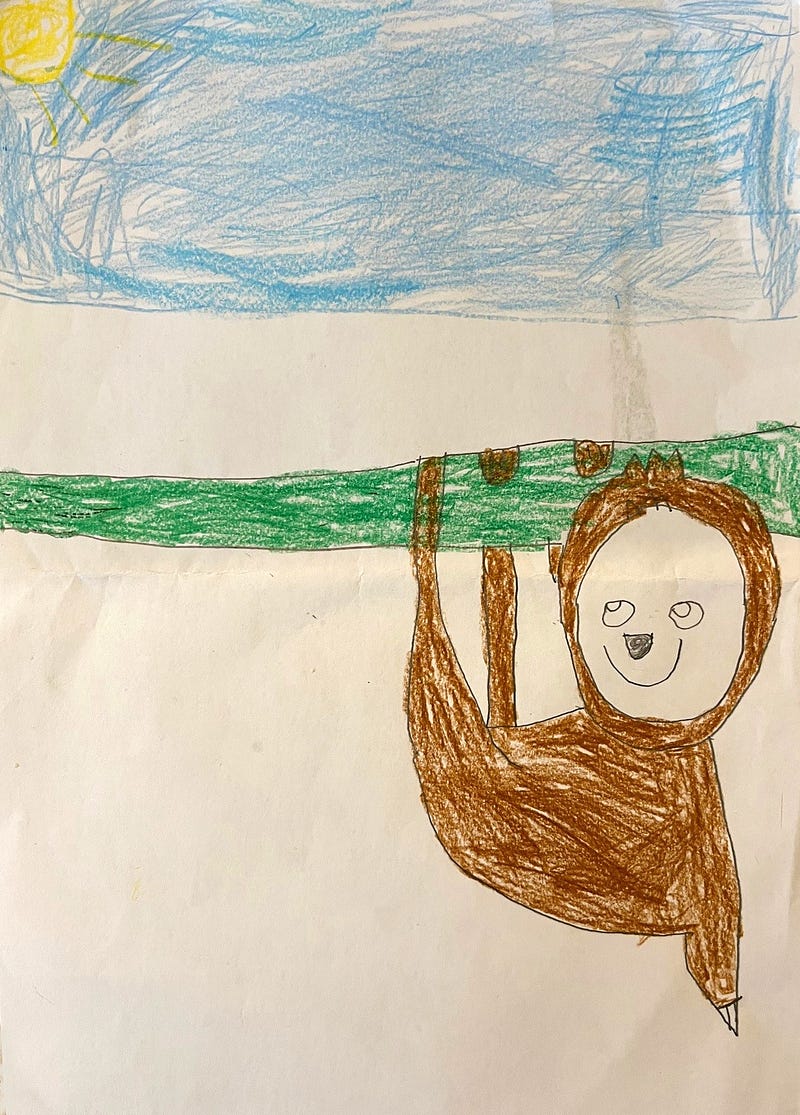
illustration by author’s 6-year-old grandson

sloth hanging from a tree all day and night except once a week when the urge to poop grips she then descends to the ground where she attends to her toilet at the base of her jungle treehouse; a girl after all needs her privacy

© Carolyn Hastings 2023

Dedicated to my grandson, Wesley, who drew the cute sloth picture that inspired my poem and, like many just-turned-6-year-olds, delights in toilet tales.

Wesley drew the picture at school after his class read the The Sloth Who Came to Stay (2017), a well-worth-a-read children’s picture book by well-known Australian author, Margaret Wild.

The story has nothing to do with the toileting habits of sloths and everything to do with a sloth who teaches a family the benefits of slowing down. With the craziness of modern life, we could all take a leaf out of sloth’s book. 😊

You can follow the story here in this YouTube video -

Note: the book is also marketed as The Sloth Who Slowed Us Down

Inspiration and Creativity

We all know books are a wonderful source of knowledge, inspiration, and creativity. The story you’re reading right now is a perfect example of that: I would not have been inspired to write my poem if it weren’t for Wesley being creative with his sloth drawing, and that only came about because his class read a story book that used a sloth as a metaphor to convey an important message.

Wesley’s sloth drawing awakened the sloth sleuth in me — by which I mean, it had me expending energy to reach for my phone and google sloths!

Prior to that, my knowledge of sloths was limited to them being the much maligned tree-dwellers associated with Christianity’s Seven Deadly Sins.

My cyber-sloth-sleuthing uncovered some fun facts about sloths:

  • sloths spend their lives in trees because that’s where their food source is — leaves, a bit of fruit, algae, and more leaves.
  • sloths have a large, four-chambered stomach similar to cows. They digest their food very thoroughly and extremely slowly. They only eat when they have room in their stomachs for more food. Some days they barely eat at all. A full sloth stomach can account for a third of the sloth’s body weight.
  • sloths have a very slow metabolic rate which explains, and contributes to, their slow digestion — and their infrequent need to pee and poop.
  • sloths have light brown fur that can take on a distinctly greenish tinge. It’s not the chlorophyll in the leaves they’ve eaten acting as hair dye — it’s algae growing on the hairs! 😝 Sloths cultivate a symbiotic ecosystem in their fur! Not only do they use the algae as a nutritional supplement for their low-calorie diet of leafy greens, their fur is home to colonies of moths, insects and fungi. 😲
  • once a week, sloths painstakingly (and at considerable risk of predatory attack) descend their treetop homes for a toilet break on the forest floor. The fresh droppings make the ideal incubator for moth eggs and a readily available food source for moth larvae. Upon maturation, the moths take off and join the moth colonies residing in a sloth’s fur.
  • sloths are completely colourblind and are virtually blind in broad daylight. The filtered light in the canopy of the rainforest trees they live in makes it possible for them to move about the branches, albeit slowly.
  • sloths sleep up to 20 hours a day hanging upside down from a tree branch or snuggled into a fork in the tree. 😴 Apart from toileting, they conduct all their business in the treetops including the ‘boy-meets-girl’ thingy, and six months later, the ‘popping out a cub’ thingy. 😉
  • unlike other mammals, a sloth’s body temperature fluctuates with that of the surrounding environment. On average their body temperature ranges between 24–33°C (74–92°F) i.e. significantly lower than the normal body temperature of a human.
  • owing to their weak hind legs, sloths find it difficult to walk on all-fours when they’re on the ground. They are, however, excellent swimmers.
  • sloths have inhabited Earth since the time of the dinosaurs. Originally, they were giant-sized ground dwellers but around 11,000 years ago they down-sized and took to the trees where they have remained ever since.
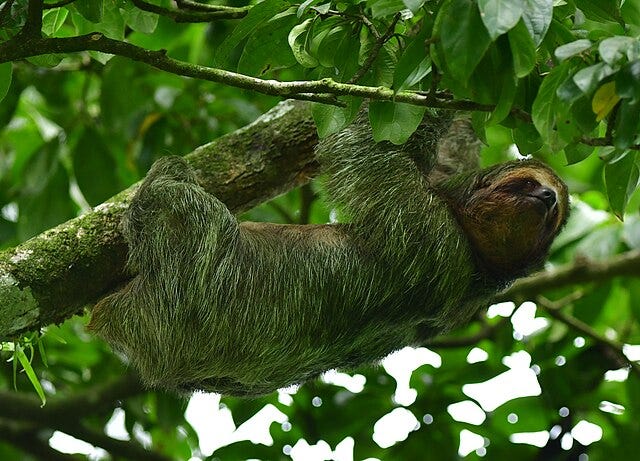
an algae camouflaged sloth (image by Panegyrics of Granovetter, CC BY-SA 2.0 via Wikimedia Commons)

All this sloth-sleuthing has me itching to write another poem. Here goes:

moth lays eggs in sloth poo under the tree larvae hatch and gorge on all-they-can-eat dung till cocooned, they grow wings flutter to the treetops above where they find colonies of their kind loving life in the algaed fur of sloths

© Carolyn Hastings 2023

Etheree Poetry

The 10-line sloth and moth poems I’ve written are called etherees. They’re essentially shape poems starting with a one-syllable line and increasing one syllable per line to finish with a 10-syllable line.

Etherees can be inverted i.e. the first line is 10 syllables long and the last line is one syllable. These are called reverse etherees. I wrote one here.

Etherees are related to nonets which are shape poems constructed with nine-lines starting with a nine-syllable line and decreasing incrementally by one syllable to a one-syllable line. I recently wrote one, here.

A note for teachers about etherees and beating ChatGPT

Etherees are a fun poetic form for students to play around with. As well as practising their syllabification skills, etheree poetry gives students the opportunity to present information and concepts they’ve been studying in a creative, neatly-packaged product.

Etherees also get around some of the issues ChatGPT and its chatbot cronies have brought to the education sector. Put simply, ChatGPT can’t write etherees (or for that matter, nonets and other shape poems). Here’s the evidence:
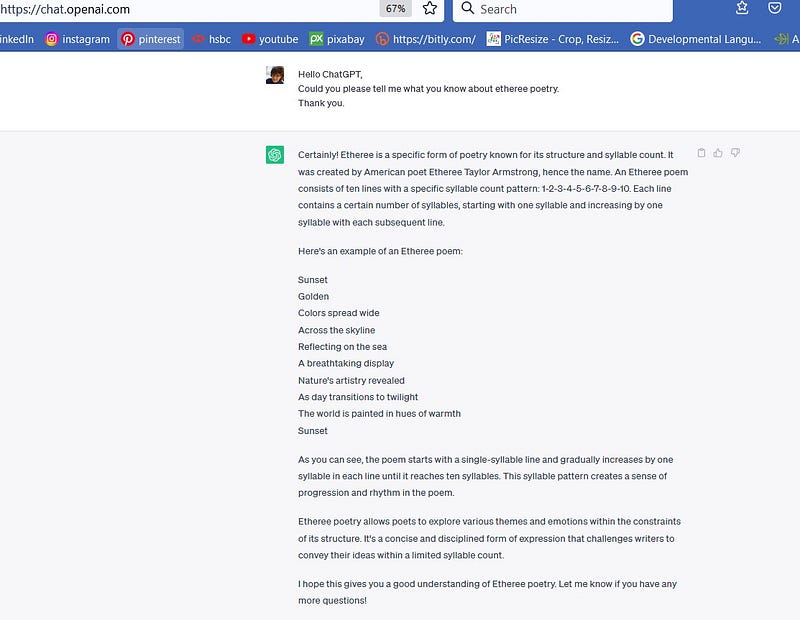
screenshot by author

Comment: ChatGPT has the definition and origins of etheree poetry down pat, but the example it has provided is way off the mark in terms of syllable-line count (2, 2, 4, 5, 6, 6, 7, 8, 9, 2). Its critique of its own poem proves it has little capacity to assess its own product against the criteria. Conclusion: Students will be caught out if they rely on ChatGPT to write an etheree for them. 😉

If you’re looking for a factually accurate info doc on etherees, you’ll find it here in Melissa Coffey’s article, Syllabic Poetry: Meet the Etheree

Thank you so much for reading. 🙏

Carolyn Hastings is an Australian speech pathologist, educator, author, poet and editor for an online poetry publication. Feel free to connect with her here on Medium or via Facebook, LinkedIn or Twitter.

✨ If you like what you’ve read, please consider — 👉 Subscribing to my email list 📩 👉 Becoming a Medium member using my affiliate referral link

Poetry
Etheree
Sloth
ChatGPT
Education
Recommended from ReadMedium