
Sleeping in Silence: The Unseen Struggles of Homeless Older Women
My talented poet friend is now homeless, and she’s not alone.
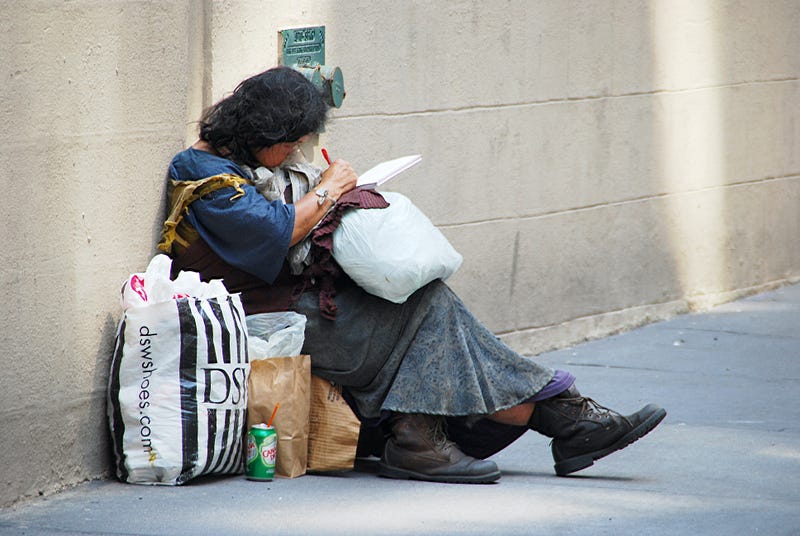
My friend sleeps in her car.
I’ve seen the camps of unhoused people, tents huddled under overpasses, derelict cars and RVs along deserted streets, and lonely people huddled under blankets on the sidewalks. I never imagined a close friend would turn out to be one of them.
The San Francisco Chronicle reports that homelessness in Oakland, California, where I live, increased 24 percent over the last three years, while the number of folks living in their cars or RVs increased by 39 percent.
Alameda County has 9747 unhoused people. 5055 live here in Oakland — a city that only has a combination of shelter beds and specified parking areas for less than half of them.
Now, it’s not just numbers. It’s personal to me.
Arlene — not her real name — is an experienced teacher and published poet, both in English and in her native tongue.
We serve together on the board of a local poetry group that sponsors workshops and live readings. She features regularly at Bay Area readings, stunning her audiences with the poignant beauty of words spoken on behalf of our endangered planet.
Like many unhoused older women, that did not happen all at once.
Not that long ago, she shared a lovely home with her partner, who I’ll call Harvey, even though that’s not his real name.
Harvey was the breadwinner, but Arlene worked too. When she retired from teaching, she took on tutoring gigs focusing on remedial reading and other language skills.
Then, one day, Harvey had a fatal heart attack.
And was gone. Just like that.
Before he had a chance to make out his will and leave the house to Arlene.
Instead of her inheriting it, his siblings fought a nasty court battle to keep her from getting it. And won.
Boom! She had to move.
Now, she was newly single, living on a limited income that had to cover housing in addition to everything else.
So, she ended up renting a room in a family’s house. She offset some of her rent by teaching their developmentally disabled son.
And for a while, that arrangement worked.
But it was far from perfect.
Contracting down from a house to one bedroom is tough.
Who wants to get rid of their dishes and appliances when they hope to be back in a house one day? Better to store than re-purchase, right?
Arlene was given space in the family’s garage. Her belongings overflowed that space, causing friction with her landlady.
Arlene has a temper, and the stress of her new life doesn’t help her stay cool, calm, and collected. When pressured about her stuff, she lost it. Started arguing and yelling.
When her landlady couldn’t get her to calm down, she called the police.
The police placed her on a 5150 — an involuntary 72-hour psychiatric hospitalization. It turned out she also had some medical issues and ended up staying first in an acute hospital and then in short-term skilled nursing rehab.
In the meantime, she was evicted from the house she’d been living in. So, the discharge planner arranged for her to go to a temporary shelter. With the stress on temporary.
While there, Arlene reached out to friends asking us if we had a room she could rent or knew of someone who did.
No one offered.
That’s how Arlene ended up sleeping in her car.
Fortunately, not on the street.
But in a special parking area in the town of Alameda, set up for folks like her called Village of Love. Oakland first modeled the program, and other cities followed suit. The Village has a staffed Day Center offering hot food, restrooms, activities, peer support, and case management services. Once a week, a specially outfitted truck comes so folks can take hot showers.
But only once a week.
I can’t imagine.
This is the San Francisco Bay Area. It’s warmer than much of the country but can dip below freezing in the winter.
I have another friend who sleeps in her car for different reasons. And she turns it on during the night to run the heater.
No matter how you slice it, spending the night in your car is not conducive to a good night’s sleep.
And if you already have any kind of physical or mental challenges, they’re only going to compound. Not to mention the dangers of that much vulnerability.
Still sleeping in a car beats sleeping in a tent–or worse–in the open, on the streets in the winter.
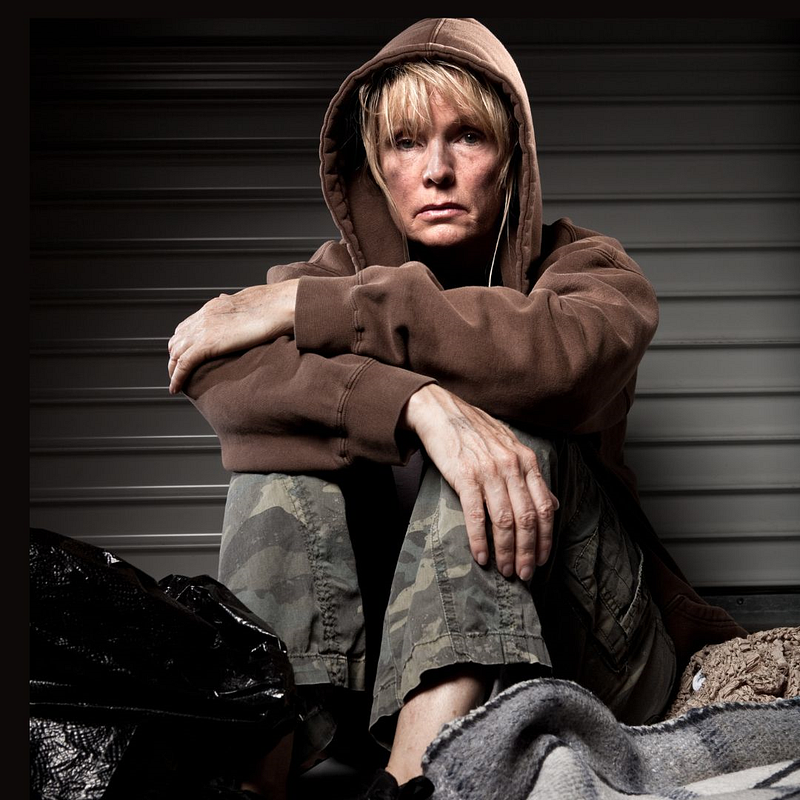
Like lots of people do.
In fact, one in every 200 Americans, according to Will Harlan, writing in Blue Ridge Outdoors. I’ve quoted him here before, but it bears repeating:
“Within our own borders, one in 200 Americans sleep on the streets or in shelters each night, and nearly 20 percent of Americans go hungry. Most of them are children.”
He goes on to say, “They were not the lazy alcoholics and drug addicts I’d assumed them to be. They were ordinary people looking desperately for jobs and finding none. Many have kids they call from pay phones. All were ashamed of their situation.”
Many of them are middle-aged or older women, like Arlene who’s in her seventies.
Arlene’s story got me wondering about these women, vulnerable and at risk in so many ways. And praying, there but for the grace of God go I.
So, I did some Googling.
I learned that fifty-nine percent of Americans are one missed paycheck away from homelessness. And 80% of unsheltered women self-report trauma or abuse as the cause of that situation.
According to The Economic Hardship Reporting Project (EHRP), older women are one of the fastest-growing groups of unhoused people. The high cost of Bay Area rents and both sex and age discrimination, as well as pay disparities, contribute to these numbers.
The fact that women often outlive their male partners is also a factor.
Being homeless takes such a toll on our bodies that a woman in her 40s or 50s often looks to be 70 or 80. Physical ailments or disabilities add to the challenge. Can you imagine being on the streets with limited vision or mobility?
When I worked in occupational therapy at a county rehabilitation hospital, many of the patients came from the streets. Even though the social workers did their best to place them somewhere safe upon discharge, many of them ended up back there for various reasons.
Many of our patients used alcohol or drugs to cope with their chaotic lives, which may be why a stroke or head injury brings them there. Some, perhaps, were on the streets because of their addictions. A patient once told me, “Booze sure makes my ‘concrete pillow’ a little softer.”
What could I say to that?
Again from EHRP: “If you’re a homeless woman, you’re guaranteed to be assaulted on the streets,” said Paul Boden, organizing director of the Western Regional Advocacy Project (WRAP), a West Coast coalition of homeless organizations.
Boden, who was homeless himself at 16 after the death of his mother, also served as executive director of San Francisco’s Coalition on Homelessness. “Women try to double up with guys to be safe, but they usually get beaten up by those guys, so their options are limited.”
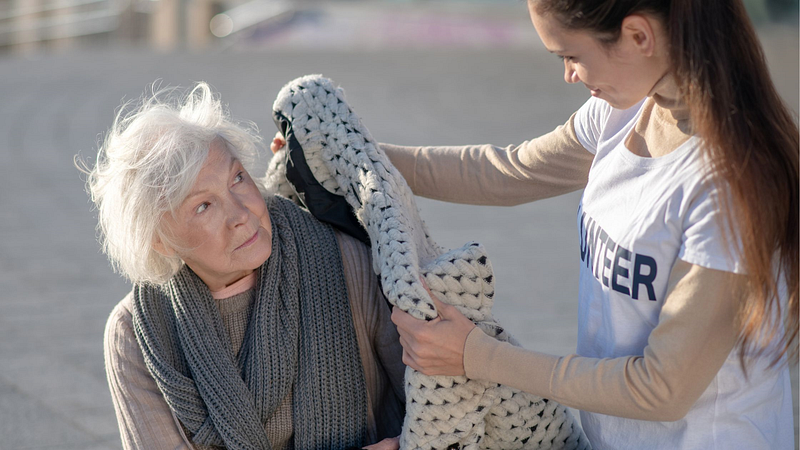
When we think of an unhoused person, who comes to mind?
If you’re like me, it’s not usually an older woman.
Unless it’s actress Maggie Smith playing a real woman, Mary Shephard, in the mostly-true film, The Lady in the Van. And that was a comedy.
Now it’s my friend Arlene. But it’s not very funny.
Especially when you consider it could have been prevented with the signing of a document — that will that Harvey didn’t get to. Let this be a reminder to all of us not to delay filling out our paperwork. And to remember that every statistic is a person. With a story.
Like Arlene’s.
Marilyn Flower’s a sacred fool who writes every day — fiction, poetry, and blogs — inspired by a process called SoulCollage®. She’s the author of Creative Blogging and Bucket Listers: Get Your Brave On. Follow her Sacred Foolishness or SoulCollage® for Writers, and Stay in touch!


