
Slave Families on St. Simons Island
St. Simons Island Historic Slave Site
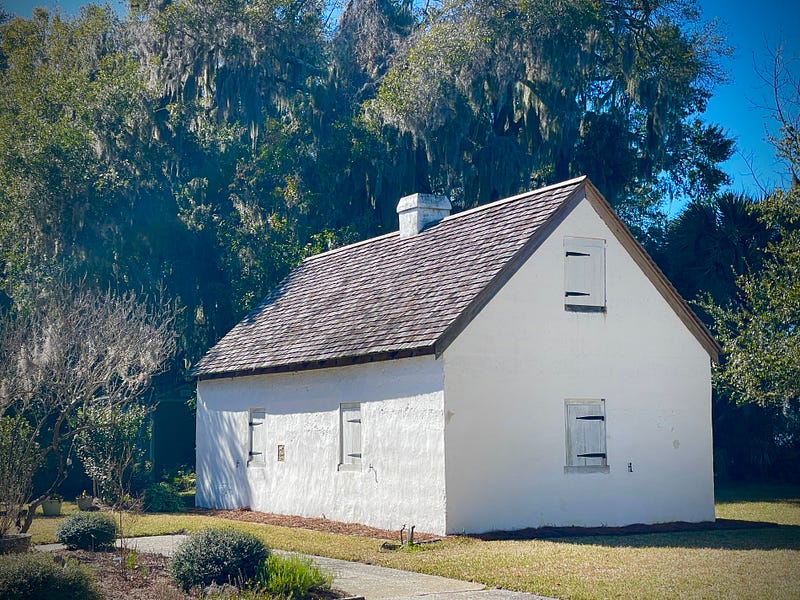
When visiting St. Simons Island in Georgia last week we stopped at the Hamilton Plantation Tabby Slave Cabins on Arthur J. Moore Dr. The cabins were placed on the National Registrar of Historic Places in 1988. The two remaining cabins were restored in 2014. The setting is a lovely well-tended garden with beautiful moss oak trees near Epworth by the Sea.
The buildings are called the “Tabby cabins” because the cabins were constructed of tabby, a concrete-like mixture of lime, sand, and oyster shells. A family lived in each half of the cabin. The fireplace in the center wall could be accessed from either side. They slept in the attic above the main room.
One of the cabins is now used as an information center. You can view a short film there documenting the history of Hamilton Plantation. After the Civil War when the slaves were freed, the cotton industry collapsed. Many former slaves were then hired to work in the logging industry that developed on the island. The information center cabin was used as an office at the mill then. (Additional info: Tabby Cabins)
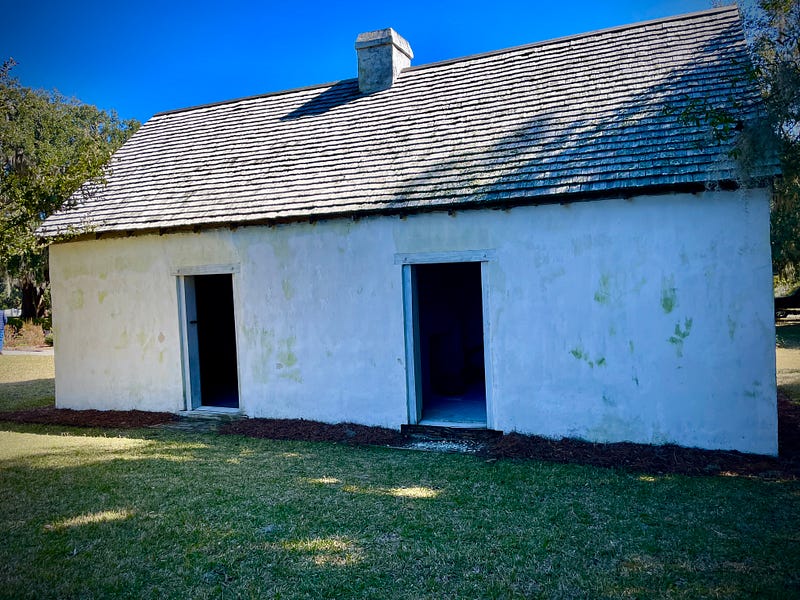
“James Hamilton Couper, the namesake of the owner and manager of the plantation, was an architect and a builder. He designed and built the cabins to house the slaves who served in the plantation’s main house.” (source)
If these cabins were built for the slaves who worked in the main house, then the windows, fireplace, and solid construction make some sense. The plantation owners probably wanted these slaves to be healthier and cleaner than the field slaves since they were in direct daily contact.
As I stood at the entrance to one of the cabins, I wondered what family lived there. I also wondered how a “family” was defined. Was a random selection of people from the group of slaves who worked in the main house put into each half of the “family” cabin? Did they develop family relationships after being placed in the cabins, or, had families developed within the slave compound before being housed together in one of the cabins?
It also made me wonder where the other slaves lived. What was their housing like?
What happened to these families after the Civil War when they were freed? Did they stay together as families? If some of the men were hired to work in the forest industry, where did they live? Were they given space to build houses? Did they continue to live together as families or did they separate hoping for better lives elsewhere?
Many years ago I read the book Roots: The Saga of an American Family by Alex Haley and I heard him speak to a group of students in Singapore when I was teaching there. He traced his family lineage back to Kunta Kinte, an African taken from the village of Juffure in what is now The Gambia.
I remember his joy in telling us about finding people in Gambia who had kept and passed on the story of Kunta Kinte’s life. He had completed his schooling and had a hut and land and then one day he disappeared. But, he was remembered.
From Haley’s research about his ancestors, it was clear that Kunta Kinte had shared his African beliefs and traditions with the woman who became his wife. She was one of the cooks in the plantation house. Their daughter Kizzy heard his stories of Africa and remembered them. She was sold to another plantation owner and had a family of her own but passed on the knowledge about Africa that she had heard from her father.
It was this passing of knowledge from one generation to another that allowed Haley to help find his roots and find Kunta Kinte’s family in Gambia.
Where did the slaves on the Hamilton Planation come from? How did they assimilate into plantation life? What languages did they speak? What African traditions and beliefs did they maintain and pass on to their families? Where are they now?