
Saucer Talk
Skinwalkers at the Pentagon
Trail of the Saucers editors Bryce Zabel and David Bates both read a review copy of the latest book from George Knapp, Colm Kelleher and James Lacatski. They have opinions.
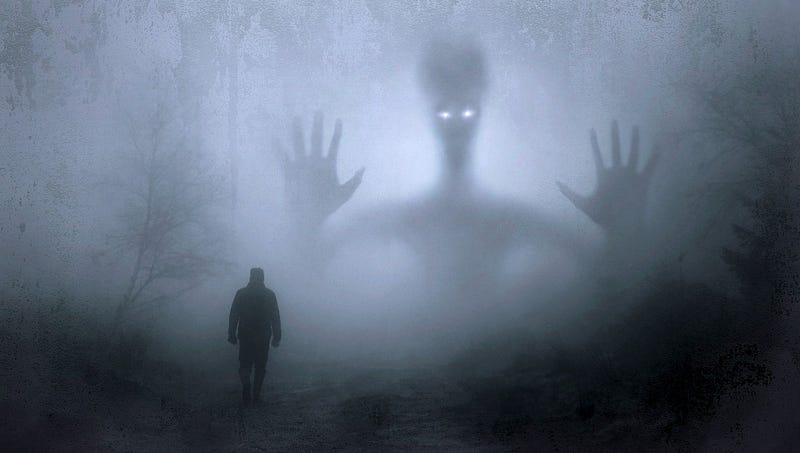
This month’s “Saucer Talk” features the new book, Skinwalkers at the Pentagon: An Insiders’ Account of the Government Secret UFO Program, reviewed by Trail of the Saucers editors Bryce Zabel and David Bates.
Bryce: First off, my disclaimer. I know George Knapp personally. He’s had me on his weekend Coast-to-Coast gig several times, a great interviewer. Plus, I’ve come to admire George’s journalistic chops on so many different projects, and, of course, he’s a brosky of former Senator Harry Reid. I could go on and on. So I was looking forward to this one quite a bit.
David: My disclaimer is that my only prior encounter with Skinwalker Ranch is Hunt for the Skinwalker, also written by Knapp with Colm Keller and published in 2005. Fascinating book. I read it last year. The first chapter, with a giant wolf seemingly impervious to being shot repeatedly at point-blank range, is a mind-bender, and then it just gets weirder.

Bryce: I guess the best way to frame this is to say that this book continues the Skinwalker Saga. I’ve never actually done a deep dive into Skinwalker, I’m not sure why. I see it, then I go back to nuts and bolts UFOs and abductions. Only now I see the attraction — Skinwalker has it all, UFOs, other dimensional beasts, blue orbs, mutilated cattle, and all the poltergeist activity that you can stomach.
David: It really is a paranormal hotspot that seems to not disappoint, no matter who visits. I’d like to see the editorial crew from Skeptical Inquirer do a weekend retreat there, spend their nights looking at the stars … and other things. But you’re right, it’s not an obviously UFO-centric place. Maybe it needs a short introduction. Shall I do the honors?
Bryce: Go for it. Sweetest words I’ve ever heard.
David: Basically, it’s 500 acres of ranchland in Utah about 150 miles from Salt Lake City. It was first introduced to the world in 1996 by a local paper and then later in an alternative weekly by Knapp. Then he went on to write the first book about it, Hunt for the Skinwalker. A primary focus in that book was on the Gormans, a Mormon family who had some genuinely bizarre experiences while living there.
Bryce: Bizarre UFOs?
David: Well, UFOs, but also creepy stuff like you mentioned. Honestly, what I recall most from the book are two incidents that had nothing to do with UAPs. The first is this encounter with an enormous and seemingly bulletproof wolf creature that Gorman and his son tracked until it literally vanished. The other involved four bulls, which were seen in their corral and then 45 minutes later were inexplicably crammed into a locked trailer, unharmed, but in a daze.
Bryce: And, just as a quick aside, this latest book from Knapp, Kelleher and Lacataski — Skinwalkers at the Pentagon — is way more than a book about Skinwalker Ranch. That’s a part, but mainly it seems to be about how our military and intelligence agencies have been studying UAP phenomenon for years and in ways that go far beyond what we thought they were doing.
David: Exactly, I think that’s the essential takeaway.
Bryce: They were all caught up in the exotic nature of the UFO mystery, including extremely strange and even haunting things that happen around UAP encounters. There’s also a lot about the biological effects. So, definitely, a whole lot of things getting pulled out of that gray basket. Here’s what they say, and I’m reading now —
“By the end of the two-year program, more than 100 separate technical reports, some of which ran to hundreds of pages, were delivered to the Defense Intelligence Agency. Among them was a 149-page report on the Soviet (and now Russian) UAP investigation/analysis capability. Another details the design and build of a functional prototype for an autonomous Unidentified Aerial Phenomena surveillance platform.”
Bryce: So, yeah. Back to you for a live update on the Ranch.
David: There’s no way I’m ever doing a live update from that ranch, or even a tape-delay update. But anyway. The property has gone through a series of ownerships. The investor Robert Bigelow bought it for his privately-formed National Institute for Discovery Science, which spent some time trying to document and study paranormal occurrences there and whose work is discussed in the first book. Another company bought it in 2016, and they keep the place sealed up tight.
Bryce: Let me digress, just a moment here to the book itself and not the content. There are so many acronyms in this book that they needed a glossary page up front and even then after you’ve seen BAAS for the eleventeeth time, your mind starts to play tricks on you. By the end of the read, every time I saw that one, BAAS, my brain translated it into Bad Ass. Which apparently, if you know Bob Bigelow, is not entirely incorrect.
David: The acronyms do give the book a wonkish vibe, which I’d say is … well, I’m not sure what I’d say. I guess it’s a double-edged sword. If the point is to illustrate the mind-boggling intricacy of the Pentagon and intelligence bureaucracy, mission accomplished, I guess.
Bryce: But man, AATIP, AAWSAP, ODNI, NIDS, UAPTF, DIRD, JWICS, SCI, SCIF, and on and on. Of course, the book is about the government’s secret UFO programs and the U.S. isn’t about to call something Secret UFO Program, right? Although that would be SUP, as in “What SUP?” so it could work, too.
David: Ha! But actually what I found useful was the clarification it provides on the distinction and relationship between AATIP and AAWSAP, which I think most people don’t understand.
Bryce: Back to the content below the acronyms, and, for me, the headline for this book is the concept of “hitchhikers,” which refers to these evil effing entities — wait, I’ve done it again!, created a new acronym, EEE — the sound you make when one of them hijacks you. Hijack means that they attach to you somehow, follow you home, infect your family, jumping from your kids to other kids and their families, all thousands of miles apart. It’s just weird as all shit, like tracking the coronavirus with a paranormal twist. One thing it makes me worry about is given all the time I read and study this subject, I sure as hell hope I’m not inviting some EEE-mofo into my house. First of all, my wife would never forgive me for bringing home an uninvited guest with no warning. Okay, I know I shouldn’t make light of this stuff but it’s only because it’s so weird and disturbing.
David: Well, it is weird and disturbing. The book basically looks at a fundamental problem, the way that UFO sightings and incidents are frequently accompanied by even weirder phenomena, the “woo” factor, to borrow a word that’s become a thing. This is nothing new, of course. Jacques Vallee gets into that in his Dimensions trilogy, among other books.
Bryce: You raise a great point. Are we saying that “woo” is a problem? Why?
David: Because for the purposes of official, “public” discussion, this remains a nuts-and-bolts issue, which is how officials want it, which is alluded to at the end, when there’s this debate over what the scope of the government’s inquiry ought to be. The only conversation they’re comfortable with is this: If even the wildest implications by people like Christopher Mellon and Luis Elizondo are to be believed, then the most exotic thing about UAPs is that they’re “aliens” in “ships” from other planets. As extraordinary and mind-blowing as that is, it’s a concept most people can wrap their heads around.
Bryce: At least some people anyway. It raises the same Disclosure strategy argument as abductions. Craft that can be seen by pilots and measured by sensors is one thing. Abductions aren’t data, they’re stated experience. Now there’s this entire other issue that seems to be part of this larger Phenomena, standing wolves, entities, blue orbs… I mean, yikes…
David: Right. But as you know, once you spend time really looking at the issue, you realize that UFOs are only the “nuts-and-bolts” tip of a very large iceberg of high strangeness. Skinwalker Ranch offers a glimpse of that. And you’re right — it can be terrifying.
Bryce: This is why this subject matter both attracts and repels me at the same time and has for, oh, like three decades now.
David: That said, it’s an interesting and frankly important step forward for those who are just now discovering this. Leslie Kean and Ralph Blumenthal told the world in the New York Times in 2017 that the U.S. Government was investigating UFOs. Now here comes Knapp, basically saying: Yes, UFOs but a whole lot more. They’re taking the “woo” part seriously. Very seriously.
Bryce: If there’s a limitation to this book, it is primarily that it sacrifices drama with its overly-journalistic tone, repetition between chapters, and overwhelming amount of acronyms. So, it should be scary as f*** to think about people being followed from one end of the country to another by paranormal hell raisers, but it’s written in a very declarative and sometimes overly just-the-facts manner. Now I know that’s probably exactly what the authors intended but the story at times could have been told with a little more juice. I’m probably overstating this case but I’ve barely slept in two days working on a writing project myself and it takes two cups of fully leaded coffee today just to feel tired. What say you, David? Too harsh?
David: Uh-uh. The best recent example I could name would be Ross Coulthart’s In Plain Sight which is a prodigious journalistic accomplishment but still feels like one man’s personal journey of discovery and from time to time slips into Coulthart’s Aussie call-it-like-it-is-even-if-it-involves-profanity bravado.
Bryce: That’s on point. It makes me wonder who the intended audience is, here. The strength of Ross’s book is that it’s a respected journalistic voice saying, “Hey, this phenomenon is real.” What Knapp has done is drilled down and taken it another step, to point details and context: “It’s real, and the U.S. government is very engaged with it — and not just the UFO part of it.” But hey, Coulthart and Knapp, two distinct and important journalistic voices engaged with this thorny subject, and cheers to both.
David: Exactly, and we need to point out, too: Knapp is a co-author here. The other two are James Lacatski and Dr. Colm Kelleher, who were involved in the Bigelow research effort in the 1990s — and were involved in the day-to-day operations of AAWSAP. The way the book brings into focus that, Skinwalker Ranch, and then the events leading to AATIP and all the way up to the UAP report goes way beyond the 2017 New York Times revelations.
Bryce: True that. I guess the other part of this is that the Skinwalker book relies to a great degree on things that people say they experienced like a dark ghost at the foot of their beds. That’s different than saying here’s an iPhone photo of a dark ghost at the foot of my bed. Coulthart, on the other hand, deals in testimony and documents and interviews and there are tons of references to the sensors, data and multiple witnesses. This is not to say that I don’t believe that what’s being said is happening at Skinwalker is happening, only that I could imagine certain skeptics writing it off more easily than they can write off actual cases and craft and wreckage.
David: Oh, and they do. Our friend Robert Sheaffer at Skeptical Inquirer magazine has dismissed the whole thing as nonsense, “nothing to see here.” I suspect that the number of hours he’s spent on the property is exactly zero. No hitchhikers for him.
Bryce: That’s a great movie idea. A skeptic goes to Skinwalker and takes home a hitchhiker and has to go to the very people he’s doubted so much and get help. Anyway, what Skinwalker does convincingly, however, is make the case that multiple elements of the U.S. government have, over time and with great persistence, chosen to double and triple down on the idea that UAP and related phenomena should be investigated even when they have publicly stated that there’s nothing to see here. That hypocrisy actually does make its own case that the things people are reporting have convinced some powerful and informed people that there’s something worth studying going on.
David: I don’t want to get conspiratorial here, because obviously I can’t read minds and I don’t know intent and motivations, but I don’t think it’s too far-fetched to ask: Given the involvement of Lacatski in writing this book, can we regard Skinwalkers at the Pentagon as part of Disclosure?
Bryce: It’s a fair point about Lacatski, but I doubt very much that anybody in government is saying about George Knapp, “Hey, let’s cut him in on our Disclosure project.” George is an investigative reporter who has had to fight for every story.
David: Let’s sum up then. To the extent that this book tells a story, what do you make of it at the end of the day?
Bryce: Give me a sec on that one. Okay, okay. The high concept to this all is that it appears that Skinwalker Ranch, hitchhikers, portals, fearsome beasts from somewhere else, magnetic anomalies, poltergeist behavior and so on — it appears that people in government take it very seriously. If they take it seriously, then I guess I should, too, and so should all of us. That makes Skinwalkers in the Pentagon an important piece of this cosmic puzzle. But, and here’s the rub, by looking at the UFO and UAP phenomena only through the evidence being presented it’s possible to truly not feel there is sufficient specificity to determine intent, like if they’re basically bad or basically good or even in-between. On the other hand, the Skinwalker phenomena just looks bad to me.
David: Yeah, that’s another point they make, that these things aren’t necessarily benign. The report that went to the government, supposedly, flat-out says as much: “The UAP phenomenon is a threat to human health and well-being.”
Bryce: It makes me nervous. It makes me wonder if the war is over and the good guys lost. And that probably goes a long way toward actually explaining why I haven’t been sleeping lately.
Read more about the book and what it has to say in this Mystery Wire article.
Trail of the Saucers is edited by writer/producer Bryce Zabel and published by Stellar Productions. Zabel co-hosts the popular new podcast Need to Know with Coulthart and Zabel that can be found on all major platforms.


