avatarPaul Coogan

Free AI web copilot to create summaries, insights and extended knowledge, download it at here

1364

Abstract

-colon, and a set of parenthesis. I would love to see a diagram of this but unfortunately, I do not have the skill.</p><p id="b639">I have frequently seen recommendations on Medium to use Hemmingway for clarity and Grammarly for spelling, grammar, and tone. Let’s see what the Hemmingway Editor has to say.</p><figure id="96f3"><img src="https://cdn-images-1.readmedium.com/v2/resize:fit:800/1*fJqgCDMqgldimSgOVHFyeQ.png"><figcaption>Screenshot by the author</figcaption></figure><p id="f756">Poor? Kind of critical. A readability rating of post-graduate appeals to me greatly, but what if it were to read like this?</p><blockquote id="e40a"><p>Dickens wrote the original ending of Great Expectations with Pip and Estella staying apart. Modern critics regard this to be proper. Some accuse Dickens of selling out for writing a different ending.</p></blockquote><p id="ddd0">Well, that gets the point across but makes it choppier than the North Sea in November. Does the Hemmingway Editor like it?</p><figure id="836f"><img src="https://cdn-images-1.readmedium.com/v2/resize:fit:800/1*WX8eQnGxrcenhCwtoHQEiQ.png"><figcaption>Screenshot by the author</figcaption></figure><p id="c2c3">Yes, the revised version gets a good Hemmingway score but it is trash in terms of prose and readability.</p><p id="10d5">Grammarly does much better with writing recommendations, only

Options

suggesting an extra comma. Read it with and without — I believe you will find the additional comma superfluous.</p><figure id="9166"><img src="https://cdn-images-1.readmedium.com/v2/resize:fit:800/1*r8_wTlhikaAGUfrRX_LLbw.png"><figcaption>Screenshot by the author</figcaption></figure><p id="d83d">These tools can be useful. I find that Grammarly is improving my use of punctuation — I even ran this article through Grammarly. But like any set of tools, it’s judicious use that leads to fine craft. Don’t sand the wood down to a pile of sawdust if it’s a chair you want.</p><p id="a4a3">You also don’t have to use every tool in the box. Hemingway is not bad if you are cautious and writing for general consumption journalism. However, if you are writing for the Partner Program and want to increase reader engagement, John Irving has some observations that could prove useful.</p><blockquote id="0a7d"><p>Dickens never wants a reader to be lost; but, at the same time, he never wants a reader to skim. It is rather hard going to skim Dickens; you will miss too much to make sense of anything. He made every sentence easy to read because he wanted you to read every sentence. <i>— John Irving, Trying to Save Piggy Sneed</i></p></blockquote><p id="e8de">Skim-proof writing that engages the reader. Sounds like the Holy Grail of Medium authors.</p></article></body>

Skim Proof Reader Engagement

John Irving demonstrates less is not necessarily more
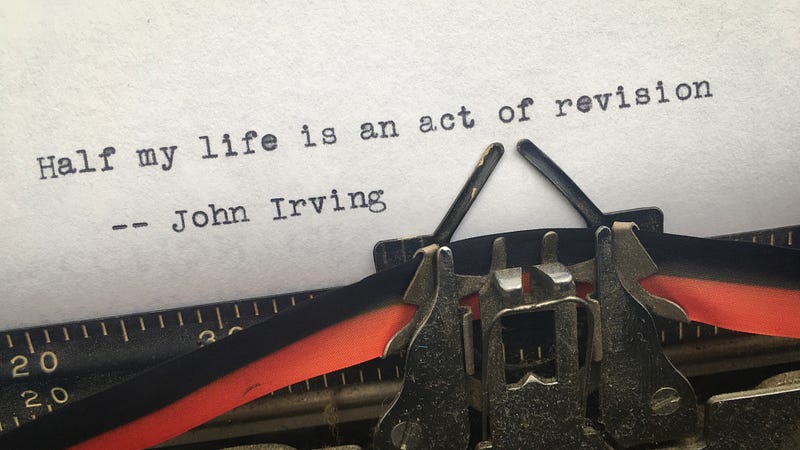
Photo by the author

I was reading John Irving’s Trying to Save Piggy Sneed and noticing his use of punctuation. At first, I thought these were the occasional complexity where an aside is needed for clarification but on further reading, it became apparent this was inherent to Irving’s style. My observation was confirmed by the author in his homage to Dickens: “He is a master of that device for making short sentences seem long, and long sentences readable — the semicolon!”

My admiration of his phrasing plays out particularly well with this sentence from the same chapter.

Dickens’s original ending to Great Expectations, that Pip and his impossible love, Estella, should stay apart, is thought by most modern critics to be the proper (and certainly the modern) conclusion — from which Dickens eventually shied away; for such a change of heart and mind he is accused of selling out. — John Irving, Trying to Save Piggy Sneed

Nine phrases, four commas (two calling birds), one semi-colon, and a set of parenthesis. I would love to see a diagram of this but unfortunately, I do not have the skill.

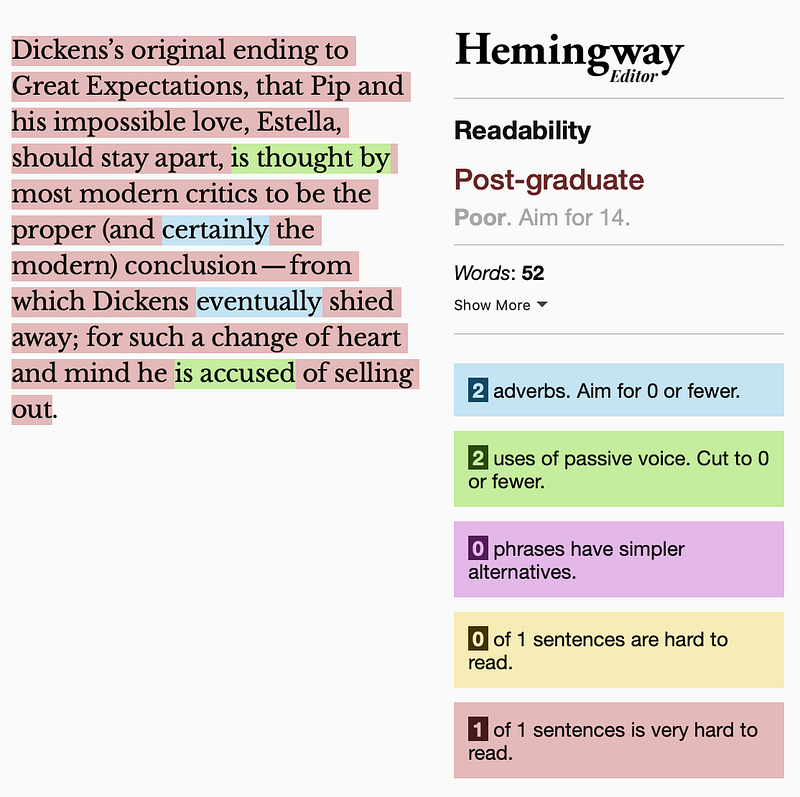
I have frequently seen recommendations on Medium to use Hemmingway for clarity and Grammarly for spelling, grammar, and tone. Let’s see what the Hemmingway Editor has to say.
Screenshot by the author

Poor? Kind of critical. A readability rating of post-graduate appeals to me greatly, but what if it were to read like this?

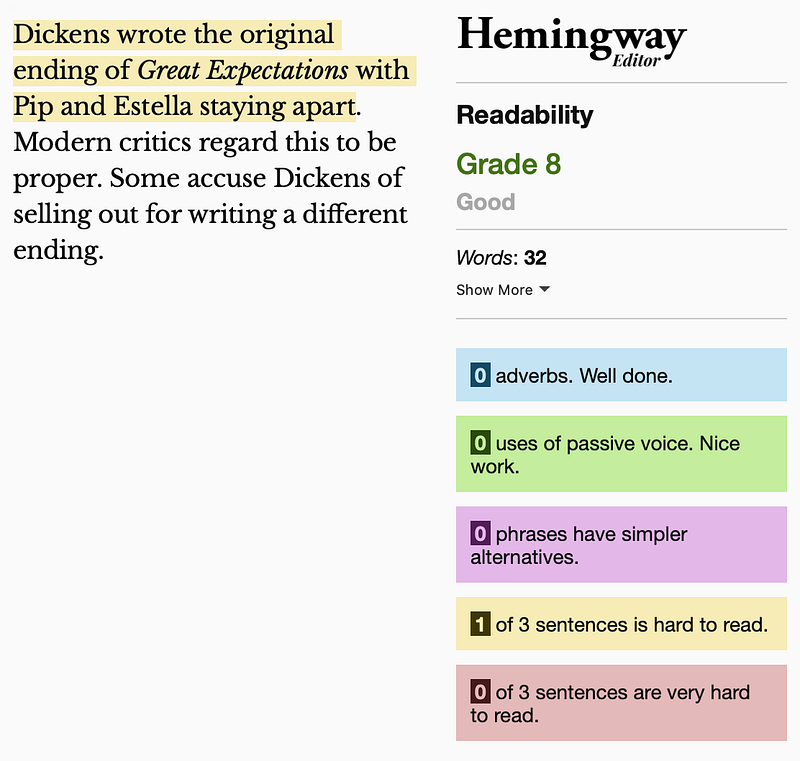
Dickens wrote the original ending of Great Expectations with Pip and Estella staying apart. Modern critics regard this to be proper. Some accuse Dickens of selling out for writing a different ending.

Well, that gets the point across but makes it choppier than the North Sea in November. Does the Hemmingway Editor like it?
Screenshot by the author

Yes, the revised version gets a good Hemmingway score but it is trash in terms of prose and readability.

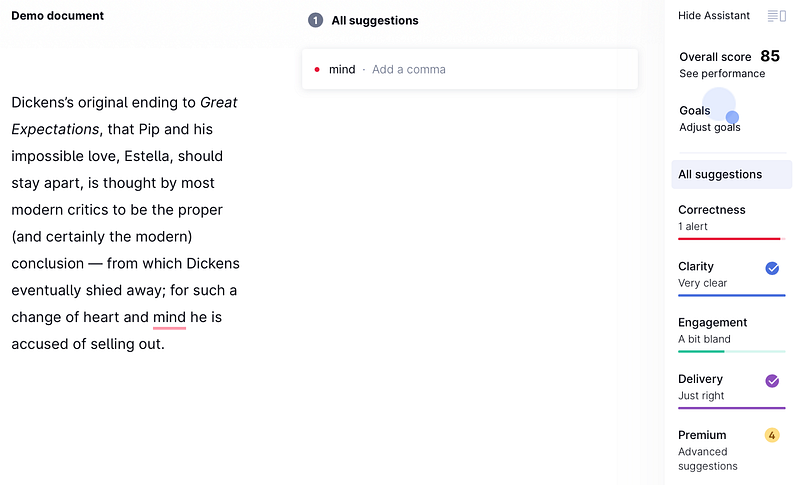
Grammarly does much better with writing recommendations, only suggesting an extra comma. Read it with and without — I believe you will find the additional comma superfluous.
Screenshot by the author

These tools can be useful. I find that Grammarly is improving my use of punctuation — I even ran this article through Grammarly. But like any set of tools, it’s judicious use that leads to fine craft. Don’t sand the wood down to a pile of sawdust if it’s a chair you want.

You also don’t have to use every tool in the box. Hemingway is not bad if you are cautious and writing for general consumption journalism. However, if you are writing for the Partner Program and want to increase reader engagement, John Irving has some observations that could prove useful.

Dickens never wants a reader to be lost; but, at the same time, he never wants a reader to skim. It is rather hard going to skim Dickens; you will miss too much to make sense of anything. He made every sentence easy to read because he wanted you to read every sentence. — John Irving, Trying to Save Piggy Sneed

Skim-proof writing that engages the reader. Sounds like the Holy Grail of Medium authors.

Writing
Grammarly
Editing
Engagement
Literature
Recommended from ReadMedium