
Sizes
It’s All So Relative
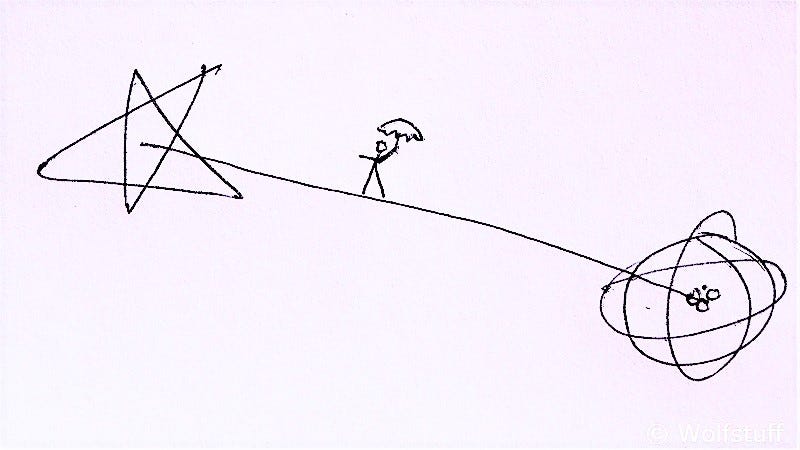
Immeasurably large Immeasurably small Man caught in-between
Look up, and there is no telescopical end to them, look down and there is no microscopical end to them.
Looking up —
In 1995, astronomers pointed the Hubble space-telescope toward what appeared to be a small, utterly starless region of Ursa Major and then proceeded to collect ten days’ worth of earth-reaching light. To everyone’s amazement, the resulting image revealed an estimated 3,000 never before seen galaxies.
This image composite was named the Hubble Deep Field and was, at the time, the farthest anyone had ever seen into the universe.
As the Hubble telescope received upgrades, astronomers repeated this experiment twice. In 2003 and 2004 scientists created the Hubble Ultra Deep Field, which in a million-second exposure revealed about 10,000 never before seen galaxies in a small spot in the constellation Fornax.
In 2012, again using upgraded instruments, astronomers again used the Hubble telescope, this time to look at only a small fragment of the Ultra Deep Field during repeat visits for a total of 50 days.
Even in this much narrower field of view, astronomers were able to detect about 5,500 galaxies. They dubbed this tiny dot of sky the eXtreme Deep Field (XDF) and it remains the deepest image of the universe ever viewed.
How small was this field? Were you to hold a pin at arm’s length and aim at the night sky, the XDF area would be that covered by the pin’s head.
This, naturally begs the question: if that single sliver of sky contains thousands of galaxies, how many more galaxies exist in other spots, all across the night sky, as yet unseen? Well, astronomers have now estimated the totally number of galaxies in the universe by using the ratio of this tiny point of XDF sky to the entire universe — assuming minimal cosmic variance, i.e., that the universe is homogenous; doing the math, they extrapolated the total number of galaxies in the universe to be about 200 billion. Put another way: 200,000,000,000 galaxies.
And as if this was not enough, when the James Webb Space Telescope launches in 2020, this space observatory is expected to reveal even more information about early galaxies in the universe (read, more galaxies).
How about stars then? Well, there are approximately (by last count — and it took me all night) 100 billion stars in the Milky Way. Multiply this by 200 billion galaxies: there’s your answer: many, many.
Or put another way, 20,000,000,000,000,000,000,000 stars.
Or put another way, twenty sextillion stars.
And let’s assume (and I think we’re safe doing that) that the majority of these stars have a number of planets circling, say on average five, that would set the total number of planets in the universe at one hundred sextillion planets.
And, if we keep playing it safe and assume that only one planet per star is fit to sponsor life and have sprouted and now harbor intelligent life forms, that still leaves us with as many life-harboring planets as there are stars, to wit: that two followed by twenty-two zeros.
Now, what are the chances that of these twenty sextillion life-bearing planets only one (and only one single one), our own Mother Earth, should harbor intelligent life?
I’d put that chance at a deafening mathematical zero.
The amazing bottom line (looking up) is that there seems to be no end to it, that the universe is (as many believe) infinite. However, I have it on good authority that the universe is not infinite, but also on that same excellent authority that it is indeed incredibly, overwhelmingly, devastatingly, completely incomprehensibly large.
Looking down —
And what about small?
As for atoms, the current estimate of the number of atoms in a grain of sand stands at 43,000,000,000,000,000, that is, forty-three quadrillion.
Then ask yourself, how many grains of sand on this planet? Very, very many. And, of course, there is more than sand here on Earth. How many atoms, say, in a drop of water? Answer: 5,000,000,000,000,000,000,000 or, put another way, five sextillion.
Another way to look at this: Lord Kelvin once proposed this as a great illustration: suppose that you could mark (say, paint blue) every molecule (two hydrogen atoms one oxygen ditto) in a glass of water; then suppose that you pour the now marked content of the glass into the ocean and stir the latter thoroughly so as to distribute the marked molecules uniformly throughout the seven seas, at all depths; then suppose that, once done, you scooped up a glass of water anywhere out of the seven seas, at any depth, you would find (if you counted) in it about a hundred of your marked (blue) molecules.
But then again, atoms are no longer the smallest building blocks in the universe. Quarks are considered to be a thousand times smaller than an atom, and now they’re looking at particles smaller than that.
Another bottom line: looking down you realize that the number of atoms and elementary particles is incredibly, overwhelmingly, devastatingly, completely incomprehensibly large.
And every star and planet in the universe sports them.
And here, as if someone is dead set on messing with our minds, smack in the middle of two incomprehensibly large realities we sit, earthlings with our telescopes and microscopes and particle colliders and logic, trying to fathom, trying to make sense of this.
Are we succeeding? I think the truth is that try as we might, we cannot wrap our intelligence around the enormity of either direction (up or down). Intellectually, perhaps, but viscerally, no.
Solution: ignore. Watch a football game or something.
Meanwhile snickering stars twinkle on.
© Wolfstuff


