
Six Steps To Identify and Articulate Your Unique Product Superpowers
Discover the superpowers that have been within you all along.

So you’ve been gaining experience in your product management career, learning to master product delivery and execution, taking on each challenge as they come. Fantastic!
But over time, your satisfaction starts to wane as you run out of growth opportunities in your current role. So, you start looking around for greener pastures — you apply for new roles, only to receive rejection letters, one after another.
So how does one stand out in a crowd of many thousand product professionals, each touting similar skills to you? To answer this requires you to answer the most pertinent question of personal branding:
“What Product superpowers do I possess? How do I articulate these to find opportunities that grow my career?”
In this post, I provide a six-step approach that will not only help you identify your unique selling proposition effortlessly, but also allow you to gain a deeper understanding of the gaps you need to fill to reach your ideal niche.
Introducing: the CLEOC method: Customer, Lifestage, Experiences, Outcomes, and Competencies.
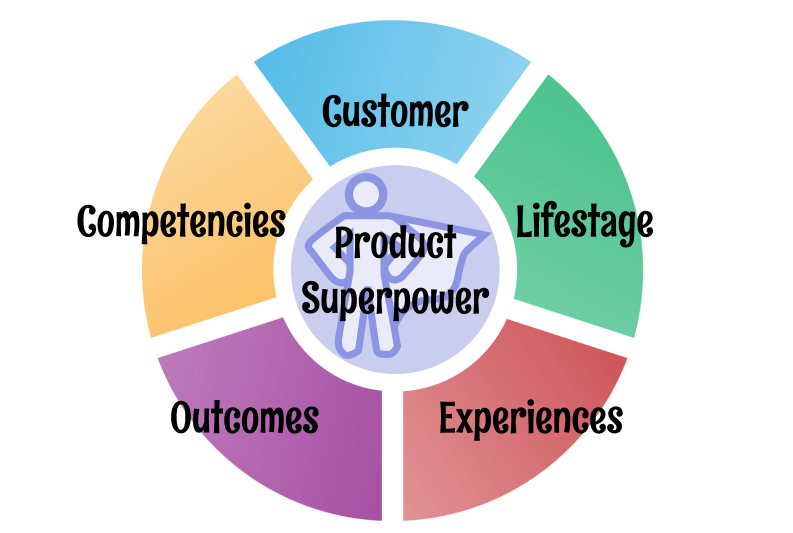
By the end of this exercise, you’ll be able to create what I call the ‘Product Pledge’ — an elevator pitch you can use with your professional network to clearly communicate to your manager, stakeholders, clients and professional network your unique selling proposition (USP). This allows them to:
- quickly understand how you can best help them in their strategic challenges;
- find you new opportunities that match your skills and chosen niche;
- balance teams and projects and distribute skillsets efficiently;
- quickly realise to come to you to troubleshoot strategic problems you normally wouldn’t have been considered for; and
- Many more…!
Now, let’s dive in.
Step #1: Articulate the kind of customers you love solving problems for!

Knowing what kind of customers you’re passionate about solving problems for allows you to empathise better and take pride when you solve their problems. It also motivates you to work harder as a result.
Do you love solving problems for direct consumers (B2C), businesses (B2B), government (B2G) or marketplaces (B2B2C / B2B2B / others)? Do you want to broaden your exposure to different kinds of company types, or stick to what you know?
You may even find that you have served different types of customers over time, and that’s OK too. That said, I always recommend eventually sticking to one customer type for a more consistent and clean narrative that you can communicate to your managers, clients and your professional networks as well.
Step #2: Compare the different company life stages you’ve worked at.
Identifying the customer stage and size you prefer will save you future headaches when deciding upon your next opportunity for growth.
Have you solely worked for smaller companies, start-ups, or scale-ups? Have you dealt with large enterprises and many dependent teams? Or, are you flexible enough to navigate all these?
List all your companies and look for patterns.
For example, in my case, I have worked in almost all phases of tech companies, both internally and externally:
- (Seed to Series A/B) I built a start-up from 0 to 1, validating the MVP through lean customer development, launching and growing a payments product from scratch
- (Series C+) I established product-led culture, scaled outcome-focussed teams, and shipped complex software products in highly sales-led B2B and B2G companies
- (Post-IPO) I advised management teams and also grew revenues within a wide portfolio of emerging mobile payments product integrations at PayPal
- And as a strategy consultant, I advised executives at Fintech and Payments companies, on market-entry, product strategy and positioning to generate new revenue opportunities, reduce costs, and progress M&A transactions worth >$100m.
For me, I enjoy working within smaller sized companies that have past product market fit, to create growth loops and immediate and scaled impact. However, I also have the flexibility of working in any size company to achieve outcomes at scale through my consulting experience.
Step #3: List out your past projects and job experiences, mapping deliverables for each.
Every project you have worked on gives you experience and lessons learned. If you failed, you learn what not to do in future. If you succeeded, you will have metrics or outcomes you can measure and promote.

In this step, list out all of your significant project deliverables that you worked on, at the companies you listed in the previous step. List out:
- the experience you gained,
- the role or responsibility you had, and
- the deliverable you shipped to the customer or stakeholder.
A major benefit of this activity is that you critically analyse the impact you made in each organisation, your role, and whether you emotionally connect or recall the achievements easier for one role, company or industry, more so than another.
Once you have written down your experiences, select the top 5 or so you are most proud of. You’ll need these for the next step.
Step #4: Map out your key outcomes per project deliverable.
By this point, you’ll know your ideal customer, industry, company lifestage, and an initial view of project deliverables.
For each project deliverable, map out your top measurable outcomes (aka results). Find commonalities to craft your elevator pitch of the outcomes you LOVE to deliver to your ideal customers.
For example:
Deliverable: launched redesign of a customer checkout UX Outcome: reduced failed payment rate by XX%, increased WoW sales by YY%
Deliverable: validated designs and shipped lean MVP to market Outcome: adopted by 10 enterprise customers, processing $X gross value p.a
Deliverable: overhauled a merchant onboarding page design Outcome: improved conversion by XX% leading to $Y revenue p.a
After listing out your deliverables and outcomes, find a common pattern or theme of the types of outcomes you can drive for your clients and customers. For example, from the list above, you may focus on how you achieve double-digit revenue growth for B2B customers, or creating frictionless UX to generate financial impact.
Step #5: Identify your top 3 strengths against free, industry-tested competency frameworks.
Critically analysing your skills against established competency frameworks, allows you to know what your strengths and weaknesses are for specific product skillsets.
Ignoring this step is like being a chef who never tastes their own food — how will you know if you’re cooking up greatness?
I recommend using progression.fyi, a buffet of open-source competency frameworks at leading tech companies. Search across similar industries or company stages, then pick a framework that appeals to you. Perform a self-assessment to identify your top 3 strengths and weaknesses for future improvement.
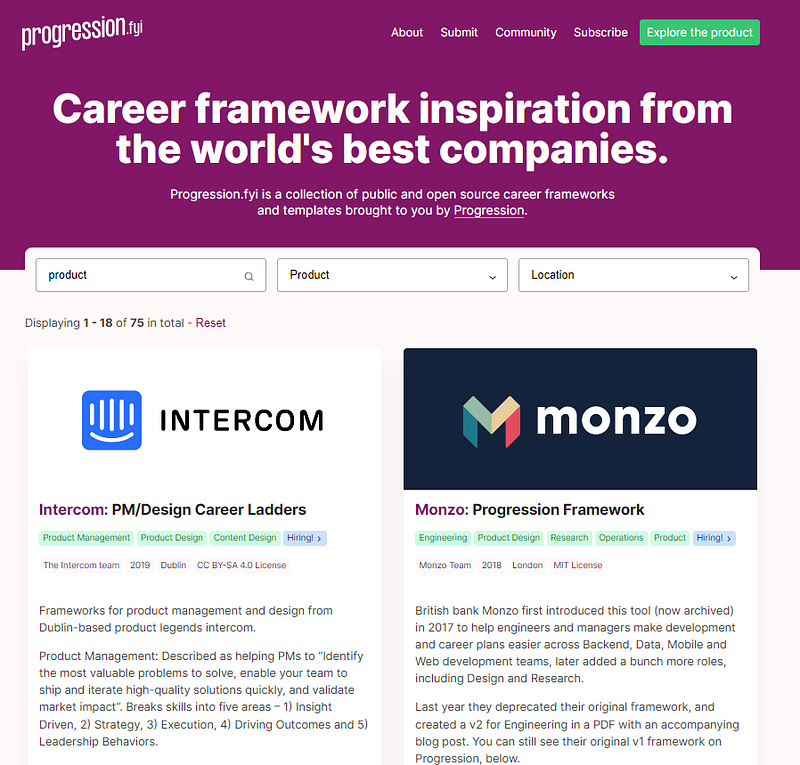
If you can’t pick a single framework, try the popular Reforge Product Growth Framework, with 12 dimensions spread across 4 competencies. When I used this framework in my last full-time product role, I found that I was strongest in three competencies:
- Business Outcome Ownership
- Strategic Impact, and
- Stakeholder Management
When crafting my personal branding statement, I know that I should highlight my ability to inculcate an outcome-focussed product-led culture and structures and on my skills in communicating strategy to a wide array of stakeholders.
Step #6: Draft your Product Pledge: a personal brand statement for your superpowers. Share and iterate.
It’s now time to craft your first draft of your personal brand statement, what I call your ‘Product Pledge’! Your pledge serves as your own guiding principles for personal branding and career development. This allows you to communicate a more memorable the value you bring as a Product Leader.
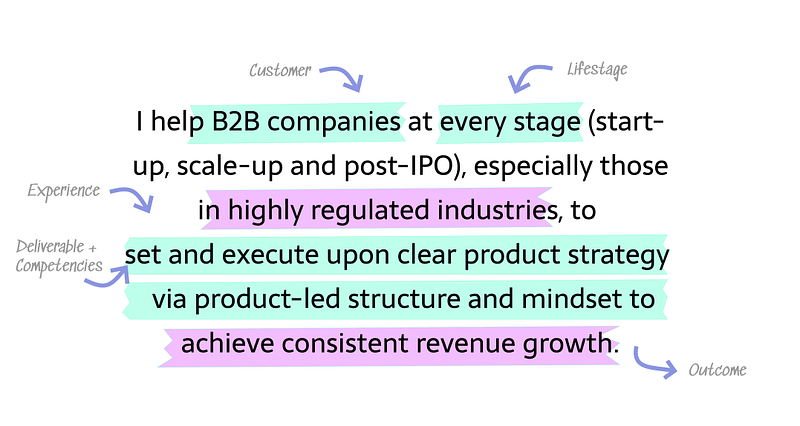
Your pledge should be concise and non-exaggerated. I like using the following pitch template for this:
I <verb> <target customer type> at <company lifestage>
to <verb> <deliverables and / or competencies>
to <verb> <outcome>
For example, a sample Product Pledge could be:
Share your pledge with some peers in your team, or even other product managers that you may want to collaborate with on this exercise to help them find their superpowers too! The more the merrier.
Iterate on your statement with the feedback gained to fine tune your statement for a wider audience later.
You’ve found your superpower. What’s next?
With the above steps, I hope that you have discovered your product superpowers that have been within you all along!

For those who are still struggling to nail your pitch down: this is completely normal. Hopefully through the exercises above, you’ll have gained a better appreciation of what your strengths and weaknesses are in this exercise, and with this, you’ll be able to figure out your superpowers soon enough.
Once you have your superpower and your Product pledge, you can start promoting yourself in various ways to your peers, managers, stakeholders and clients.
Communicating your pledge consistently will allow you to find your next challenge and growth opportunity faster than aimlessly accepting any project that comes your way!
Thanks for reading!
If you enjoyed this article and want to share your personal statement with others, please comment below, or share them with my via my socials! Tag me here on Medium, LinkedIn, or Twitter.