avatarCarlyn Beccia

Free AI web copilot to create summaries, insights and extended knowledge, download it at here

3842

Abstract

sitic mite <i>Sarcoptes scabiei </i>(scabies). Wolves, dogs, and coyotes infected with scabies will have extreme hair loss, skin shriveling, and constricted blood vessels that can lead to life-threatening fatigue.</p><p id="f78c">And while usually a coyote or wolf will have no problems hunting prey, once infected with Sarcoptic mange, coyotes may choose to hunt more available meals….such as livestock.</p><figure id="e8c2"><img src="https://cdn-images-1.readmedium.com/v2/resize:fit:800/1*reyFCEX3J9hSbmiJaoIBNw.jpeg"><figcaption>Alpine musk deer | <a href="https://en.wikipedia.org/wiki/Musk_deer#/media/File:Moschus_chrysogaster.jpg">Public Domain</a></figcaption></figure><h1 id="2526">The Vampire Deer</h1><p id="1d2b">It may look like Mother Nature is messing with us, but the South Korean musk deer is a gentle herbivore that has no interest in sucking blood. At first blush, its protruding fangs are puzzling. Fortunately, the “fangs” are actually sabers that the males use to fight during the mating season.</p><p id="3f3f">The vampire deer is hunted by humans but not for its tusks. Male Siberian musk deer (<i>Moschus moschiferus</i>) are poached for its scent glands (worth nearly $20,455 per pound on the black market.) Their musk is so valuable to the perfume market that the species has almost been hunted to extinction. And then, sadly, it <i>will </i>become mythical.</p><figure id="7faf"><img src="https://cdn-images-1.readmedium.com/v2/resize:fit:800/1*FGDjdCRv-eV1EqgcM06SlQ.jpeg"><figcaption>Haast’s eagle attacking <a href="https://en.wikipedia.org/wiki/Moa">moa</a> by John Megahan | <a href="https://creativecommons.org/licenses/by/2.5">CC BY 2.5</a></figcaption></figure><h1 id="259d">The Stymphalian Birds</h1><p id="b9f4">One of Hercules’ labors was to kill the Stymphalian Birds — man-eating birds with the peculiar habit of throwing dung. The Greeks were not the only ones who liked to scare their youngsters with killer bird tales. The Maori tribe of New Zealand told similar legends of the <i>pouakai</i> or <i>hokioi</i> — a giant, black and white bird that swooped down from the sky to pick off small children.</p><p id="7260">Scientists today know that these Thunderbirds existed. Called Haast’s eagle, the bird stood over six feet tall and had a wingspan of over eight feet. The Haast eagle would sit atop trees and then ambush its prey by swooping down at 60 mph speeds. Then it would disembowel its meal with sharp talons before the poor slob could even worry about dung throwing.</p><p id="f49e">Hercules would never have survived these hell birds. But you can sleep well tonight. The Haast’s eagle went extinct around the 15th century (maybe…)</p><figure id="3161"><img src="https://cdn-images-1.readmedium.com/v2/resize:fit:800/1*1OBIl5p9sJsIL8VHFYMQbw.jpeg"><figcaption>Odysseus’s boat passing between the six-headed monster Scylia and the whirlpool Charybdis | <a href="https://commons.wikimedia.org/wiki/File:Caught_between_a_rock_and_a_hard_place.jpg">Public Domain</a></figcaption></figure><h1 id="0e16">Charybdis</h1><p id="bc8d">Nothing is more frightening than being sucked underwater by a whirlpool that feeds on human flesh three times a day. The Charybdis first appeared in Homer’s <i>Odyssey. </i>During this epic tale, Odysseus must sail between the six-headed sea monster Scylla and the flesh-eating whirlpool Charybdis.</p><p id="9189">These two dueling sea monsters attacked in intervals — much like a whirlpool’s regular intervals of tidal activity.</p><p id="c57a">It sounds terrifying, but whirlpools that pull ships underwater really do happen. Known today as <i>Garofalo</i>, one is found in the Strait between Italy’s mainland and Sicily. Garofalo occurs when winds blow across the Strait in opposition to the tides. This makes it technically not a whirlpool (there’s no circular

Options

motion). But it does have the ability to wreak havoc on ships and pull humans into a watery grave.</p><p id="1d1c">This is one instance where science is just as scary as sea monsters.</p><figure id="5859"><img src="https://cdn-images-1.readmedium.com/v2/resize:fit:800/1*nVmFzU53zwiD_9Ffuxe34Q.jpeg"><figcaption>The Nightmare, John Henry Fuseli | <a href="https://en.wikipedia.org/wiki/The_Nightmare#/media/File:John_Henry_Fuseli_-_The_Nightmare.JPG">Public Domain</a></figcaption></figure><h1 id="731c">The Incubus</h1><p id="5e2b">During the witchhunt craze of the sixteenth and seventeenth centuries, people had some really messed up ideas on how human reproduction occurred. One way was for a demon to steal a man’s seed and impregnate a helpless woman during her sleep. The monster that stole the precious sperm was called a succubus, and the monster that implanted the sperm was called an incubus.</p><p id="3307">The incubus would sit on top of your chest while you slept, making it impossible for you to move if you woke. (Sort of like being molested by a possessed sexsomniac.)</p><p id="f7b6">But before you condemn medieval people as crazed horndogs trying to attack innocent women, there is a scientific basis for believing in such monsters.</p><p id="f45c">The condition is called sleep paralysis, and as someone who has experienced it…I would prefer the demon spawn. During sleep paralysis, you are fully awake but cannot move or cry for help. It feels like you have had a stroke.</p><p id="27e4">But although it is terrifying, sleep paralysis is harmless. Most sleep experts attribute it to being caught between REM (rapid eye movement) and NREM (non-rapid eye movement) sleep. Either way, before sleep stages were understood, we can see how our ancestors would have thought it was a demon sitting on your chest. (Although adding the sex part seems gratuitous.)</p><p id="2904">I hope these mythical creatures with a twist of rational science make you think twice the next time you hear that crazy uncle swear he saw Bigfoot.</p><p id="cd6f">*Bigfoot, if you are reading this….I totally believe in you. Please don’t kill any more dogs.</p><h2 id="15bc">About the author:</h2><div id="87df"><pre>Carlyn Beccia <span class="hljs-built_in">is</span> an author, illustrator, columnist, <span class="hljs-built_in">and</span> speaker. Beccia<span class="hljs-comment">'s books, including The Raucous Royals, I Feel Better with a Frog in My Throat, They Lost Their Heads, and Monstrous have won numerous awards, including the Golden Kite Honor, The International Reading Association's Young Adult Book Award, and the Cybil Award. For more information: www.CarlynBeccia.com</span></pre></div><p id="e1bd">If you enjoyed this article, explore more history, science, and weird dinner conversation topics in <a href="https://www.amazon.com/s?k=carlyn+beccia&amp;crid=3CUCLPCCQSPUV&amp;sprefix=carlyn+beccia%2Caps%2C85&amp;ref=nb_sb_noss_1">one of my many books</a>. (*Note: I am not an Amazon affiliate. Please support your local bookstore.)</p><h2 id="1026">To read more, please visit my affiliate link. A portion of your Medium subscription supports my work:</h2><div id="428c" class="link-block"> <a href="https://carlynbeccia.medium.com/membership"> <div> <div> <h2>Join Medium with my referral link - Carlyn Beccia</h2> <div><h3>Read every story from Carlyn Beccia (and thousands of other writers on Medium). Carlyn Beccia is an award-winning…</h3></div> <div><p>carlynbeccia.medium.com</p></div> </div> <div> <div style="background-image: url(https://miro.readmedium.com/v2/resize:fit:320/0*fESBfGy6uhjBjWmi)"></div> </div> </div> </a> </div></article></body>

Six Mythical Creatures That Are Actually Real

And science can prove it
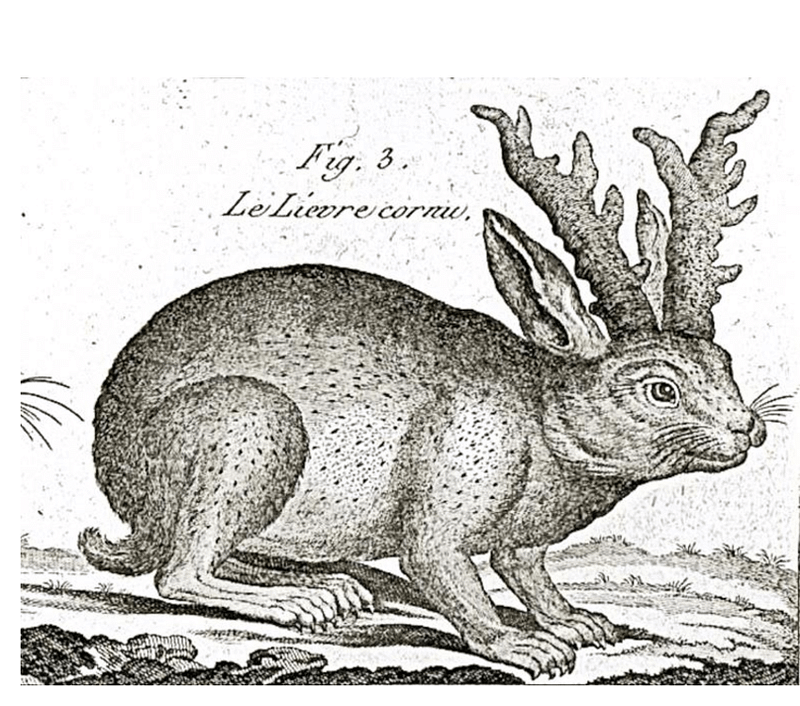
Hare with horns (Lepus cornutus), Bonnaterre’s Tableau Encyclopedique et Methodique, 1789 | Public Domain

If you step into any Midwestern tavern, you are bound to see heads of moose, deer, rabbits, and bears adorning the walls. But occasionally, you can also find a stranger creature — the mythical jackalope.

The jackalope resembles any rabbit or hare except for the antlers sprouting from the top of its head. The ones mounted on walls were created by wily taxidermists and are as real as P.T. Barnum’s Fiji Mermaid. But ask the locals if the jackalope exists, and they will tell a different tale. They say the jackalope mimics human voices, enjoys whiskey, and is extremely dangerous. And many have taken pictures of it in the wild.

Is the jackalope just a creature of urban legend or a whiskey-swigging hell bunny? Well, hide your Easter eggs, kids, because the jackalope is coming for you.

In June 2020, the Smithsonian’s mammal collection manager, Suzanne Peurach, stumbled upon a jackalope in their specimens collection. At first, she thought it was another hoax. But upon further examination, she realized that the jackalope was not cobbled together by imaginative taxidermists.

It actually had horns.

Ok, not technically horns. It had cutaneous horns or tumors.

These horns are caused by the Shope papillomavirus, which causes cottontail rabbit papillomavirus (CRPV). CRPV causes hard, hornlike tumors to grow out of rabbits, mostly around their head, mouth, and eyes. The human form of this virus (HPV) also causes cancerous growth. In fact, our recent HPV vaccine was developed from CRPV. (Thanks, jackalope!)

What is science going to wreck next? Do unicorns just have a giant carcinoma sprouting out of their heads?

Well, I hate to ruin a good legend, but the jackalope is not the only mythical creature that science can prove exists. The following fabled monsters have some very logical explanations behind their fantastical sitings.
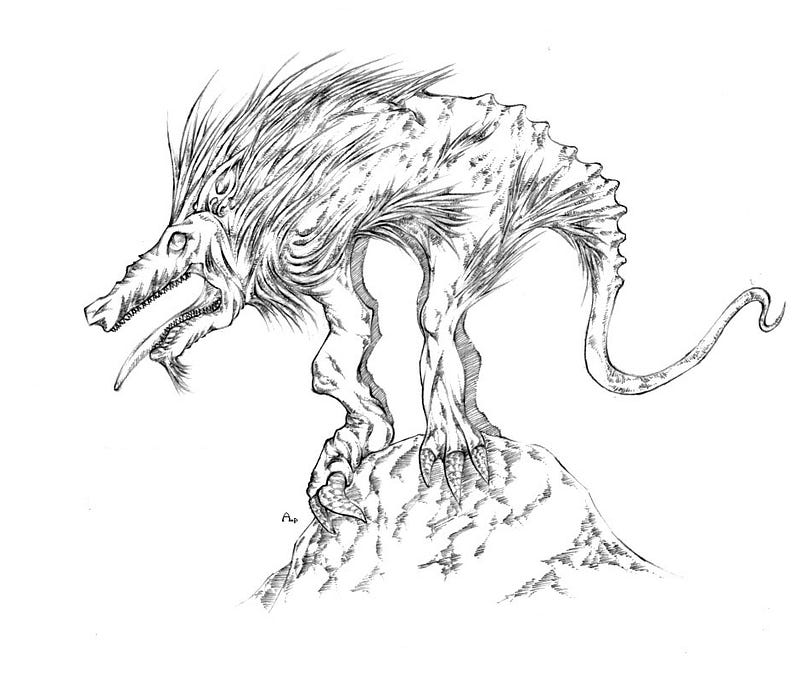
Greyscale drawing of Chupacabra, 2011 | Public Domain

El Chupacabra

We are taught from an early age — don’t approach scary looking dogs. And while no one can get a clear picture of Bigfoot, the Kraken, or the Loch Ness monster, there is one monster that is oddly not camera-shy — the legendary el Chupacabra.

The Chupacabra was first sighted in Puerto Rico in the ’70s. A wave of sightings followed in the late 1990s. During this time, livestock throughout Puerto Rico was found drained of blood. These Chupacabra or “goat-sucker” attacks caused panic among local residents who claimed a vampire was feeding on their livestock. Although descriptions have varied, most describe a hairless, alien-like monster with spikes going down its back and glowing red eyes.

It sounds dubious. But how could so many people capture pictures of the same ugly doglike creature? The answer may be found in science…

One plausible theory is that these creatures are coyotes suffering from Sarcoptic mange — an inflammatory skin condition caused by the itch-inducing parasitic mite Sarcoptes scabiei (scabies). Wolves, dogs, and coyotes infected with scabies will have extreme hair loss, skin shriveling, and constricted blood vessels that can lead to life-threatening fatigue.

And while usually a coyote or wolf will have no problems hunting prey, once infected with Sarcoptic mange, coyotes may choose to hunt more available meals….such as livestock.
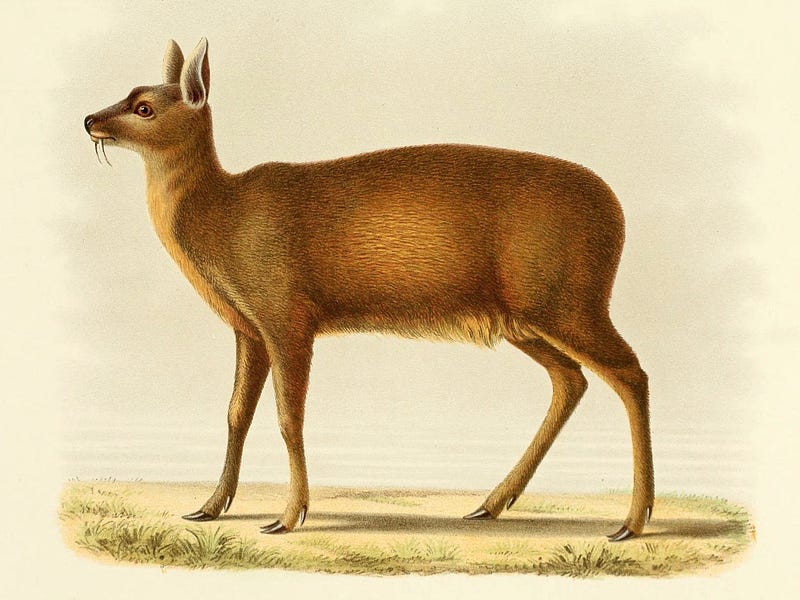
Alpine musk deer | Public Domain

The Vampire Deer

It may look like Mother Nature is messing with us, but the South Korean musk deer is a gentle herbivore that has no interest in sucking blood. At first blush, its protruding fangs are puzzling. Fortunately, the “fangs” are actually sabers that the males use to fight during the mating season.

The vampire deer is hunted by humans but not for its tusks. Male Siberian musk deer (Moschus moschiferus) are poached for its scent glands (worth nearly $20,455 per pound on the black market.) Their musk is so valuable to the perfume market that the species has almost been hunted to extinction. And then, sadly, it will become mythical.
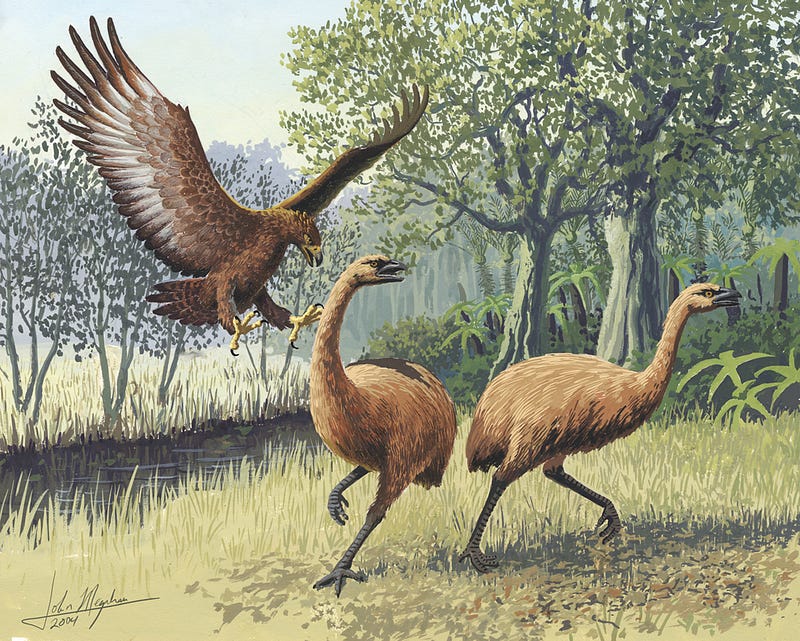
Haast’s eagle attacking moa by John Megahan | CC BY 2.5

The Stymphalian Birds

One of Hercules’ labors was to kill the Stymphalian Birds — man-eating birds with the peculiar habit of throwing dung. The Greeks were not the only ones who liked to scare their youngsters with killer bird tales. The Maori tribe of New Zealand told similar legends of the pouakai or hokioi — a giant, black and white bird that swooped down from the sky to pick off small children.

Scientists today know that these Thunderbirds existed. Called Haast’s eagle, the bird stood over six feet tall and had a wingspan of over eight feet. The Haast eagle would sit atop trees and then ambush its prey by swooping down at 60 mph speeds. Then it would disembowel its meal with sharp talons before the poor slob could even worry about dung throwing.

Hercules would never have survived these hell birds. But you can sleep well tonight. The Haast’s eagle went extinct around the 15th century (maybe…)
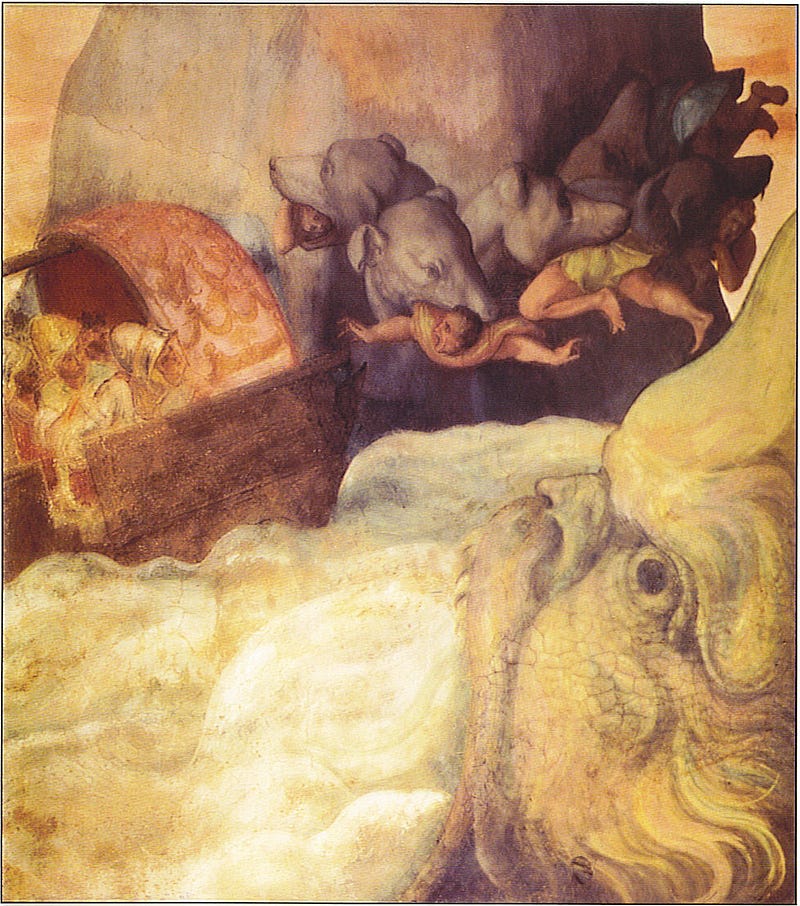
Odysseus’s boat passing between the six-headed monster Scylia and the whirlpool Charybdis | Public Domain

Charybdis

Nothing is more frightening than being sucked underwater by a whirlpool that feeds on human flesh three times a day. The Charybdis first appeared in Homer’s Odyssey. During this epic tale, Odysseus must sail between the six-headed sea monster Scylla and the flesh-eating whirlpool Charybdis.

These two dueling sea monsters attacked in intervals — much like a whirlpool’s regular intervals of tidal activity.

It sounds terrifying, but whirlpools that pull ships underwater really do happen. Known today as Garofalo, one is found in the Strait between Italy’s mainland and Sicily. Garofalo occurs when winds blow across the Strait in opposition to the tides. This makes it technically not a whirlpool (there’s no circular motion). But it does have the ability to wreak havoc on ships and pull humans into a watery grave.

This is one instance where science is just as scary as sea monsters.
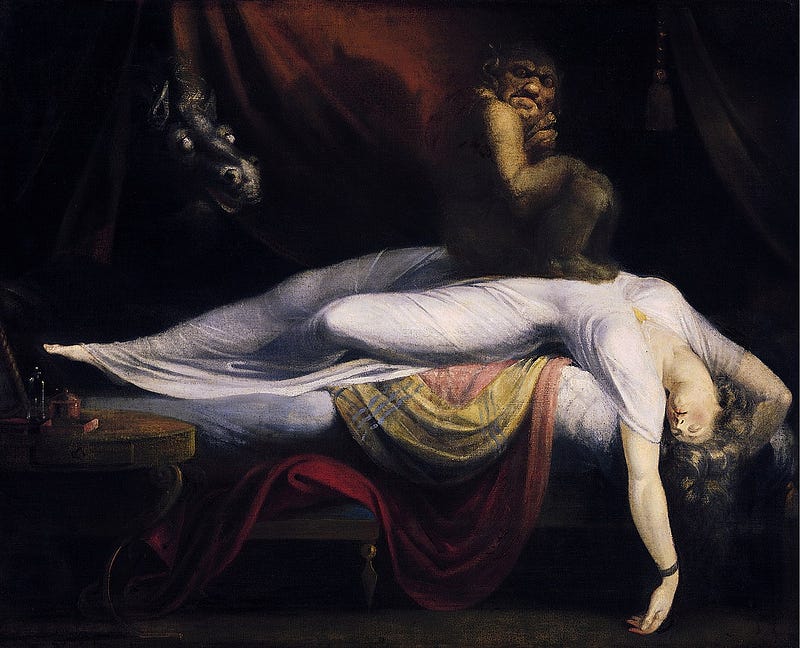
The Nightmare, John Henry Fuseli | Public Domain

The Incubus

During the witchhunt craze of the sixteenth and seventeenth centuries, people had some really messed up ideas on how human reproduction occurred. One way was for a demon to steal a man’s seed and impregnate a helpless woman during her sleep. The monster that stole the precious sperm was called a succubus, and the monster that implanted the sperm was called an incubus.

The incubus would sit on top of your chest while you slept, making it impossible for you to move if you woke. (Sort of like being molested by a possessed sexsomniac.)

But before you condemn medieval people as crazed horndogs trying to attack innocent women, there is a scientific basis for believing in such monsters.

The condition is called sleep paralysis, and as someone who has experienced it…I would prefer the demon spawn. During sleep paralysis, you are fully awake but cannot move or cry for help. It feels like you have had a stroke.

But although it is terrifying, sleep paralysis is harmless. Most sleep experts attribute it to being caught between REM (rapid eye movement) and NREM (non-rapid eye movement) sleep. Either way, before sleep stages were understood, we can see how our ancestors would have thought it was a demon sitting on your chest. (Although adding the sex part seems gratuitous.)

I hope these mythical creatures with a twist of rational science make you think twice the next time you hear that crazy uncle swear he saw Bigfoot.

*Bigfoot, if you are reading this….I totally believe in you. Please don’t kill any more dogs.

About the author:

Carlyn Beccia is an author, illustrator, columnist, and speaker. Beccia's books, including The Raucous Royals, I Feel Better with a Frog in My Throat, They Lost Their Heads, and Monstrous have won numerous awards, including the Golden Kite Honor, The International Reading Association's Young Adult Book Award, and the Cybil Award. For more information: www.CarlynBeccia.com

If you enjoyed this article, explore more history, science, and weird dinner conversation topics in one of my many books. (*Note: I am not an Amazon affiliate. Please support your local bookstore.)

To read more, please visit my affiliate link. A portion of your Medium subscription supports my work:

History
Humor
Science
Mythology
Culture
Recommended from ReadMedium