Sister of Swans
A tale of a princess, a witch, and dancing with rainbows
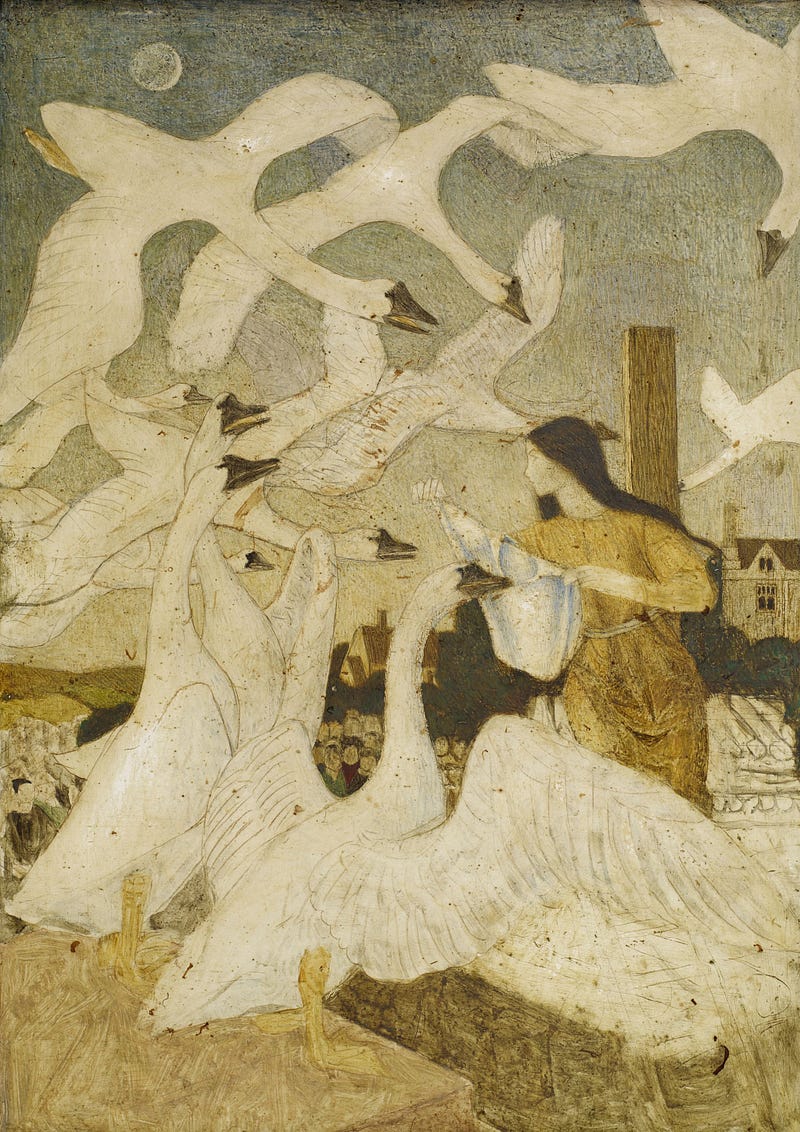
Eliza was seven when she first had the dream.
She was dancing, wearing a dress made of rainbows that swirled around her as she twirled, a breadth of colour that left all who saw her breathless.
Her brothers stood guard around her, each with a star on his breast and a sword by his side. They wore silver diadems that caught the light and sparkled back in their eyes as they smiled at their younger sister. A pair of white wings rose high over each prince’s head, folded against his back.
Eliza was twelve when her father married the queen of a neighbouring land. At the wedding, the bride stared at Eliza with eyes as cold as ice. Eliza stood close to her brothers, her heart sinking deeper each time she caught her new stepmother’s frosty gaze. The queen wore a dress of white and silver that caught the warm light from the candles and torches in the ballroom and cast it back cold and shattered.
Eliza’s youngest brother, Benyamim, never left her side. Her other brothers brought her cakes and cordial. And they all kept an eye on the queen and kept Eliza far away from her.
Eliza danced with each of her brothers in turn, her sky blue dress swirling around her legs, her silver crown sitting heavier on her brow than it was wont to do. She could not understand the hostility from the queen, and it weighed on her soul.
The next day, the queen came into Eliza’s rooms with a regiment of footmen. At her direction, they collected every dress and every scrap of lace and frippery and removed it. Then they measured Eliza and brought her new clothing: tight breeches, white shirts, and slim jackets.
Eliza’s chest tightened as the footmen dressed her. She found it harder and harder to breathe as she watched her reflection in the full length mirror change into someone she didn’t recognize.
Her stepmother stood over Eliza’s shoulder and watched with satisfaction. “I will not have boys wearing dresses in my house,” she said, her voice cold.
Once Eliza was dressed in clothing suitable for a prince, the queen sent her to the stables to go riding with her brothers. At first, they didn’t know her, and then they were horrified and their anger toward the queen grew hot. Immediately, they set out to find her.
But the queen only curled her lip in disgust at their protest. “No boy will wear dresses within these walls while I am queen.”
Eliza’s oldest brother, Rúben, put his hand on the hilt of his sword and took a step toward the queen. But she was ready for him, and she lifted her hands, holding them all in place with magic. “Fly like great birds who have no voice,” she snarled, and Eliza’s brothers became eleven beautiful wild swans. The queen flicked her fingers and, with a cry, the swans flew through the windows of the palace, and over the walls to the forest beyond.
Eliza watched in horror as her brothers vanished into the distance, then turned to face her stepmother. Her new boy’s clothing did not include a sword, and she would not have known how to use one if it did, but she wished she could scratch the queen’s eyes out. Or, at the least, reproach her actions. However, words stuck in Eliza’s throat and left her speechless. Tears sprang to her eyes and she turned and ran — from the queen’s chambers, from the castle, from the grounds, and into the forest.
She found the swans on the shore of a small lake deep in the forest. Their snowy white feathers gleamed in the sun as they gathered around her, pressing their heads and wings against her in an endeavour to comfort her as the tears flowed down her cheeks. Eliza fell to her knees and gathered them close and wept.
A rustle of branches and leaves heralded the arrival of an old woman carrying a basket in which she had been gathering mushrooms and berries. She nodded her grey head in greeting and bade them good day. Then she seemed to grow taller and more regal.
She took Eliza’s hands in hers and proclaimed, “Your brothers can be released if you have only courage and perseverance. True, water is softer than your own delicate hands, yet it polishes stones into shapes; it feels no pain as your fingers would feel, it has no soul, and it cannot suffer such agony and torment as you will have to endure.
“Do you see the stinging nettles? Quantities of the sort grow round the cave yonder. These you must gather even while they burn blisters on your hands. Break them to pieces with your hands and feet, and they will become flax, from which you must spin and weave eleven coats with long sleeves; if these are then thrown over the eleven swans, the spell will be broken. But remember, from the moment you commence your task until it is finished, even should it occupy years of your life, you must not speak. The first word you utter will pierce through the hearts of your brothers like a deadly dagger. Their lives hang upon your tongue. Remember all I have told you.”
With that, the old woman released Eliza’s hands, picked up her basket and continued on her way. Eliza and the eleven swans stood in astonishment for a moment, then Eliza scrambled through the underbrush to the cave and began to pick the nettles. Each touch brought pain like burning fire. Great blisters soon covered her hands and arms, but she did not flinch and she did not stop.
She bruised the nettles with her feet and spun them into flax as her brothers stood guard. As the sun set, the swans became men again and some of them went to find food and supplies while the others stayed to guard their sister. In the morning, as the sun rose, they were once again swans. The curse compelled them to fly away.
Eliza watched them go but never paused in her task except to eat and drink from that which they had brought her. That evening, just before the sun set, the swans returned and, as the day ended, they were her brothers once again.
So passed many days. The work was slow, and the pain made it slower. The second day, Benyamim brought Eliza a dress he had stolen from the washing on a line outside a peasant’s cottage and, with silent relief and gratitude, she exchanged it for the breeches, giving him a hug and a kiss.
One day, news reached them that their father had died and the queen was now the sole ruler of both lands. Though they had not planned to return home, the knowledge they never could was sobering. And, though their father had not been the best of fathers, he had never been cruel, so they mourned his loss.
Eliza was sixteen when the king of a neighbouring land found her sewing coats from the green cloth she had spent years in weaving. She sat in the small cottage her brothers had built for her in the forest. As the day was full, she sat alone. The king asked her name and how she came to be so far from anything else. When she would not speak, he knelt at her feet and begged her to come with him and be his queen and live in his castle. He promised her gold and jewels and silk and velvet.
But she would not speak and would not go, so he left with his head bowed low.
The next day, he came again and promised her pearls and satin and silver and gold. She baked him a loaf of fresh bread with butter she had churned herself. She offered a flagon of cold fresh water from the well her brother Simão had dug behind the cottage. But she did not speak, and she would not go with him.
The next day, he came again. And the next and the next. He gave up on promising her richer and richer gifts, and he only spoke to her of his dreams. He sat in silence, watching her sew. She grew to value his companionship; the seed of a gentle love took root within her heart and began to grow for this king, this man, her Philip.
She had nearly finished the last coat when Philip again asked her to be his bride. This time he did not offer anything but his heart, and she could only nod, for he already held hers. He whooped with joy and begged her to come back with him, offering to carry all the coats and cloth back with them so she could finish her task in the comfort of his castle. Finally, she agreed and, handing him a paper and pen, made him understand with gestures that he must to leave a note for her brothers, so that they could find her.
At the castle, Eliza was dressed in a dress more beautiful than any she had seen in her life. It was made of silk that changed colour in the light and reflected back a rainbow. She remembered her dream and smiled, but she returned to her sewing as soon as her attendants had finished dressing her, even while they dressed her hair.
The priest came to see Eliza and asked her many questions of her family and her baptism, but she said not a word, for Benyamim’s coat was not yet finished. Finally, the priest took Philip aside. “My king,” he said to him, “you cannot marry her.”
“And why not?” Philip asked indignantly.
“My liege, she is a witch. And besides that, she is not a woman!”
Philip’s mouth fell open. “I have known her for several weeks, and you have only just met her.”
The priest shook his head. “You are blinded by love, my king, and cannot see clearly. In fact, I would venture to suggest she holds you under a spell.”
Philip opened his mouth to protest again, and a shadow passed over the window as eleven swans flew past, wheeled in midair, and returned to enter the room. The air was filled with wings and white feathers as they settled in a circle around Eliza, as the king and the priest stared in amazement. While Eliza had made Philip understand that she had someone to leave word for, she had not been able to explain the curse.
The priest called for the guards, certain that the witch had called upon nature to invade them, but Eliza threw the coats over the swans, and they immediately became eleven handsome princes. Only Benyamim had one wing instead of an arm, for she had not finished the last sleeve of his coat.
“Now I may speak.” Eliza stood tall and held Philip’s eyes. “I am not a witch, but I am a woman.”
Rúben put his hand on her shoulder and faced the priest and the king. “She is our sister.”
Philip ignored the priest’s sputtering, and took her hands, his eyes glowing with love for her. “May I ask for your brothers’ blessing on our marriage?”
Eliza smiled back, her heart full to bursting with love and joy. “You may.”
All the church bells rang of themselves, and birds came in multitudes. Eliza wore the dress of rainbows, and they had a marriage celebration such as no one had ever before seen.

This piece is part of the Prism & Pen fiction challenge, hosted on Crossin(G)enres. This week’s theme is ‘Ice, Water, and Swans’