
Singularity
On single(dom) and collective(dom)
Perhaps the power of singularity is underrated. Perhaps we are too lonely or perhaps it’s the punctuation that is the problem. Who knows?
You see, singularity has become an isolated phenomenon in our mass induced society. Reflective and nouns don’t compete with popular and adjectives. Our society is run by the complex system of people that comprise it, and the discourse and interactions between them that occur. These complex phenomena are studied extensively by disciplines as they are the backbone of our society. Complex and single interactions require analysis, just like grammar, as we are socialized from an early age and therefore, a cumulative dazed system of systematic interactions that make up what we call ‘us.’ We are a by product of the system, individual yet not, competitive yet subjective~ but where is the reflective? In the social jungle, jumble, where lies the individual self, or have we yet to find them? And, last, what of it?
There is a power in the individual and the social self; most psychoanalysts have beaten the topic to death. Carl Jung, the famous psychoanalyst who challenged his mentor’s (Sigmund Freud) theory of the primitive self, had this to say in the The Archetypes and the Collective Unconscious: “A group experience takes place on a lower level of consciousness than the experience of an individual. This is due to the fact that, when many people gather together to share one common emotion, the total psyche emerging from the group is below the level of the individual psyche. If it is a very large group, the collective psyche will be more like the psyche of an animal, which is the reason why the ethical attitude of large organizations is always doubtful. The psychology of a large crowd inevitably sinks to the level of mob psychology. If, therefore, I have a so-called collective experience as a member of a group, it takes place on a lower level of consciousness than if I had the experience by myself alone.” Therefore, the individual-social interaction environment produces a psyche that can be defined by the experience itself. Alone or not, it becomes what it is.
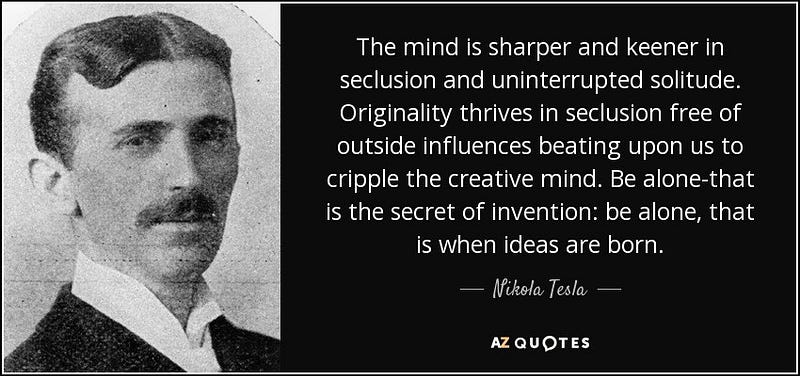
When it comes to innovation, the Croatian inventor Nikola Tesla swore by the power of the individual to create in an atmosphere of individuality, rather than the collective.
If this is the truth, then why is our culture moving towards a standard of the collective, away from the individual self, away from the ‘I’, away from the eye (third eye), from even inhabiting the self to know our selves a bit better? Is it that society is tying to dumb us down or that we are being encouraged to take steps forward to realize our collective evolution? Or, can we have both? Can creation and reflection and stewardship happen in both environments? Many questions revolve the ‘I-them’ conundrum.
Let’s say perhaps, that we are a polluted self, socially constructed since the day that we are born.
Then, there really is no ‘I,’ not without social influence. The mother and father (or authority) figures project unto the child their often subconscious minds, thoughts, wants and needs, though in reality they may want them to succeed individually. Why is the language of the self, introspection and inward reflection a ‘new age’ thing, rather than something that was introduced let’s say, in the era of the Buddha and enlightenment. Once again, the question arises, in which context are we best suited and most productive as human beings? Or does it depend on the end result; what we want to get out of the situation? For example, it is often not until our twenties that self realization happens, either through education or career or simply through advancement of the higher mind.
If in fact we are most creative and open when we access our higher minds, it is the truth that it is often a laborious and lengthy process. Why? Because from an early age, we are taught to buy into the collective. Friends, family, relationships, the social self, interactions with society, the ‘other’ dimensions are all social and primary. It is rare that we examine the ‘I’ until we are at a point in our self growth where it becomes important, or, deemed necessary. For example, if taking up Buddhism, this process is natural, it is at the heart of the belief system and the enlightenment process. We often start to think of ourselves only after the layers of what was built by others begin to peel off like the proverbial onion. And this can be initiated by a life event, a milestone, a predicament, even a concerted effort, perhaps learned through example. It is a funny thing that we are chasing the self through learning in the collective.
Therefore, who are we? The by product of socialization? The self, the I, the higher mind or the ego? Does the social self mean that we are inherently social beings, or, are we missing a crucial part of ourselves by missing out on the ‘I’ equation?
So, in relation to the above question, ponder this. Is it that singularity has become a lost cause, in the case of collective evolution, or are individual efforts just as important to the individual collective or the self? Additionally, does one precede the other? In other words, is it, as the quotes relay below, that individual efforts bring about collective change, only?, or, are individual or singular efforts simply but a waste of time, and we need to focus on the group or collective action or input? While I would never dismiss individual efforts because as individuals, we require the attempt at individuation, it is crucial that we do identify with collective action and evolution, so that our efforts do not go in vein. Yet, as individuals, we have every right to go against the grain. So,
I’d say, honestly, both.
Anna Rozwadowska 2022