Singapore’s Sustainable Electric Vehicles Revolution
Our Future History of Electric Mobility
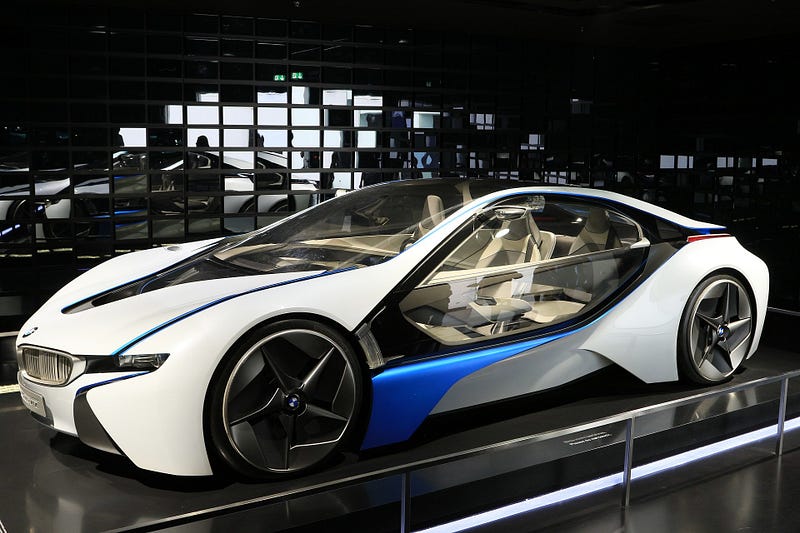
Modern cities by definition and design are not sustainable due mainly to their reliance on fossil fuel that results in unacceptable levels of carbon emission, negative impact on human health as well as over-consumption of other non-renewable resources. Future generations will bear the increasingly burdensome costs of their maintenance and expansion.
In 2035, Singapore becomes the first country in the world to have nearly 100% electric vehicles (EVs) on the road.
From 2034, only EVs are allowed to be imported and sold in Singapore. Unlike other countries, Singapore deploys a nation-wide EV-charging network powered completely by natural renewable energy, mostly solar power and some urban wind energy, which make it truly sustainable. The EV infrastructure is part of a national sustainable mobility infrastructure consisting of smart roads, Internet-based mobile apps, human mobility engineers, public transport systems, car parks, natural energy, commercial and industrial buildings as well as residential apartments and houses.
This is a brief history ’of the future’ in Singapore’s ambitious plan to engage global climate change by making fossil fuel history through a massive total replacement of its vehicular traffic by sustainable electric vehicles (sEV) and their impact on Singapore’s electric mobility lifestyles.
One Happy Motoring Day in 2035
I leave home at 7am that morning and am greeted by a pleasant “Good morning, Michael,100% charged” effeminate voice. “Thank you,” I reply, before realising that I am talking to a machine!
As I slide into my sEV, I decide to switch to driverless mode and let the vehicle bring me to my favourite breakfast meeting location. The location is one of several destinations visited before and “remembered” by the sEV’s computer. The smart sEV leverages on Singapore’s island-wide IT network supporting the intelligent road system via GPS Google Maps and my mobile apps to plot the best and fastest route with the least morning traffic jam. It “remembers” every destination visited, monitors possible traffic hotspots real-time and tracks useful motoring services such as charging points, car-wash locations, tyre shops, convenience stores and eating places. If desired, one can even scan for sEVs of friends within three kilometres, call contacts and connect with them via the hands-free telephone built into the steering wheel.
It is a busy morning. From the breakfast meeting to Changi Airport to pick up a couple of key clients and bring them to their hotel at Marina Bay, before going to Jurong, Bedok and the city for other meetings. Hours pass. Suddenly, the voice reminds: “40% power”, which I believe to be adequate for the rest of my day. Automatically, the sEV shows all the proximate charging locations, highlighting those where I had been before and those that are associated with my sEV Power Membership. I choose a new shopping centre just five minutes away for my lunch.
The car park operator of the new shopping centre is not associated with my sEV Power Membership. Charging for sEV is, however, free for shopping centre patrons. The entry point recognises my IU and vehicle numbers. Anyway, ad hoc charging fee can always be deducted from the IU cash card if necessary.
The car park has remote charging at every lot. I pull into a lot and the sEV’s computer confirms the vehicle’s alignment with the charging strip embedded on the floor and I engage the remote charging with a voice command “Engage”. How convenient. No need to connect a charging cable to my sEV.
Solar-powered charging stations are available everywhere in private as well as Government’s HDB/URA car parks and commercial buildings. Most charging is free since it consumes very little energy and is included in the parking fee if required. There are also sEV Power-Stops, most of which are located at former petrol stations that are now obsolete. At these stops, one finds supermarkets, café, food courts, fast food restaurants, gyms, snooker saloons, reading rooms and free Internet hotspots. Drivers of sEVs are occupied while their sEVs undergo fast charging and a car-grooming session. Many sEV service providers sell special monthly packages for unlimited charging for as low as $30 per month. This is awesome saving when compared with the $400-$500 previously spent on petrol for fossil fuel vehicles.
The shopping centre is one of several new buildings that had incorporated renewable energy into their designs. The government had earlier motivated developers with non-financial incentives such as increased GFA (gross floor area) bonus should they choose to invest in renewable energy in an enhanced manner. Developers were required earlier to provide for sEV-ready car parks in their building plans. Every 10% use of renewable energy would earn a 20% bonus in the permitted GFA.
The GFA measures the sheltered floor areas of a building and unsheltered areas for commercial uses for plot ratio control and determining development charges. Any GFA bonus essentially reduces the cost of the building and allows more usable space to be built and marketed. Using the GFA does not cost the public a single cent and allows developers to invest in the renewable energy equipment and infrastructure to reduce fossil fuel consumption. It adds to better building sustainability.
Developers have hitherto focused on “green” buildings and energy efficiency as their sustainability guide. By 2020, the oxymoronic notion of sustainable “green” buildings is discarded to embrace a wholly-natural energy basis for sustainable buildings, in addition to using sustainable building materials and accessories. The use of absorption chiller air-conditioning systems, waste heat re-circulation, recycling of used water and a host of other measures are part of the developers’ arsenal for a sustainable building.
Developers develop master energy plans for their buildings for sustainable end goals such as zero-carbon footprint, easy maintenance, comfort and productivity, and with extended life-cycle. To achieve zero footprint, developers deploy renewable sources such as solar thermal, solar photovoltaic (PV), urban wind and water.
The shopping centre has a condominium consisting of low-rise blocks to high 30-storey towers. Built in a unique East-West facing to maximise solar and urban wind impact, its seeming all-glass façade are actually solar PV panel arrays, which also adorn its roof-top next to absorption chillers. Small-wind turbines can be seen at strategic locations to capture the wind gust bursting through the buildings to produce urban wind energy, which together with the solar PVs power the elevators, as well as common and household lighting and heating. The complex is rated RE70, meaning renewable energy drives up to 70% of its energy needs. Only a very small fraction of this renewable energy (just 1 kW-hr per parking lot) is needed for sEV charging.
I finish my lunch and the restaurant endorses the complimentary sEV charging before I proceed to the car park. My sEV greets me: “Welcome back, Michael, 100% charged.” The top-up charging from 40% to 100% takes less than an hour while I have lunch. How convenient indeed.
I decide to take charge of the vehicle and drive to my next meeting before proceeding home to prepare for the evening dinner with the newly-arrived clients. An incoming call from overseas requesting a short conference prompts me into the driverless mode again, as I continue the journey without stopping.
Along the way, I wonder whether I should take either an electric bus or sEV taxi later since the dinner venue is quite near my house.
The sEV revolution offers motorists numerous advantages in the areas of energy efficiency, motoring costs and pollution emission. The sEV engine is twice more efficient than previous fossil fuel vehicles (FFV), with braking efficiency at around 65% compared with 18%-23% for FFV. Using renewable energy for battery charging means virtually zero carbon emission, compared with only 66% reduction in carbon emission when using electricity from fossil fuel (gas) generation previously.
This is my second sEV, being one of the first to benefit from the 10% COE (Certificate of Entitlement) first released for sEV in 2026. COEs for sEV are competitive but affordable when one factors in the convenience, lower maintenance cost and recurring energy cost. Prices of sEV have become much lower than standard fossil fuel vehicles, whose prices and base COE prices have gradually tripled after the government acknowledged the unacceptable social costs associated with their harmful CO2 (carbon dioxide) emission.
Battery technology for sEV has improved by leaps and bounds. They charge faster, hold more charge, cost less and last longer. A typical fully-charged battery can last more than 250 km instead of just 150 km in 2015. Singaporeans on the average drive less than 60km each day. Similarly, taxis clock from 250km to less than 300km daily.
The computers on board sEVs are embedded with smart technology. One can remotely summon the sEV from a carpark or home via the GPS locator on your person, e.g. watch, pen or clothing, and instruct it to return home or to a transitional parking location to await your next summon. Various buildings and many commercial buildings have designated driverless taxi stands and car parks to add to the convenience of happy electric mobility.
Climate change threat to our survival — why sEV matters
For years, many scientific studies by the United Nations and other credible research institutes have all concluded that human activities in the past 250 years are responsible for global warming of nearly 2degreeC (Celsius) due to increasing massive greenhouse gas emission from the burning of fossil fuel (coal, petroleum and gas) for rapid industrial development. The final solution is simple — make fossil fuel history.
Singapore has committed to reduce emission by 16% below 2020 levels. We are responsible for less than 0.2% of global emission and rank 123rd out of 137 countries in terms of carbon emission per US$ GDP and 27th out of 137 countries based on per capita emission mainly from our refineries and the petrochemical sector. Grid electricity is generated by fossil fuel gas, which replaced petrol-fed power stations that generate gas, thereby reducing carbon emission by half. Gas is, however, also a non-renewable fuel source.
Key Policy Review and Innovations
For Singapore, the truth that “green is not sustainable” hits home, and the impact of global warming in devastating coastal regions and hamper valuable food crops demands an innovative response from a resourceful Singapore, where only an audacious and unconventional solution would create the kind of impact for the world to emulate.
The massive adoption of EVs must be within the wider context of climate change and carbon emission reduction. It requires a coordinated national effort and resolve. Obsolete paradigms regarding sustainability, fossil fuel, vehicular mobility and national survival need to be re-calibrated and re-configured for the sake of Singapore’s future.
The success factors of the sEV revolution in Singapore can be narrowed down to the following:
· The sEV transformation is not just a transport policy but a critical tool to combat climate change and global warming by making fossil fuel history.
· The measures to make sEVs more affordable are not “consumption subsidies” as narrowly conceived previously. They are actually social investments in the sustainability of Singapore’s future generations.
· Import duties on sEVs are reduced. Road tax for fossil fuel cars increased sharply due to the unacceptable social costs associated with their harmful carbon dioxide emission.
· Prices for sEV become much lower when the authorities allow the exclusion of the sEV battery, which constitutes about 40% of its cost, from import tax computation, provided sEV vendors import them separately. The sEVs could be sold without any battery; batteries are separately purchased or more popularly subscribed to under various sEV membership power plans sold by many sEV service providers. Batteries are recyclable and a healthy, vibrant industry exists for second-hand batteries. Some sEV models provide for battery swapping instead of charging; others have both modes.
· Renewable energy such as solar PV and urban wind is feasible and offers better alternatives. Since 2014, solar energy has achieved grid parity in Singapore in terms of costs. Up-scaling solar power in buildings and car parks to serve the 100% sEV population brings investment payback to less than five years with much cheaper solar technologies.
· Solar-powered car parks have been prevalent in Germany and Europe for the past 20 years. The often-misquoted variability of solar electrical generation is effectively addressed by companies such as ABB, Siemens and Bosch, among others.
· Buildings and developers are key elements of the solution for reducing emission through the enhanced adoption of solar and urban wind power. The use of GFA is an ingenious non-financial incentive to motivate and encourage developers towards lowering fossil fuel dependency in their buildings. The sheer beneficial economics of GFA bonus guarantees its effectiveness. Building owners need to provide only 1kW-hr per parking lot charging point, which is a tiny fraction of the entire building’s energy consumption.
· The clever use of COE (Certificates of Entitlement) to gradually scale up sEV adoption enables a complete transformation of Singapore road vehicles to 100% sEVs within just 10 years. This is a remarkable feat only possible in Singapore, where more than 95% of road vehicles are less than 10-year-old.
Imagine the possible — greater energy security with reduced carbon emission
The sEV revolution requires an entirely innovative nationwide infrastructure harnessing natural solar and urban wind energy to empower sEV car parks, sEV power hubs and charging points, sEV workshops and sEV buildings in place of current petrol stations, motor workshops and conventional car parks.
The sEV revolution in Singapore reduces our oil dependency by nearly 20%. A 100% sEV population simply eliminates the 16% of imported oil that used to go directly to petrol pumps to quench our fossil fuel vehicles. This adds to significant energy security and cuts carbon emissions drastically.
Singapore’s electric grid infrastructure remains a strong backup to reinforce continuous energy supply during the haze or other environmental hazards that may impede our solar and urban wind power generation. The grid infrastructure is, however, empowered by power stations that produce electricity generated by fossil fuel gas.
This peek into our future suggests sEV (powered by renewable energy) as that proverbial tipping point pebble on the status quo calm water to produce rippling waves after waves of “healthy” and truly sustainable electric mobility impact throughout the country for a better future. Just imagine the possibilities.
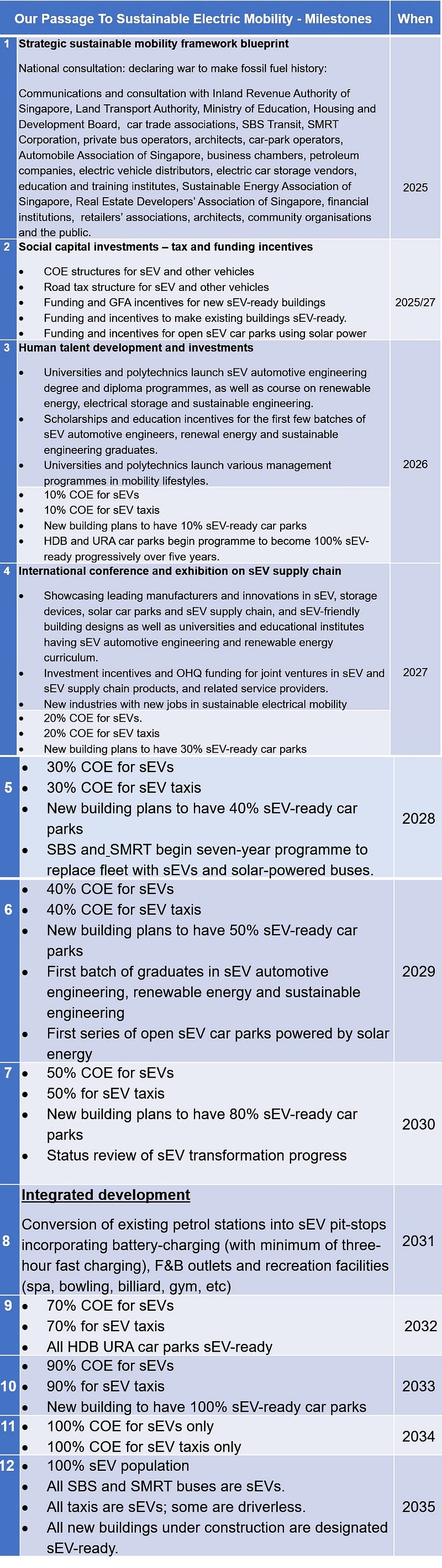
The illustration below chronicles the milestones of policy and measures during our passage to achieve sustainable electric mobility.
They tell the story of an exceptionally resourceful nation, led by visionary leadership at every level, embarking on an ambitious plan to make fossil fuel history through the 100% transformation of its fossil fuel vehicular traffic to electric vehicles powered by natural renewable energy. In the end, the sEV becomes more than just a mode of transportation to usher an era of rich electric mobility lifestyle for our sustainable future.
This Article was first published in the SG50 Book “Beyond 50 — Re-Imagining Singapore”, conceived and edited by Joachim Sim. Click HERE to download.
Please enjoy my recent Articles.
You can also subscribe to my stories and social media posts via your email.
Enjoy more interesting Articles by signing up to Medium here: https://thefuturistoracle.medium.com/membership