
Singapore the Green
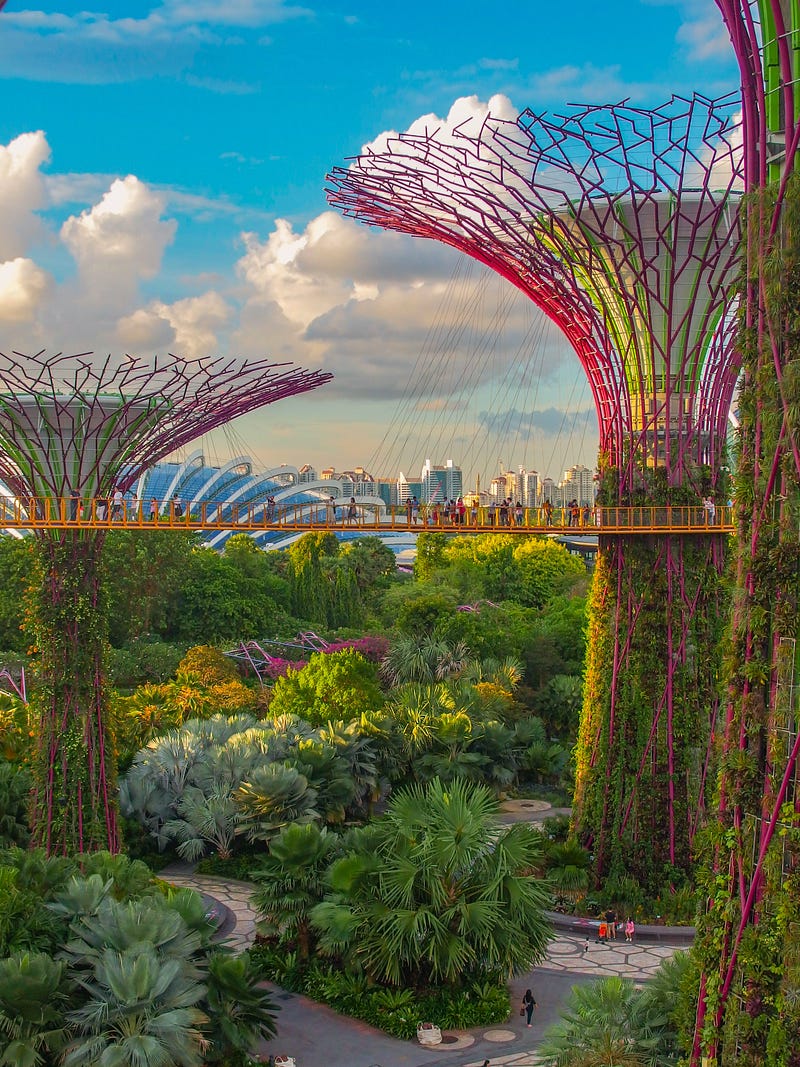
Singapore is a country-city located in the Malays Peninsula in Southeast Asia. It is composed of 63 islands, has a land area of 700 km2 and a population of 4.4 million. Singaporean climate is a tropical rainforest climate with constant temperature, high humidity and high rainfall. The landscape is mainly urban with residential and commercial structures. More than 50% of the area is covered by urban structure. The remaining 2000 ha of remaining forests are protected as reserves. In the centre of the city-state, wetland forests are delineated as the Central Catchment Reserve (CCR) and the Bukit Timah catchment reserve.
Windsor Park and a nature in transition
Windsor park belongs to the CCR and share its high tree species diversity. There are over 500 different species of trees in the CCR. Before the 1980s, Windsor Park was inhabited by farmers who later were evicted by the government. The ruins of the former farms and some broken cooking utensils are still noticeable along the trail. Once these people left the area, the forest came back and outgrew the few crops left by the farmers. These fruit orchards, gardens and rubber plantations are still visible today as palm oil, mango, durian… Today the forest has not completely recovered and is still considered as a secondary forest.
A secondary forest is defined as the tree regrowth after disturbance, its main features are short-lived pioneer plant species which reproduce quickly and tolerate a wide range of conditions. Such forests have a sparse, low and even canopy, trees are usually of similar size, and species diversity is lower.
The opposite of a secondary forest is the primary forest. A primary forest has to be undisturbed for a long time so it can develop a higher species diversity with a more complex structure.
The regeneration process the forest goes through to move from a secondary state to a primary state is called ecological succession. This process can occur at large scale like after a fire but also at a small scale when a tree falls for instance. Typically, an open gap in the canopy is colonised by light-demanding fast growing pioneer plants which are later replaced by slow growing, larger and long-lived primary forest species like dipterocarps. Dipterocarps are a family of 500 species which dominate the Southeast Asian tropical forests. They are identified by their regular, straight and parallel venation pattern as well as the two wings on their fruits which gave them their names (from the Greek diptero=two wings and carpo=fruit).
Biotic interactions in the forests
Around the few light holes left by fallen trees, pioneer trees are competing for the space and grow in direction of the light. Light is a scarce resource in a forest and the only opportunity for young seedlings to grow tall is to quickly colonize the hole once a tall tree died. To investigate the competition for light between two species of seedlings, one could log all the seedlings from species A and observe the growth of species B and vice versa. If the species A grows in the space where species B was, then it means that the two species were competing for light and space. This experiment would destroy the forest though.
Mutualistic interactions where two species benefit from each other, are not easy to notice. Rambutan fruits on the floor are an indice such mutual and positive relationship a tree can have with animals. The animal gets food from the fruits while the tree benefits from the movement of the animals which disperse their seedlings. It could be interesting to check which animals are eating rambutan fruits in the forest and whether they are highly mobile or not. Birds for example can disperse the seeds far away while mammals cannot. Another way to investigate seed dispersion is to collect animal’s faeces, preferably from one selected species, and cultivate them. After few weeks, seedling will grow out of the faeces. This experiment can show which seeds are still viable after going through the digestive system of the chosen species. The dispersion of seeds is very important for plants to colonize new areas where young plants would not have to compete with their relatives.
Take home message
Forests are going slow process which are hardly detectable by human beings. Even if we do not see it, forests are living. It is probably for Singaporean to have a glimpse of this living scene that the city of Singapore has kept this much national parks. It is important to keep the connection people have with Nature and remind them of its value.