
Sinéad O’Connor Did Not Go Quietly
Nor should we.
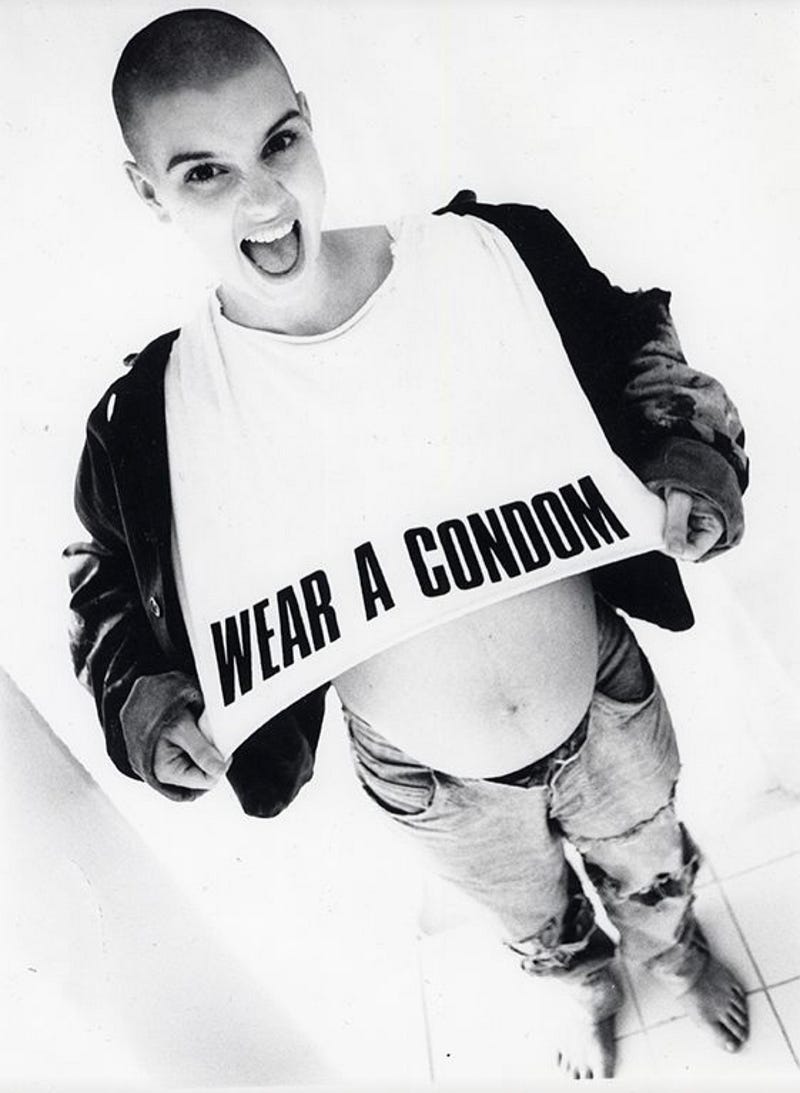
I wanted to write something about Sinéad O’Connor later today, but felt I was at a loss for words. As I pause and turn that last sentence over in my mind, I realize I am not bereft of words but, perhaps, overly burdened by them. I shall attempt to explain further here.
I am sad, certainly. I am not gutted by her death, or devastated, but rather quietly certain that she lived a lot longer than many in her inner circle likely thought possible. One of her children died by suicide just last year. She wrote that she was lost without him. I believe she told the truth. I also believe it is folly to neatly tie one person’s death to another’s suicide, to say things like, “Now she is with him, where she wanted to be” or “She would have gone on if not for that loss.”
Hers was not an easy life, and there are a thousand reasons we may have lost her earlier than we did. That she lived to 56 is a testament to her ferocity and a willingness to fight on.
By her own admission, I do not imagine she always was an easy person to live with, or to love, and in this way I suppose many of us can likely see a bit of ourselves or our own family members in her, though we did not know her.
I do not know all of her music, though I certainly enjoyed much of it. This is not an elegy by a music fan, but by a faraway observer, a listener and, at times, a great admirer.
She helped save lives and she gave people hope. Our heroes are not always or often angels, though she happened to be born with the face of one.
How confused people were when confronted by her rage. How shocked and betrayed they felt when this porcelain doll with Precious Moments eyes opened her mouth to scream at the injustice of the monsters who raped and humiliated the people of her own country, and of so many other countries.
Why is she so angry? She’s so pretty. She’s so beautiful. Why did she do that to her hair? She could be a model. She could sell perfume, or clothes, or more records. She’s rich now, isn’t she? She must be. Why is she still so mad? She’s mental. She’s selfish. She could do so much more good if she were just nicer.
I cannot imagine the bravery it took to do what she did earlier than so many others: speak out against the Catholic Church’s horrific legacy of massive childhood sexual abuse. It is the world’s oldest, largest and most successful continually operating for-profit international corporation, and its primary concern is to hurt people in a myriad of ways while dressing that hurt up in ritual, incense, stained glass and solemn tones, all in the service of making money.
Don’t believe me? Look at the real estate. No modern tycoon could ever be so successful. Look at the art, the jewels, the palaces called “cathedrals.” Look at how your grandmother still gives them money, still, and thinks “it goes to the poor.” Look at how they say, “This Pope is the best one yet. He lives in a humble apartment.”
Every successful cult needs a CEO who understands the value of public relations.
Sinead O’Connor never avoided a chance to discuss how that corporation has done endless damage in the countries in which it operates. Colonialism, war, trauma, racism, greed, homophobia, transphobia — these elements are its legacy, no matter how nice your Jesuit priest was at your very nice private liberal arts college; no matter how sweet the nun at your elementary school who served as the kindly contrast to your cruel mother; no matter how lovely the outreach program where you may have volunteered to help migrant workers, as I myself did one summer in college, long after I should’ve left any aspect of the Church of my childhood behind.
There are better ways to help people, better organizations to join, better methods of providing love and care.
I am angry, and she was angry, and so many of you are angry, and we should be. We are meant to be. We are not meant to act as if it only happened over there, or over there, or over there, or that once the movie came out that talked about it — or that other movie, or that other one — it was okay.
It is not okay.
We who were raised in the Church and we who suffered for its sins, who carry a legacy of shame and worry and addiction and horror about the most fundamental and beautiful aspect of our human lives — we all owe Sinéad O’Connor a great debt. She was not the only one who stood up, but she did it earlier and louder than many.
Her personal and private legacy is, I’m sure, as complex as any of a parent who suffered greatly from mental illness. Her public legacy is clear: beyond the music, she left an example of how to fight back, and how, for a time, to endure.
She told them all to fuck off.
May they all fuck off. May we all keep our dollars out of their dens of sin and abuse. May they never know peace.
May her legacy be that we all yell back oftener and with more gusto, that we get bigger and scarier and even less compliant, that we should make life quieter and safer for the children who come after we are gone.
Some angels are awfully loud. I hope she’s making a ruckus up there, with a devilish smile on that heavenly face.
***********************
This essay was originally published on Substack.
Thank you for reading. Please support my work by buying a Medium subscription through my link or by joining Patreon. Patrons get a private podcast, THE AUDIO LETTER, four times a month, plus other perks. You can also subscribe to my Substack, where I publish a weekly newsletter called SARATONIN. Finally, if you’re interested in working with me, check out my website for more info.


