
Simultaneous Invention: Why You Shouldn’t Wait to Create
In a sentence, simultaneous invention is why you shouldn’t wait to create.
When I was in college, I was collecting notes for a book that I wanted to write. The book would be about human evolution, and how evolution has led to some of the most remarkable and seemingly impossible feats that human beings have achieved. The book would be about the evolution of human potential. The working title for the book was (Super)Human: The Evolution of Human Potential.
A couple months after graduation, I found myself in a bookstore in Boulder, Colorado. I was browsing the science section, as I tend to do, and a book caught my eye: Superhuman: Life at the Extremes of Our Capacity by Rowan Hooper. I picked it up and flipped through it. My jaw was on the floor. This was the book that I planned on writing.
While I was off daydreaming about the book that I would get around to writing someday, someone else wrote it. (Though, to be honest, I think Hooper did the subject far more justice than I could have at the time. The man is a seasoned science journalist with a PhD in evolutionary biology. I was an aspiring writer with a Bachelor’s degree. But I digress.)
This story comes up in conversation every now and then, and when I tell it, somebody inevitably shares their own, very similar experience. The book they wanted to write, that someone else wrote. The business they wanted to start, that someone else started. The documentary they wanted to make, that someone else made. My sister once told me with a straight face that the ShamWow guy (Vince Offer) stole her idea.
This is an age old story, it turns out.
On January 7, 1839, Louis-Jacques-Mandé Daguerre shocked the world when he announced the invention of photography. He revealed his photographs, the first photographs anyone had ever seen at that point in history, to members of the French Académie des Sciences, and regaled them with tales of his experimentation.
For nearly a decade, Daguerre had been trying to capture images seen through the lens of his “camera obscura.” The thing looked like nothing more than a little wooden box on a tripod. It had a lens on one end, through which light traveled and projected an image onto a sheet of frosted glass on the inner wall at the other end of the camera. Daguerre, along with his partner, Nicéphore Niépce, devised a technique of capturing the images and developing them in fumes of mercury. Then they fixed the images on a silver-plated sheet of copper with a solution of sodium-thiosulfate. Daguerre called his photographs, perhaps a little immodestly, “Daguerreotypes.”
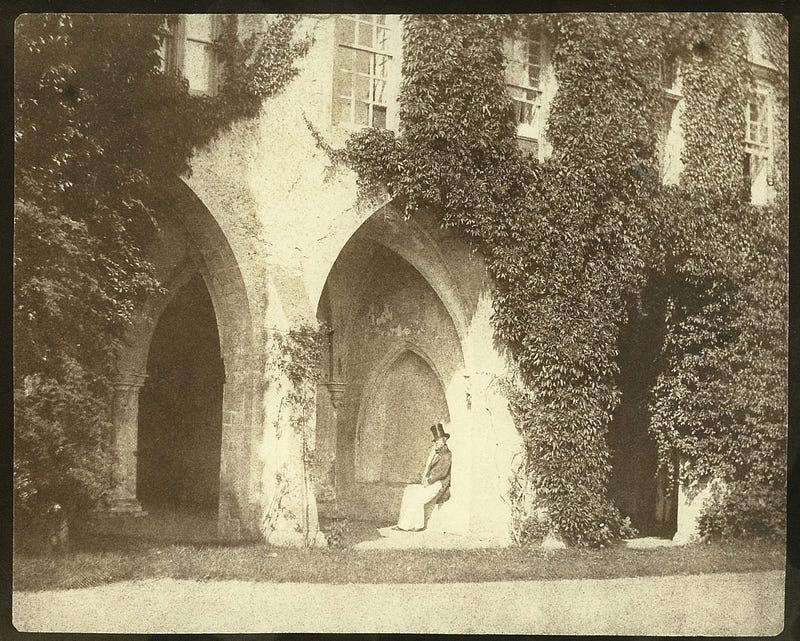
Just weeks after Daguerre’s announcement, a British polymath and self-described “gentleman of science” named William Henry Fox Talbot stepped forward and said that, for years, he too had been working on a method of capturing images “drawn by light.” His technique was a little different. He captured his images not on a silver-plated sheet of copper, but on a sheet of writing paper veneered with salt and silver nitrate. Where light passed through the lens of his camera and onto this piece of photogenic paper, the paper darkened. Today, photographers call such images “negatives.” Mostly, Talbot took photos of landscapes and plant specimens. He called his method the “art of photogenic drawing.” He called his photographs “calotypes.”
Daguerreotypes were unique, one-of-a-kind images. They couldn’t be replicated or reproduced. Calotypes, on the other hand, were reproducible. With time, Talbot’s art of photogenic drawing went on to become photography. Calotypes became photographs. It was William Henry Fox Talbot’s technique that laid the groundwork for modern photography. Daguerre’s invention became a footnote in history.
My point in telling this story is this: Two men in two different countries invented photography at the same time, completely independent of one another.
This phenomenon is known as “simultaneous invention.” The sociologist Robert Merton called it “multiple discovery.” And multiple discovery, Merton argued, is the “dominant pattern” in science. “All scientific discoveries,” Merton claimed, “are in principle multiples.”
You don’t need to look far to find examples that back Merton’s argument up. Daguerre and Talbot simultaneously invented photography. Charles Darwin and Alfred Russel Wallace developed the Theory of Evolution at the same time, in the same country, without drawing inspiration from one another’s work. Issac Newton and Gottfried Wilhelm Leibniz both invented calculus. (Or perhaps they both discovered calculus. Is mathematics invented or discovered? That’s an ongoing debate among mathematicians which I won’t get into here.) Joseph Preistley discovered oxygen in 1774, and unbeknownst to him, Carl Wilhelm Scheele had discovered the molecule the year prior, in 1773.
How exactly simultaneous invention works remains somewhat mysterious. The social psychologist Dean Simonton reviewed hundreds of cases of simultaneous invention, and proposed three potential explanations. One was genius. Great minds think alike, so the saying goes. Another was chance, dumb luck, sheer coincidence. The third was zeitgeist. This explanation — zeitgeist — has a Juangian flavor to it. Sometimes, some argue, the time comes when the world is just “ready” for a given idea. There’s a problem that needs to be solved, and the solution seems to emerge in the collective unconscious of human beings living in a given time and place.
Whatever the explanation may be, the truth remains: no matter how radical and revolutionary your idea may be, someone out there might have the same idea that you have, and they might be acting on it. They might be bringing some version of that idea into the world as we speak. It’s true of science, and it’s true of art as well.
“If you have an idea you’re excited about and you don’t bring it to life,” Rick Rubin wrote in his book, The Creative Act: A Way of Being, “it’s not uncommon for the idea to find its voice through another maker. This isn’t because the other artist stole your idea, but because the idea’s time has come.”
Simultaneous invention, as strange as it may seem, is very much a real thing. The existence of this phenomenon, and my first-hand experience of it, taught me two important lessons about creativity:
- If you’re going to create, create something unique; create something that only you can create.
- When you have an idea for a creative project that excites you, get to work on it as soon as possible. You never know when someone else might beat you to it.
In a sentence, simultaneous invention is why you shouldn’t wait to create.


