
Simplify Your Life By Asking Better Questions
“If the truth was complicated, everyone would understand it.” Walt Whitman

Tim Ferriss is a highly successful author, podcaster, entrepreneur and investor. He has written five #1 New York Times bestselling books, and the success of his podcast, which recently exceeded to over 300 million downloads, has seen him named “the Oprah of audio” due to its influence.
In 2017, however, as he turned 40, several of his close friends died in quick succession. It was a harsh reminder that time is a non-renewable resource, and life’s big questions started bubbling to the surface.
“Were my goals my own, or simply what I thought I should want?”
“How much of life have I missed through underplanning or overplanning?”
“How can I be kinder to myself?”
Overwhelmed by the gravity of his personal interrogation, he asked himself one more question…
“What would this look like if it were easy?”
By journaling on this question, one idea jumped out from the page…
“What if I had a tribe of mentors to help me answer these questions?”
What followed was his most recent book Tribe of Mentors, where Tim reached out to his dream list of interviewees and asked them the very questions he was struggling with himself.
The result of this book is a deconstruction of the tools, routines and tactics from 130 of the world’s top performers. This book is a masterpiece on the secrets of success and happiness. If life is getting you down right now, the chances are you will find a solution in there.
Information Overload
When I sat down to write this article over a month ago, I wanted to tell readers about a tool I came across from that very book. It’s a journaling technique I use when life gets busy.
I wanted the introduction to shine, so I began writing about fancy concepts such as cognitive biases, memory capacity, decision-making, information overload, and even neuroscience.
The words were spewing out of me…
I was on a roll…
It was going to be brilliant.
I excitedly read back over it when I finished. To say it was not good is an understatement. It was crap. When I read back over it, I couldn’t figure out what was wrong. It was a complicated mess, and it was giving me a headache.
Then it hit me…
I was struggling to implement the very technique I was writing about. I was overloaded with information and trying to solve the problem in my head.
But solving complex problems doesn’t work like that. If you want to get answers, you need a technique. And if you want to get to the heart of something, you need to get specific.
Reflective Writing
“Our life is frittered away by detail. Simplify, simplify.” — Henry David Thoreau
A powerful tool for getting to the core of a problem is reflective writing. You simply put a heading at the top of the page and write anything that comes to mind. It is very important that you give yourself time, a minimum of 10–15 mins. Then just let it flow.
Don’t worry if it doesn’t make sense at first. The idea is to create links that might connect to something you’re missing.
Now here’s the critical piece…
You need to use specific questions.
If you’re trying to push a project forward, and you write ‘project goals’ at the top of the page, that’s far too vague.
Use something specific: “What can I subtract from the current project that will help me to accomplish things quicker?”
Subtractions work great and specific questions provide cues to get to the heart of an issue.
I once used this method to make an important career choice. I wasn’t sure whether I should focus on my new self-development business, or continue with my studies.
So I asked myself two questions:
“What is it about research that makes me come alive?”
“Why do I want to pursue my business so quickly?”
Notice the specificity of the words in bold. This is what guided my answers.
I won’t go into the details, but I found that both options were interconnected. It made sense to do both, so I did. More importantly, however, I made an informed decision, and my mind was clear.
Thinking Clearly
I also use this method to clarify my thinking and track my life progress.
Here are five questions I ask myself on a regular basis:
“What excites you, what are you passionate about?”
“What new things are you learning right now?”
“What have you done in the last two weeks that is potentially a waste of time?”
“What is your number one goal? Where do you want to go in life?”
“Have you failed at anything recently, are you pushing hard enough?”
I had a remarkable insight when I first used this method, which is why I hold it so dear. Three years ago, I asked myself the first question: “What excites you, what are you passionate about?”
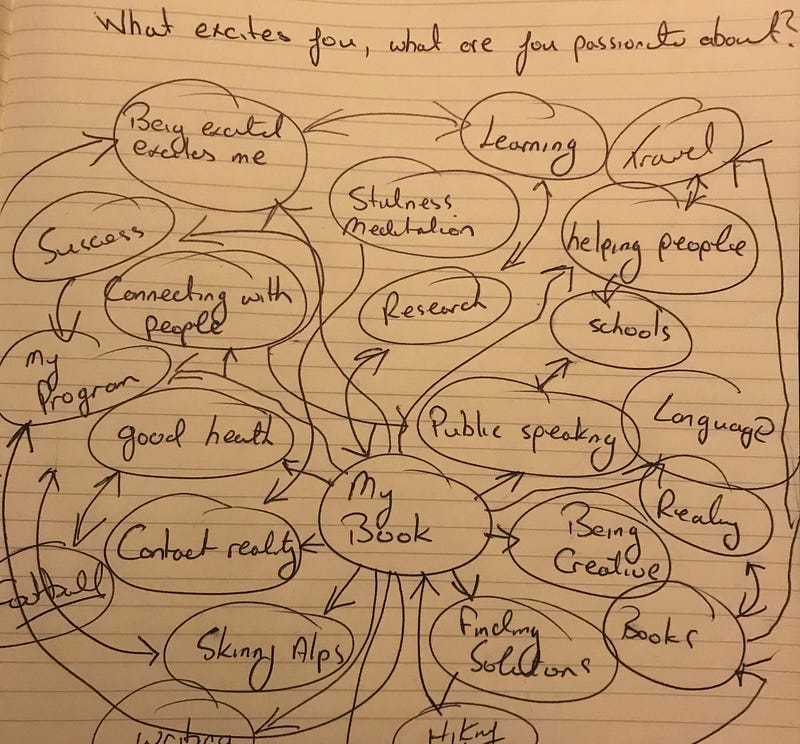
I scribbled down anything that excited me… meditation, language, mental health, helping people, skiing, making connections, public speaking, research.
But there was something missing, something big.
I sat with it for a while, scribbled some more, sat with it for a while, and scribbled some more. Then it came to me. I was shocked.
I had forgotten my passion.
For the previous three years, I couldn’t shut up about a book I wanted to write. But the busyness of life had clouded my mind. I had not thought about it for months. I’m not saying that it was gone forever, but if I had forgotten something that important, what else might I be missing?
What’s more, when I wrote the words ‘my book’ on the page, it was connected to everything else I was passionate about. Writing is now my greatest passion and the focus of my future career.
And I have just finished my first book that will be released in spring 2020.
Would this be the case if I had never used this tool? I’ll never know for sure.
All You Need To Know
Modern life is frantic. There are so many moving parts. If you want to get to the heart of something, there is nothing better than sitting down with a pen and paper.
But if you want to go deep, it’s all about the questions. Vague questions give you vague answers, so you need to get specific. This is the power of reflective writing. You’ll also be able to think, talk, and express yourself better.
Henry Ford was right: “Whether you think you can or you think you can’t, you’re right.”
So maybe it’s time to get specific and find out what that is.
What would you do if you had a second chance at life?
Having escaped from the depths of heroin addiction, I decided to devour every second of it. Then I decided to write a book about it. Bonus Time: A true story of surviving the worst and discovering the magic of every moment. You can pre-book here.


