
Similarities & Differences Between API and Microservices Explained
API vs Microservices: Two Key Ingredients of Modern Software Development

Application Programming Interface (or API) and Microservices are two concepts that are commonly used in software development. While both are used to provide a way for different software components to communicate with each other, they serve different purposes. In this article, we will explore the similarities and differences between API and Microservices in detail, and provide examples to help you better understand these concepts.
TLDR; Don’t have time to read? Here’s a video to help you understand the Similarities & Differences Between Microservices and API in detail.
What is an API?
API is an abbreviation for Application Programming Interface. An API is a set of protocols, routines, and tools for building software applications. It defines how different software components should interact with each other. An API provides a way for developers to access the functionality of another system without having to know the details of how that system works. APIs can be internal, which means they are used within a single organization, or external, which means they are exposed to the public.
APIs are commonly used to integrate different systems, to provide access to data, and to enable third-party developers to build applications that interact with a service. For example, the Twitter API provides a way for developers to build applications that can post tweets, read tweets, and access other Twitter data. The Google Maps API provides a way for developers to embed maps and location data into their applications.
APIs can be classified into two types: RESTful and non-RESTful. RESTful APIs are based on the principles of Representational State Transfer (REST) architecture. They use HTTP requests to POST, GET, PUT, and DELETE data. RESTful APIs are the most common type of API used today.
What are Microservices?
Microservices are a software development approach that focuses on building applications as a set of small, independent services that communicate with each other through APIs. Each service is designed to do one thing well and can be developed, deployed, and scaled independently. Microservices are typically deployed using containerization technologies such as Docker or Kubernetes.
Microservices architecture has gained popularity in recent years because it provides several benefits over traditional monolithic architectures. Microservices are more scalable, reliable, and maintainable than monolithic applications. They are easier to deploy, and changes to one service do not affect other services.
Microservices can be classified into two types: synchronous and asynchronous. Synchronous microservices communicate with each other in real-time, while asynchronous microservices communicate with each other using messages or events.
Difference Between API and Microservices
APIs and Microservices also have several differences. Some of these differences are:
1. Purpose
The purpose of APIs is to provide a way for developers to access the functionality of another system without having to know the details of how that system works. The purpose of Microservices is to build applications as a set of small, independent services that communicate with each other through APIs.
2. Size
APIs are typically smaller than Microservices. APIs are designed to provide access to a specific set of functionality, while Microservices are designed to do one thing well.
3. Complexity
APIs are less complex than Microservices. APIs are often simple endpoints that provide a way to retrieve or manipulate data. Microservices, on the other hand, can be complex and require additional infrastructure and tooling to manage.
4. Deployment
APIs can be deployed as part of a monolithic application or as a separate service. Microservices, on the other hand, are always deployed as separate services that communicate with each other through APIs.
5. Dependency
APIs can be dependent on a single monolithic application, while Microservices are not dependent on a single application. Microservices can be developed and deployed independently, which means that they can be updated or replaced without affecting other services.
6. Integration
APIs are commonly used for integration purposes, while Microservices are commonly used to build complex, distributed systems.
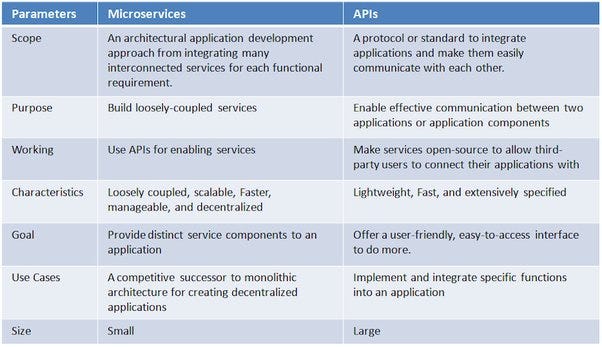
Despite these differences, microservices and APIs are often used together. Always remember, in a microservices-based application, each service typically communicates with other services through APIs, allowing the different services to exchange data and functionality as needed.
Similarities Between Microservices and API
APIs and Microservices have several similarities. Some of these similarities are:
1. Both use APIs
APIs are a fundamental component of both APIs and Microservices. APIs provide a way for different software components to communicate with each other.
2. Both provide a way to build scalable and maintainable systems
APIs and Microservices are designed to build scalable and maintainable systems. APIs provide a way for developers to access the functionality of another system, while Microservices provide a way to build applications as a set of small, independent services that can be scaled and maintained independently.
3. Both are used to build distributed systems
APIs and Microservices are used to build distributed systems. Distributed systems are systems that are made up of multiple components that communicate with each other over a network.
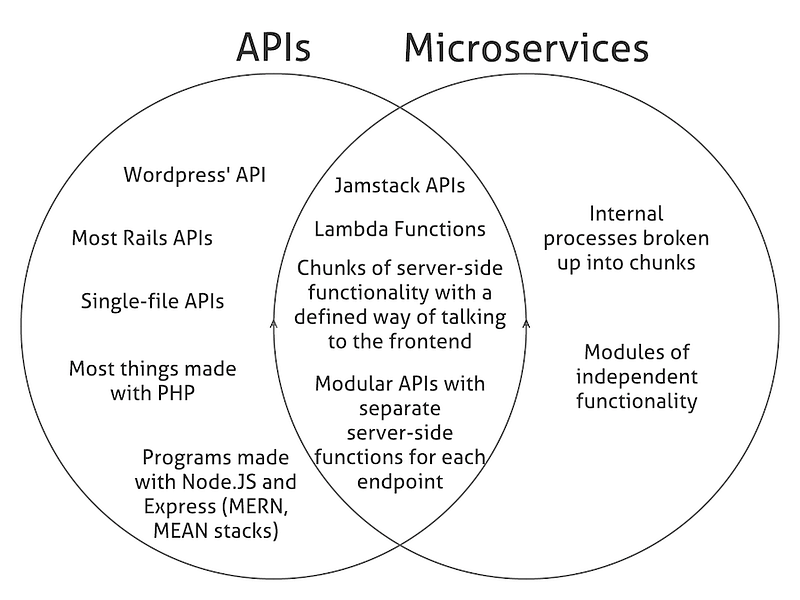
By breaking down a large, monolithic application into smaller, self-contained services (as is done with microservices), it becomes easier to modify and extend the functionality of the application without affecting the entire system.
Similarly, by enabling communication between different systems or services through APIs, it becomes easier to integrate those systems or services and build more complex applications.
Despite these similarities, it’s important to note that microservices and APIs are not the same thing. We should account for the fact that microservices are a software architectural style, while APIs are a way for different systems or services to communicate with each other.
However, microservices and APIs are often used together in the industry, with each microservice communicating with other services through APIs.
Examples of APIs and Microservices
To better understand the similarities and differences between APIs and Microservices, let’s look at some examples.
Example 1: Twitter API and Microservices
The Twitter API provides a way for developers to build applications that interact with the Twitter service. The API provides endpoints for retrieving tweets, posting tweets, and accessing other Twitter data. The Twitter API is an example of an external API, which means that it is exposed to the public.

Microservices, on the other hand, are used to build applications as a set of small, independent services that communicate with each other through APIs. Twitter itself could be built using a Microservices architecture, where each service provides a specific set of functionality such as handling user authentication, managing timelines, and posting tweets.
Example 2: Amazon Web Services (AWS) API and Microservices
Amazon Web Services (AWS) provides a wide range of APIs that provide access to its cloud infrastructure. The AWS APIs include endpoints for managing virtual machines, storing data, and processing data. These APIs are an example of internal APIs, which means that they are used within a single organization.

AWS itself is built using a Microservices architecture. Each service provides a specific set of functionality such as handling user authentication, managing virtual machines, and storing data. These services communicate with each other through APIs.
Conclusion
In conclusion, APIs and Microservices are both essential components of modern software development. APIs provide a way for different software components to communicate with each other, while Microservices provide a way to build applications as a set of small, independent services that can be developed, deployed, and scaled independently.
Microservices are a software architectural style that structures an application as a collection of small, independent services, while APIs are a way for different systems or services to communicate with each other.
APIs and Microservices have similarities in terms of their use of APIs, their focus on building scalable and maintainable systems, and their use in building distributed systems. However, they differ in terms of their purpose, size, complexity, deployment, dependency, and integration.
Understanding the similarities and differences between APIs and Microservices is essential for software developers to build efficient and scalable systems. By using the right architecture and tools, developers can build applications that are easy to maintain, scale, and update.
You may also like,