Silicon Valley Bank: Another Bailout — Can We Finally Stop Using the Term “Free Market?”
While we’re at it let’s eliminate: entitlements, handouts, democracy vs. authoritarian framing, and more
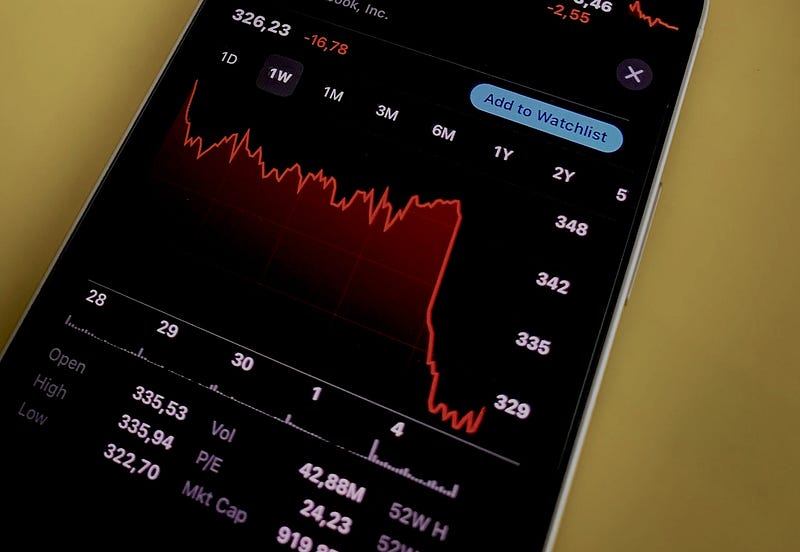
The Western financial system is once again on shaky footing as the US saw two large bank meltdowns — one the second-largest behind only Lehman Brothers — in incredibly short succession last week. The collapses of Silicon Valley Bank and Signature Bank have rightfully gotten a ton of attention. Because much of the chaos occurred on a Friday, markets closed, and nobody was sure how they would react once reopened the following Monday morning.
The panic and suspense went way beyond either bank’s depositors with many predicting a full-blown economic meltdown and lines of customers wanting to withdraw deposits from banks across the nation if the government didn’t get involved.
Two relatively large financial institutions tanking in a matter of days doesn’t exactly give confidence in a nation’s banking system.
It doesn’t exude economic stability either.
Details are still emerging and a lot is being written about exactly why Silicon Valley Bank went belly up with deregulation — a lot due to its own lobbying, a lack of oversight, higher interest rates from the Fed, losses on a huge number of bonds, and the evaporation of customer confidence all apparently playing a role.
Or, as many GOP members of Congress are claiming, it was “wokeness” — I can’t wait for the freaking Jordan Peterson tweet.
Whatever the root causes, the trusted US government stepped up to the plate in a matter of hours to guarantee all depositors would be made whole. Importantly, even those above the $250,000 FDIC threshold would be protected, which was apparently around 90% of the SVB depositors.
The Federal Reserve, Treasury Secretary Janet Yellen, and the White House were all quick to reassure the globe that Uncle Sam was taking care of it, and there’s no shaky-ass financialized neoliberal house of cards economy to look at here.
Of course, in one sense, the bank’s customers didn’t necessarily create the problem. They opened accounts and didn’t have control over how that bank leveraged those deposits and created a mess.
That being said, this was a bank in Silicon Valley that catered to startups and venture capital — aka pools of rich people’s money making ungodly sums of more money, and those are usually the very people calling for “less government” interference and lobbying for deregulation of all industries, including the financial industry.
Also, the reason around 90% of the bank’s deposits were way above the federally insured limit was apparently that the bank offered sweetheart deals like low-interest loans to customers who put larger portions of their deposits at the bank. So, rather than do the safe thing like using a number of financial institutions, keeping deposits under the 250k insured limit, and spreading out the risk, Silicon Valley Bank’s financially savvy customers put all of their eggs into one basket.
One has to assume they knowingly took that risk. Not that it matters anymore, because they’ll all be made whole with a bailout.
Although many are saying it won’t technically be a taxpayer-funded “bailout” like in 2008 because the Federal Deposit Insurance will cover the customer funds, and that fund is a pool into which all FDIC-insured banks contribute.
But if the government didn’t promise to backup all of the losses, that could have created a financial meltdown that taxpayers surely would have been on the hook for because, as David Sirota at The Lever pointed out, “the federal government’s Deposit Insurance Fund has a balance of just $128 billion against $9.9 TRILLION of insured bank deposits in the United States.”
So, it is not unreasonable for the federal government and the central bank to intervene, guarantee customer deposits, and calm the situation.
Nobody wants a repeat of 2008 or worse to occur.
Two relatively large financial institutions tanking in a matter of days doesn’t exactly give confidence in a nation’s banking system… It doesn’t exude economic stability either.
But this crisis revealed a dump truck worth of annoying hypocrisies, and who knows how this would have been handled had the customers been regular working people. One frustrating piece was the swiftness with which the government reacts to a crisis when it involves bankers while always feigning impotence when the emergency is affecting regular humans.
That double standard is glaringly obvious and proves, once more, that the federal government can do extraordinary things when it wants to.
An even more annoying piece is the Silicon Valley tech bro/free market fundamentalist VC “gurus” who pretend to be libertarians but scream for government assistance and “handouts” the moment they f*ck up.
Nathan J. Robinson at Current Affairs had a great piece on that very subject entitled, “Every Libertarian Becomes a Socialist The Moment The Free Market Screws Them.”
It is a sad truism at this point.
Or there’s Mark Cuban who asked “Where were the regulators?” That is a great question, but he’s also the type of tycoon who’s scorned regulation in the past. Venture capitalists, billionaires like Cuban, and banks like SVB or Signature fight against regulations that could prevent such a disaster.
There’s a reason a top 20 bank in America like SVB wasn’t subject to more rigorous oversight, and that reason is lobbying and removing post-Great Recession rules and regulations.
But it is always the same song and dance with these free-market libertarians.
The evil government is getting in the way of my business doing whatever the hell it wants like hiring children, dumping toxins in the environment, or over-leveraging on extremely risky derivatives — I mean, the evil government is getting the way of “growth and innovation.”
Then after they’ve successfully lobbied for next-to-no oversight and greedy psychos inevitably create a dumpster fire of an economic or environmental emergency, they get on Twitter and blame the evil government again for “letting this happen.”
Oh, and by the way, they need more bailout money from Washington.
As always, Larry Summers had the most annoying and hypocritical take saying, “This is not the time for moral hazard lectures or for lesson administering or for alarm about the political consequences of “bailouts”
This economist that American media consistently has on to argue against the government doing anything to help the people and calling for millions to lose their jobs was very quick to say the government needs to provide a safety net…to banks/customers who had more than $250k.
As many pointed out on Twitter, Larry Summer is always making “moral hazard” arguments when legislation might benefit citizens and had some ridiculous takes when the Biden Administration was debating student loan forgiveness.
Like most of these big wig laissez-faire loons, the thought was if the government forgave student loans, pesky students in the future would take out loans for education and expect them to be forgiven as well, hence, their “moral hazard” posturing.
But when it comes to banks, bankers, venture capitalists, and Wall Street, government handouts are whole-heartedly welcome and create no such “moral hazard.”
Meanwhile, these financial goons can take on as many risky over-leveraged gambles as they want. When they win, they reap all of the rewards and use the proceeds to purchase the political system.
When they lose, the taxpayers foot the bill.
But according to Larry, that isn’t a “moral hazard” nearly as egregious as students getting 20k of their education debt forgiven.
Those eighteen-year-olds who wanted to go to college and took out loans also assumed the risk of those loans, so he says they can eat it. If a bank dishes out billions in bad mortgages or VCs take the perks and put all of their money in one bank feel any pain from a shift in the market, the government should immediately and without question make them whole.
Unfortunately, Mr. Summers getting routinely ratioed on Twitter doesn’t affect his political influence in Washington. If it did, he’d be a crackpot living in a Florida retirement community who drunkenly shout spits at CNBC instead of being a regular contributor to the mainstream news.
But in general, it’s all a big joke.
Again, as Nathan Robinson said, “every libertarian becomes a socialist the moment the free market screws them.”
But to be clear, that’s not to say the government shouldn’t step in and stabilize this economic emergency. A greater financial catastrophe is right to be avoided.
But holy sh*t, the double standard is insane.
I’m increasingly thinking we need to retire the phrase “free market” completely.
It is a religion, and it’s a complete joke.
Everyone is taught to worship at the altar of the “invisible hand” when one could argue free markets don’t even exist.
Governments with their currencies create markets and the boundaries to those markets through regulation. They guarantee property rights and root out fraud. Those two concepts alone reveal an underlying force managing the market aka regulating it aka that’s that evil government again aka this market isn’t “free.”
Not to mention, once one of these tech bros or banking wizards starts getting out-competed by a foreign firm, then they need regulation against THAT company, subsidies for themselves, tax breaks, and truck-fulls of government assistance.
But they still somehow label themselves “free marketeers.”
I vote we just stop using that term.
There’s too much power in language.
Banks get bailouts; citizens get handouts.
Businesses get subsidies; we the people get entitlements.
Lobbying isn’t a thing; bribery is the word we need to be using.
Our votes are meaningless, public opinion has zero effect on legislation, whistleblowers are routinely jailed, and we’re being monitored 24/7 through our devices by an unaccountable opaque surveillance state that has never been audited, but we’re supposed to believe we live in a utopia of “freedom and democracy.”
Meanwhile, the moment a foreign nation doesn’t do exactly as Washington dictates, we’re led to believe it’s an authoritarian hellhole.
Let’s retire the “democracy vs. autocracy” framing and the word “regime” while we’re at it.
It’s all a joke.
Just like libertarians and free market fundamentalists angrily begging for government cash.
At least, they should first quit lobbying against regulation, vilifying that very institution back-stopping their entire business model, and pretending we live in a “free market.”