
Silenced — The Terrifying Experiences of Film Composers in their Industry
Tales from the shadows from ghostwriters, interns, and music assistants
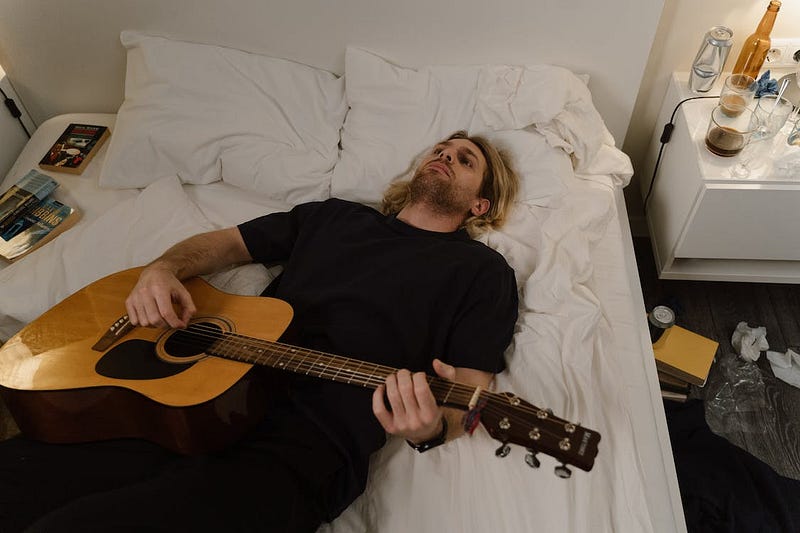
Music is a crucial part of films, but the magic often comes with a high price.
Unfortunately, the film-music industry has its fair share of stories that scream WTF?
Ghostwriters, interns, music assistants, every position comes with its set of bad experiences.
Let me share some stories from the industry and keep them anonymous to avoid any unnecessary trouble.
This normalcy must change.
Ghostwriters
They’re talented composers who are hired to help the main composer complete a film score.
But they work in anonymity.
You’ll never see their names credited in the final product. Sometimes there won’t be any paper trail showing they were part of the project.
Ghostwriters are typically paid between $10,000 and $20,000 upfront and they usually don’t get any royalties for their work. But sometimes they’re paid handsomely.
Many go through this practice to improve their skills and make money, although it can leave a scar on their souls. Many have reported being asked to work long hours without pay, being yelled at or insulted, and having their work changed or discarded without their consent, and some composers take the credit shamelessly.
You could at least say you did it with a team without further specifying it, no?
It could’ve been much easier if you had included your team
Here’s a story from a film composer. Things can get awkward pretty fast when the boss tries to get all the credit:
“[I] got to sit in the room once while a director was praising the fuck out of a cue I had written and shit all over the named composer’s work for the past couple of hours. I had the joy of watching him try to explain why he [composer] did certain things so well in his (my) cue and wasn’t nailing it for his others.
I did take a certain sense of pride watching the squirm after being told I could never tell anyone I worked on the gig. Even still I piped up and said those other ones were shit because I had messed up the midi massaging (or something like that, it was a few years back). After all, me falling on the sword hurts no one and I don’t mind being the team player.”
It’s noble of them to do that, but ghostwriters shouldn’t have to resort to this behavior in the first place.
Other bosses take it a step further. It’s both tragic and comic:
“I’ve been in that position. It was equal parts funny and sad. I was at an award show and someone that I had done additional music and mockups for went on stage to receive an award.
There was a showreel of their best work and all the music that was played was either from me or from their other ghostwriter that I knew (…) and that composer would stand there and give their thank you speech and not mention the team at all and go about their day.”
How can you fall so low that all you’re known for is someone else’s and you still don’t recognize their work?
You’ve put yourself there on your own
Bosses can go to great lengths to get their spotlight at the expense of their teammates.
“I remember being hidden away by a composer because the production of a movie frequently chose my cues over the credited composer’s cues. So they basically made sure that I was as invisible and unseen and unheard as possible so that they could basically walk into every screening and every meeting taking credit for my work.”
And this behavior can backfire rather quickly:
“I was at a scoring stage with 100% of the music that was gonna be recorded that day mine and I was sent on a coffee run [the client thought she was the intern]. For the composer to then sit there and not correct them that’s a very specific low (…).
There were later questions about the score and problems I could’ve solved very easily and then the composer would turn around and look at me like do something (…). I would just shrug, I’m just the intern. I don’t know what’s happening.”
If you treat your team badly, don’t expect them to be there for you when you need it the most.
You know it but your pride doesn’t allow you to say anything
When the boss creates such a high image of themselves, it’s difficult to change that attitude.
It becomes a vicious cycle. The boss gets praised for something they didn’t do but to continue delivering excellent cues, they have to get these people to do the work for them. Otherwise, the house of cards will fall in an instant.
“This composer was treated like the biggest VIP. He was flown around the world first class and put up in fancy hotels to be in the country of the production. They even set him up a studio. Bought all kinds of studio gear so he could work while on location.
This composer didn’t write a single note on that score. All the work was done by me here in L.A.(…). There were meetings that were absolutely funny. I would just be in there via Zoom or some Google program whatever and I would be just quietly sitting in the meetings so I could hear the notes, the revisions, and all that stuff. All the information that I need since I’m writing the score and this director [the client] turns around after a cue that I was particularly proud of, I knew this was a good cue, like one of the best ones I’ve ever written, and he [the client] turns around to that composer and says, well I like your previous score but this is hands down the best thing you’ve ever written. This is academy award worthy. Like it doesn’t even sound like you anymore (…).”
It’s a small win for the ghostwriter, but they can only enjoy it in the shadows.
Interns
Interns are usually young, aspiring composers who are eager to gain experience and connections in the field.
Those ambitious rookies hungry to please are the perfect victim to take advantage of.
Many end up doing menial tasks, such as making coffee, running errands, or doing administrative work. Some interns have even reported being asked to do personal tasks for the main composer, such as cleaning their house or walking their dog.
It’s not only unethical but also illegal. Interns are supposed to receive proper training and supervision, not be used as cheap labor.
Sadly, their goals get so easily crushed:
“I remember when my professors and fellow composers told me they thought it was a waste of time that I was creating a business plan for my film scoring career.”
Even the job postings for this position are disgraceful:
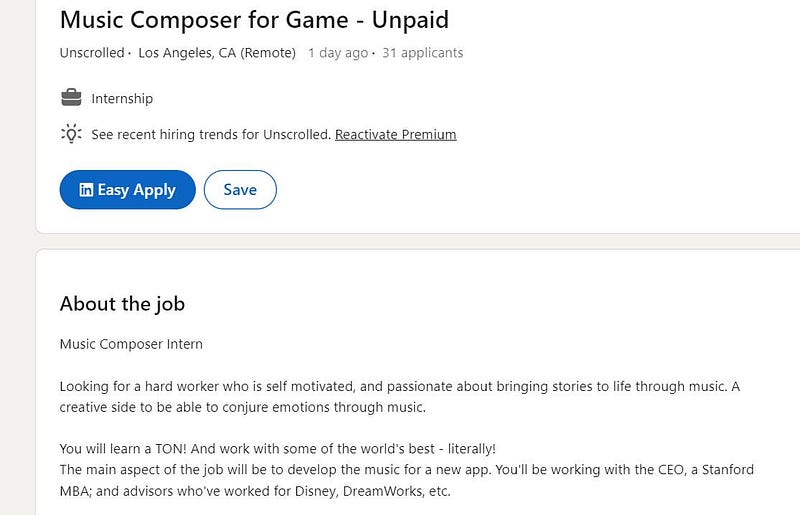
Can’t a Stanford MBA pay at least minimum wage?
And if it’s for the experience, how is this intern going to get the best learning experience if it’s a completely remote position?
Sadly, jobs like these are more the norm than the exception.
Music assistants
Music assistants are responsible for helping the main composer with tasks such as arranging, orchestrating, and editing music.
And it’s not uncommon to see them overworked, underpaid, or mistreated by their bosses. They may be asked to work long hours, including weekends and holidays, without proper compensation or recognition.
The game industry has frequent crunch sessions. It’s compulsory overtime practice in the gaming industry (usually with no additional $) where people work for 65 to 80 hours a week and can go on for extended periods.
This also happens with game composers:
“When I worked in the game studio people didn’t leave until 9 pm, like everyone, and some commonly came in during weekends while only being paid to 9 am to 6 pm on weekdays. At times I was in there until 3 am on Saturdays, to come back the following morning. Unpaid. It’s nothing to be proud of, (but sometimes it needs to be done).”
And even if you’re not in the gaming industry, just being a composer’s assistant can be highly demanding:
“One of my friends who ended up in the ER was assisting a composer for close to minimum wage, 90hs a week paid a salary, not per hour, and had no overtime, no health insurance, no benefits, not even provided food or parking, and this friend had to pay for their own medical bills”
This looks more like slavery to me.
A Guardian article about the film scoring industry, shows the sacrifices these assistants have to go through with little to no reward:
“One assistant who spent 10 years writing for a composer who gave him little or no credit said he felt angry every time he opened his royalty statements. “At one point during the pandemic, I was living off $60 a week,” he said. “One day I walked into my old boss’s fancy house and thought: ‘My labor paid for at least a third of this. What do I have to show for it?’
Another former assistant who feels similarly cheated after years of ghostwriting for an abusive boss was recently turned down to score a show for a major streaming service because he didn’t have enough credits to his name to convince the producers he could do the job.
He recalled how, as a freshly minted music graduate from the midwest, he’d hopped in his car and come straight to California because scoring films was all he had ever wanted to do. “Now I don’t know if I ever want to write music again,” he said. “I took no joy in it by the end. This industry sucked all the joy out of me.”
Takeaway
These stories aren’t just isolated incidents. They reflect a systemic problem of abuse, exploitation, and lack of respect for the contributions of talented professionals.
That’s why we need to promote transparency, fairness, and accountability in the industry. If these stories don’t get out, rookies will think it’s normal and enter into a vicious cycle already expecting it.
- Ghostwriters should be compensated fairly for their contributions and treated nicely. They’re doing the legwork their bosses will never credit!
- Interns should receive proper training and supervision, and should not be exploited for personal gain. They’re learning, give them a break!
- Assistants should be treated as valued members of the team, with fair compensation and opportunities for growth. Many composers would be completely lost without them.
Nobody gets where they are now entirely by themselves.
There’s always help along the way.
Composers should never forget this.
Check out these other articles:
If you enjoy reading stories like these and would like to support writers on Medium, consider signing up to become a Medium member. It’s just $5 a month and you’ll have unlimited access to articles from amazing writers all over the world.


