avatarPrasanna Srinath Subhasinghe

Free AI web copilot to create summaries, insights and extended knowledge, download it at here

3225

Abstract

rms, was married to King Dhatusena’s daughter and that he has physically abused and tortured her. In spiteful revenge, King Dhatusena in turn punished Migara’s mother, who happens to be his own sister. Did I not mention earlier that this tale is more twisted than the events in Game of Thrones?</p><p id="3232">Due to social rejection, usurper King Kashyapa built his kingdom away from the capital. Another reason for this relocation was the fear of his brother. It was no secret that most elite families supported the rightful heir, Prince Mugalan, who had escaped to India and was gathering troops for war against King Kashyapa.</p><p id="eee1">King Kashyapa chose a strategic location for his kingdom, a rock mountain called <a href="https://en.wikipedia.org/wiki/Sigiriya">Sigiriya</a>, situated outside the great city of <a href="https://en.wikipedia.org/wiki/Anuradhapura">Anuradhapura</a>. The fortress built on this mountain was perfect for his defensive security plan.</p><p id="f2b3">However, history tells us that his plan was not sufficient. Prince Mugalan surrounded Sigiriya with his Indian troops, and King Kashyapa ended his life with his own sword, ending his 22-year reign and leaving behind this majestic fortress for us to marvel at.</p><p id="88cb">I won’t bother you with the detailed features of this magnificent place, as there are <a href="https://medium.com/search?q=sigiriya">numerous articles</a> by talented writers, even on Medium. It suffices to know that Sigiriya is included in the list of places known as the world’s eighth wonder and was named a UNESCO world heritage site.</p><p id="753c">The gigantic lion paws, the intricate moat system surrounding the fortress for both aesthetic appeal and security, the natural air conditioning system, and the technology employed to pump water to the top of the rock are not the main focus of my discussion.</p><p id="9e0c">I will not even comment on the trending conspiracy theory that suggests Sigiriya was used as a transport hub to communicate with aliens.</p><figure id="23c8"><img src="https://cdn-images-1.readmedium.com/v2/resize:fit:800/1*H3FXOsF7FTgDpPW2COsK3w.jpeg"><figcaption>Sigiriya as an Alien Transport Hub — An AI-generated image by the Author using Bing Image Creator</figcaption></figure><p id="adee">I only intend to focus on two points. The first is the fresco paintings of Sigiriya, but not about their vibrant colors or resembling paintings at the <a href="https://en.wikipedia.org/wiki/Ajanta_Caves">Ajanta caves</a> in India.</p><p id="bd67">I want to highlight the change in our cultural perspectives. Sigiriya frescoes portray the upper bodies of women carrying flowers. It is commonly believed that they were maids from the royal palace visiting a nearby Buddhist temple in <a href="https://en.wikipedia.org/wiki/Pidurangala_Vihara">Pidurangala</a>.</p><figure id="ed05"><img src="https://cdn-images-1.readmedium.com/v2/resize:fit:800/1*k6HGv9T3sp2MkUw9uWFccw.jpeg"><figcaption>Frescoes — This<a href="https://en.wikipedia.org/wiki/File:Frescoes_at_Sigiriya_SriLanka_3.jpg"> Image is from Wikimedia </a>and is being used with the permission stated in the source page, for sharing and any other purposes subject to the stat

Options

ed conditions</figcaption></figure><p id="3e11">Although some argue that they represent Thunder and Rain Clouds due to the distinct gold and blue skin colors of the maids, personally, I prefer to identify them as royal maids.</p><p id="570a">The irony is that they are depicted as semi-nude. Today, visiting a temple in revealing attire, let alone with exposed upper bodies, is unimaginable. We have adopted a Victorian culture as our own, now considering it as a part of our 2500-year-old culture.</p><p id="00b9">I don’t intend to be radical or a naturalist. Still, it is amusing to witness some extreme groups embracing a borrowed culture as our own.</p><p id="6ebe">The next point I would like to discuss is one of my favorites because it involves my love for the Sinhala language.</p><p id="0e5c">Expressing oneself in poetic terms is often said to be the highest form of language. The graffiti on the Ketapath Pawura, or Mirror Wall, at Sigiriya provides examples of poetry that existed over 1300 years ago.</p><p id="4a5b">Those graffiti or poems were written by visitors who wanted to share their reviews regarding the beauty of Sigiriya, especially the Frescoes. These poems hold valuable significance in our culture, revealing numerous details about society and language usage during that time.</p><p id="8b9f">I would like to conclude my post with the literal translation of one of my favorite Sigiri graffiti.</p><blockquote id="9313"><p>“I am Budal. I visited this place with my relatives. I witnessed Sigiriya. Many people who witnessed it wrote poems about it, So I refrained.”</p></blockquote><p id="1902">Because in the same way, I can now say that many people who witnessed Sigiriya have written about it, so I refrained.</p><p id="1f3a">The history of Sigiriya is not a myth; it has been well-documented. It provides rich material for a fascinating tale that a creative writer can utilize. One of my favorite writers on Medium, <a href="undefined">Jack Finn</a>, did exactly that.</p><p id="673b">He has created a historically accurate masterpiece, skillfully weaving together the legends of Sigiriya and the Dutch era in Sri Lanka. Through his work, you can learn a great deal about our culture. I invite you to give it a try.</p><div id="dde7" class="link-block"> <a href="https://readmedium.com/the-heart-of-the-island-2056f837b3d0"> <div> <div> <h2>The Heart of the Island</h2> <div><h3>“We trample upon their ancient cities and loot their sacred treasures. We think there will be no accounting for that.”</h3></div> <div><p>medium.com</p></div> </div> <div> <div style="background-image: url(https://miro.readmedium.com/v2/resize:fit:320/1*[email protected])"></div> </div> </div> </a> </div><p id="d043">🔹<a href="https://medium.com/@spssubha/about">About Me</a> 🔹<a href="https://www.buymeacoffee.com/spsnath">Buy Me a Coffee</a> 🔹<a href="https://twitter.com/spsnath">Twitter</a> 🔹<a href="https://www.linkedin.com/in/spsnath/">Linkedin</a> 🔹<a href="https://me.dm/@spssubha">Mastodon</a></p></article></body>

Essay

Sigiriya — A Twisted Tale of the Usurper King and His Artistic Legacy

A perspective view of an ancient rock fortress called Lion Rock
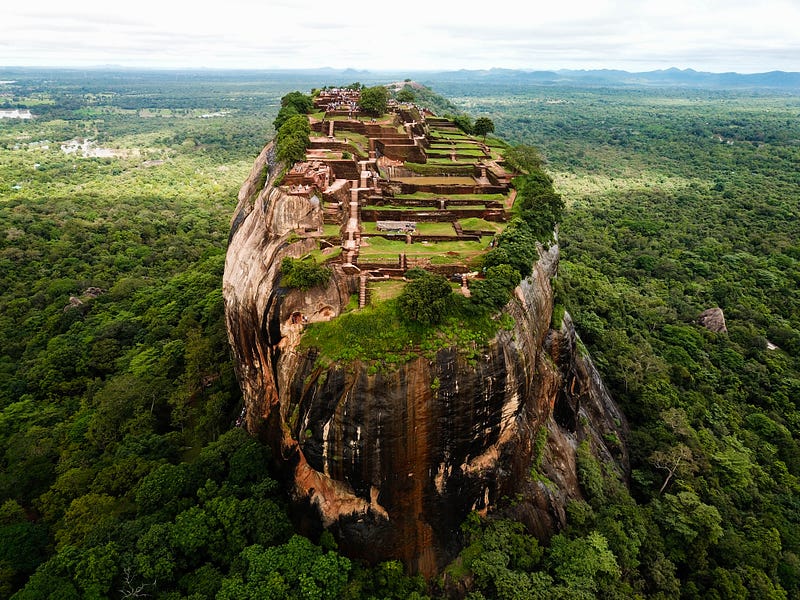
Sigiriya — Photo by Dylan Shaw on Unsplash

Having more than one wife or lover always brings trouble, regardless of your social status. The burden is tenfold if you are a king who united an entire country.

Read this article for free here. Use my referral link to enjoy unlimited access to Medium posts.

That was precisely what happened to the great King Dhatusena, who reunited Sri Lanka after ending a long reign of Dravidian rule. He had two wives and possibly more. However, we don’t need to consider the others for our story.

The queen consort gave birth to a boy, but one of his secondary wives already had given birth to another boy. The prince from the queen consort, Mugalan, was named the successor to the throne.

This decision did not sit well with the elder prince, Kashyapa, who was born from one of the secondary wives, even though he was named as the successor for Mugalan. Therefore, it marked a gruesome chapter in our history, resulting in a conflict that even shames the “Game of Thrones.”

There are several literary accounts describing this incident from various angles, so we can’t be sure who is guilty or not. However, everyone agrees on one thing: Prince Kashyapa revolted against his father and cemented him alive to the bund (river wall) of the great tank, Kalawewa. He became the King in 473 AD, precisely 1550 years ago.

What was King Dhatusena’s crime? When asked about his hidden wealth, the King was brave enough to show a handful of water from his engineering marvel, Kalawewa as his wealth, an incident historians love to talk about.

However, for Buddhists, committing patricide is strictly forbidden, leading to a near-eternal punishment in hell and societal rejection. King Kashyapa had to face these consequences, even though he was the King.

History suggests that his friend Migara played a role in influencing Prince Kashyapa negatively. Migara may have had valid reasons, considering that his mother was burned alive on the orders of King Dhatusena.

The story has it that Migara, who was also the King’s chief in arms, was married to King Dhatusena’s daughter and that he has physically abused and tortured her. In spiteful revenge, King Dhatusena in turn punished Migara’s mother, who happens to be his own sister. Did I not mention earlier that this tale is more twisted than the events in Game of Thrones?

Due to social rejection, usurper King Kashyapa built his kingdom away from the capital. Another reason for this relocation was the fear of his brother. It was no secret that most elite families supported the rightful heir, Prince Mugalan, who had escaped to India and was gathering troops for war against King Kashyapa.

King Kashyapa chose a strategic location for his kingdom, a rock mountain called Sigiriya, situated outside the great city of Anuradhapura. The fortress built on this mountain was perfect for his defensive security plan.

However, history tells us that his plan was not sufficient. Prince Mugalan surrounded Sigiriya with his Indian troops, and King Kashyapa ended his life with his own sword, ending his 22-year reign and leaving behind this majestic fortress for us to marvel at.

I won’t bother you with the detailed features of this magnificent place, as there are numerous articles by talented writers, even on Medium. It suffices to know that Sigiriya is included in the list of places known as the world’s eighth wonder and was named a UNESCO world heritage site.

The gigantic lion paws, the intricate moat system surrounding the fortress for both aesthetic appeal and security, the natural air conditioning system, and the technology employed to pump water to the top of the rock are not the main focus of my discussion.

I will not even comment on the trending conspiracy theory that suggests Sigiriya was used as a transport hub to communicate with aliens.
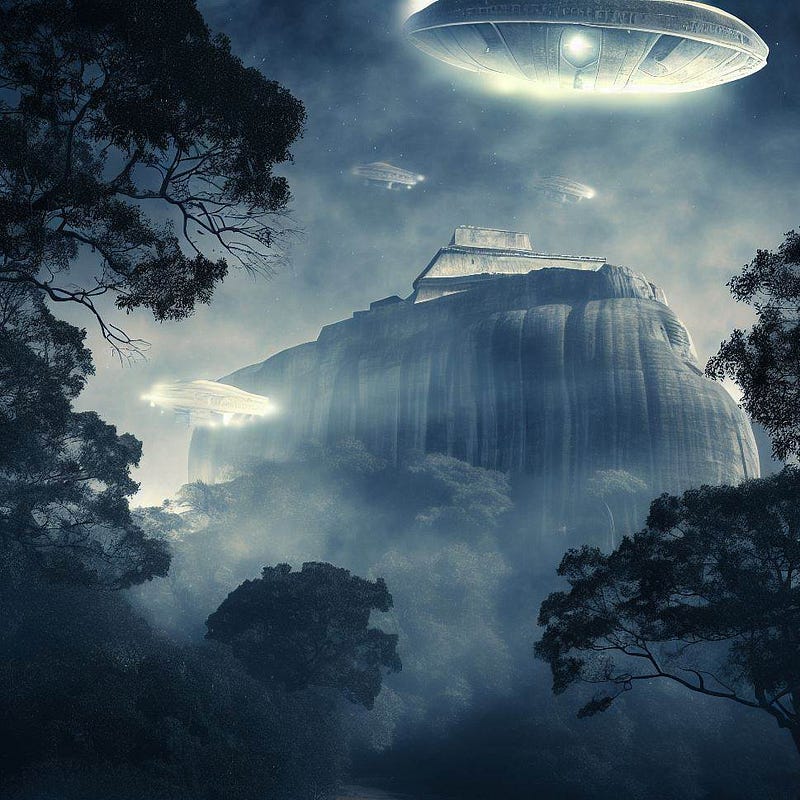
Sigiriya as an Alien Transport Hub — An AI-generated image by the Author using Bing Image Creator

I only intend to focus on two points. The first is the fresco paintings of Sigiriya, but not about their vibrant colors or resembling paintings at the Ajanta caves in India.

I want to highlight the change in our cultural perspectives. Sigiriya frescoes portray the upper bodies of women carrying flowers. It is commonly believed that they were maids from the royal palace visiting a nearby Buddhist temple in Pidurangala.
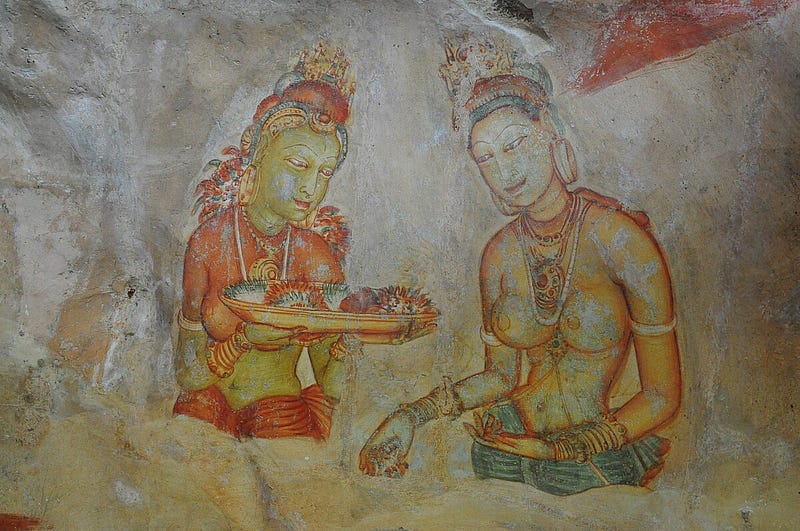
Frescoes — This Image is from Wikimedia and is being used with the permission stated in the source page, for sharing and any other purposes subject to the stated conditions

Although some argue that they represent Thunder and Rain Clouds due to the distinct gold and blue skin colors of the maids, personally, I prefer to identify them as royal maids.

The irony is that they are depicted as semi-nude. Today, visiting a temple in revealing attire, let alone with exposed upper bodies, is unimaginable. We have adopted a Victorian culture as our own, now considering it as a part of our 2500-year-old culture.

I don’t intend to be radical or a naturalist. Still, it is amusing to witness some extreme groups embracing a borrowed culture as our own.

The next point I would like to discuss is one of my favorites because it involves my love for the Sinhala language.

Expressing oneself in poetic terms is often said to be the highest form of language. The graffiti on the Ketapath Pawura, or Mirror Wall, at Sigiriya provides examples of poetry that existed over 1300 years ago.

Those graffiti or poems were written by visitors who wanted to share their reviews regarding the beauty of Sigiriya, especially the Frescoes. These poems hold valuable significance in our culture, revealing numerous details about society and language usage during that time.

I would like to conclude my post with the literal translation of one of my favorite Sigiri graffiti.

“I am Budal. I visited this place with my relatives. I witnessed Sigiriya. Many people who witnessed it wrote poems about it, So I refrained.”

Because in the same way, I can now say that many people who witnessed Sigiriya have written about it, so I refrained.

The history of Sigiriya is not a myth; it has been well-documented. It provides rich material for a fascinating tale that a creative writer can utilize. One of my favorite writers on Medium, Jack Finn, did exactly that.

He has created a historically accurate masterpiece, skillfully weaving together the legends of Sigiriya and the Dutch era in Sri Lanka. Through his work, you can learn a great deal about our culture. I invite you to give it a try.

🔹About Me 🔹Buy Me a Coffee 🔹Twitter 🔹Linkedin 🔹Mastodon

Essay
Sri Lanka
Culture
Sigiriya
The Howling Owl
Recommended from ReadMedium