
Shut The **** Up…Jason Voorhees Is Gay?!
No one escapes Camp Crystal Lake…especially if you’re queer
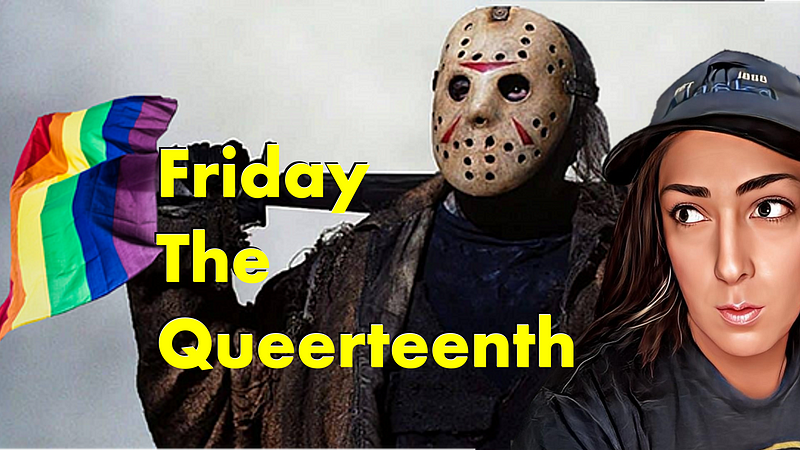
Repeat after me: sex wasn’t the problem
Jason Voorhees, iconic villain from the Friday the 13th series, is gay. If it was a slow news day, I’d bury the lede, but it’s Halloween, and there are about eight million articles published about the Friday the 13th series.
So yes, Jason is gay, and I’m giving that tidbit away for free because the fact that Camp Crystal Lake’s infamous serial killer is gay isn’t nearly as jaw-dropping as who he fell in love with.
The proof, as they say, is in the blood-spattered pudding.
Note: this article is also available as a video
What doesn’t kill you makes you stronger
If we take the comics as canon* (see Jason vs Leatherface), Jason is now officially gay. But as soon as we look back at the first movie, it turns out the series was pretty damn gay all along.
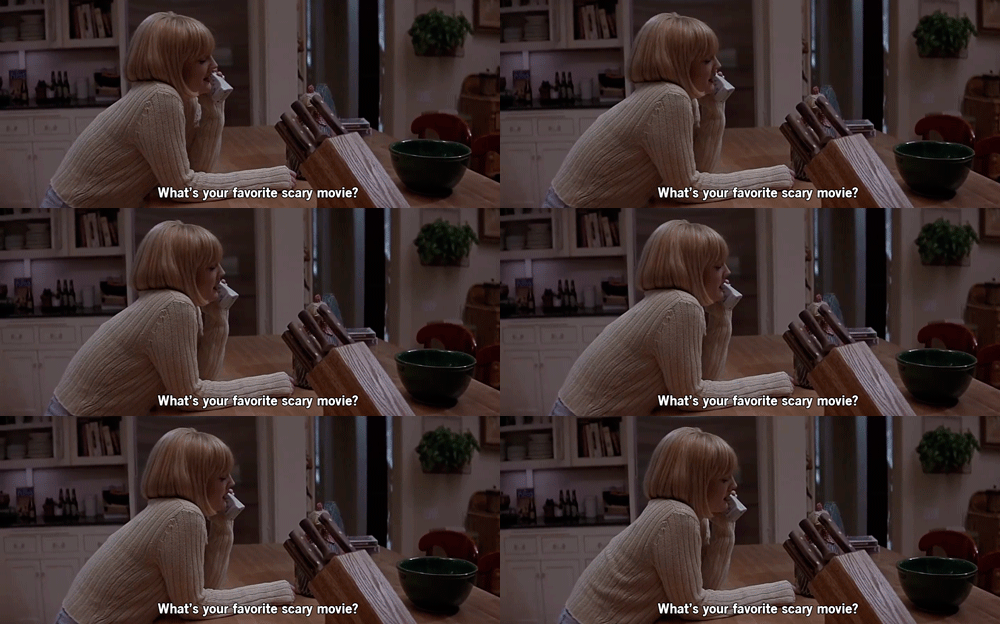
In a lesson Drew Barrymore will never forget (thank you, Scream), the killer in the first Friday the 13th only appeared to be Jason. The camera follows the killer through innovative POV shots that seduce the audience with their own assumptions about gender and violence.
And then, too late, we find out the truth.
The killer wasn’t always a man
Carol Clover, credited with developing the “final girl” theory in the horror genre, discussed the true killer’s identity in their book Men, Women, and Chainsaws: Gender in the Modern Horror Film (1993), saying:
“‘We’ [the audience] stalk and kill a number of teenagers over the course of an hour of movie time without even knowing who ‘we’ are; we are invited, by conventional expectation and by glimpses of ‘our’ own bodily parts — a heavily booted foot, a roughly gloved hand — to suppose that ‘we’ are male, but ‘we’ are revealed, at the film’s end, as a woman.”
Jason was dead the whole time (revealed as a victim of homophobia in the comic book sequels), and his mother is the true killer. Her vengeance is not evil, but rather a trauma-informed response when she sees history repeating itself at the newly reopened Camp Crystal Lake.
You can make vengeance your entire personality, but that doesn’t make it healthy
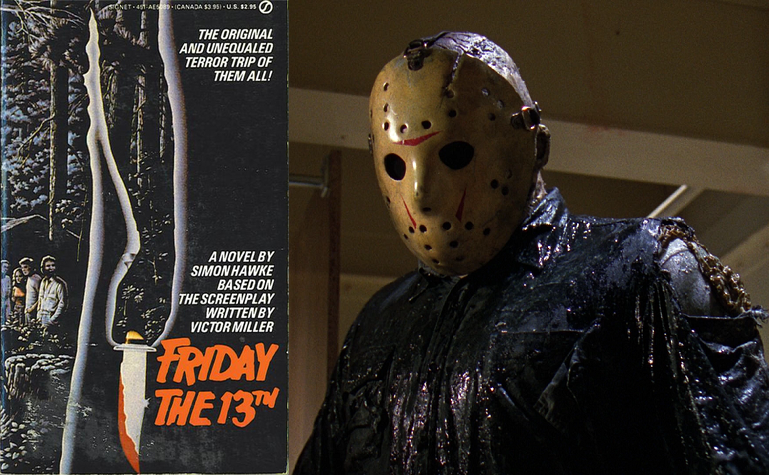
If there was any doubt, the novelization for the first film added queer-coded clarity.
One of the few additions to the book was Mrs. Voorhees begging the [family she blamed for Jason’s death] to take her back after the loss of her son; they agreed.
Another addition in the novel is more understanding in Mrs. Voorhees’ actions. Hawke felt the character had attempted to move on when Jason died, but her psychosis got the best of her. When Steve Christy reopened the camp, Mrs. Voorhees saw it as a chance that what happened to her son could happen again. Her murders were against the counselors, because she saw them all as responsible for Jason’s death (Wikipedia).
In the lingering words of academic and film critic Carol Clover, the reveal of Jason’s mother as the killer may be “the most dramatic case of pulling out the gender rug” yet seen in horror movies. The revelation makes her “one of the only slasher movie maniacs with an actual, understandable reason for slaughtering skinny young things” (The Dissolve).
But the sequels betray everything that made the first movie gay. I mean great. Okay, same thing.
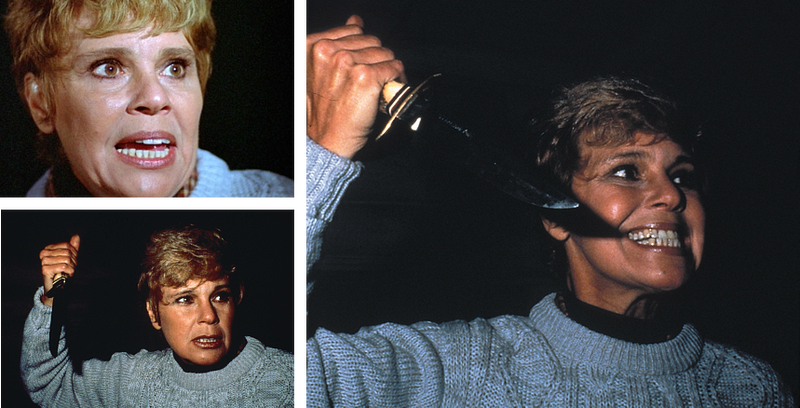
“So it’s 1944, a very conservative time,” Betsy Palmer said, reflecting on the backstory for the character her performance made famous (The Dissolve). “Pamela [Jason’s mom] has a steady boyfriend. They have sex — which is very bad of course — and Pamela soon gets pregnant with Jason. The father takes off and when Pamela tells her parents, they disown her because having [children] out of wedlock isn’t something that good girls do. I think she took Jason and raised him the best she could, but he turned out to be a very strange boy. [She took] lots of odd jobs and one of those jobs was as a cook at a summer camp. Then Jason drowns and her whole world collapses. What were the counselors doing instead of watching Jason? They were having sex, which is the way that she got into trouble. From that point on, Pamela became very psychotic and puritanical in her attitudes as she was determined to kill all of the immoral camp counselors.”
Victor Miller, screenwriter for the first Friday the 13th, said revealing Jason’s mother as the killer was what made the movie great — and making Jason the killer is why he still hasn’t seen any of the sequels.
“I still believe that the best part of my screenplay was the fact that a mother figure was the serial killer — working from a horribly twisted desire to avenge the senseless death of her son… Jason was dead from the very beginning. He was a victim, not a villain. But I took motherhood and turned it on its head and I think that was great fun. Mrs. Voorhees was the mother I’d always wanted — a mother who would have killed for her kids” (Mental Floss).
Making Jason the killer in the following sequels required him to betray what his mother stood for, and to instead become a figure of toxic masculinity.
“He’s very clear that his motivations as a slasher are born of his devotion to his beloved mother…and his absolute loathing for anyone else who dares to live and to love in his domain. Jason is presented as a creature driven by hate, someone who lost the ability to feel love or compassion a long time ago at the icy bottom of Crystal Lake” (Gayly Dreadful).
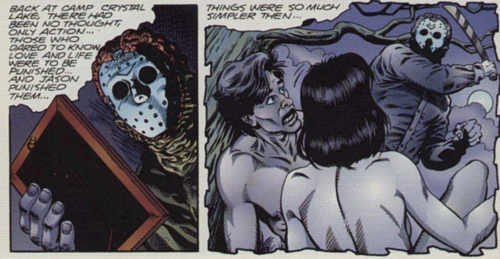
But assumptions are made to be subverted, and the thing about serial killers is that they’re never at their finest than when subverting what we took as basic facts.
Jason isn’t misogyny run wild. He’s romance forever restrained.
Jason and Leatherface sitting in a tree, K-I-L-L-I-NG
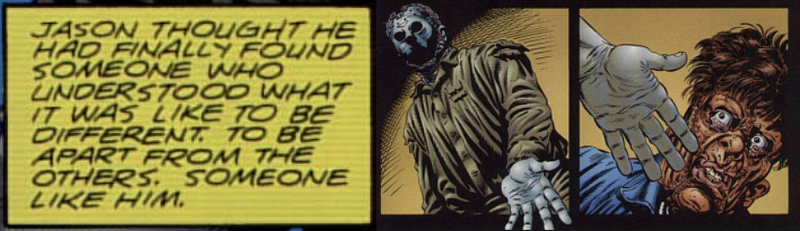
In one of the recent comics, Jason meets Bubba “Leatherface” Sawyer from Texas Chainsaw Massacre and, as told from Jason’s POV, the hockey-masked killer quickly develops romantic feelings for the one person who might understand him.
Jason is not unfeeling, he has simply long since lost interest in caring about somebody else. Until, that is, he meets someone who is like him, and it just clicks…
What he grasps is that he’s just being true to some part of his nature. While he questions it, he doesn’t resist it…
Historically, a villainous character being so devoted to someone of the same gender is used to “other” them, treat them like a joke or make them more “threatening” through their lack of conformity to traditional gender roles. (As a kid I thought it made them cool, personally.)
Here, his affection for Leatherface becomes Jason’s humanizing trait. And it’s not a punchline; it’s an earnest study in the motivations of both characters (Gayly Dreadful).
It is the violence in their pasts that brings them together. Both are forever bonded by blood to killers who slaughtered in their name. It is only Jason, however, who knew the unconditional love of his mother. The audience can’t blame him for yearning to fill that missing piece in the Sawyer family. Indeed, when Jason sees the seemingly functional Sawyer family, he finally feels the thing that makes a romance story feel complete.
He feels like he’s home.
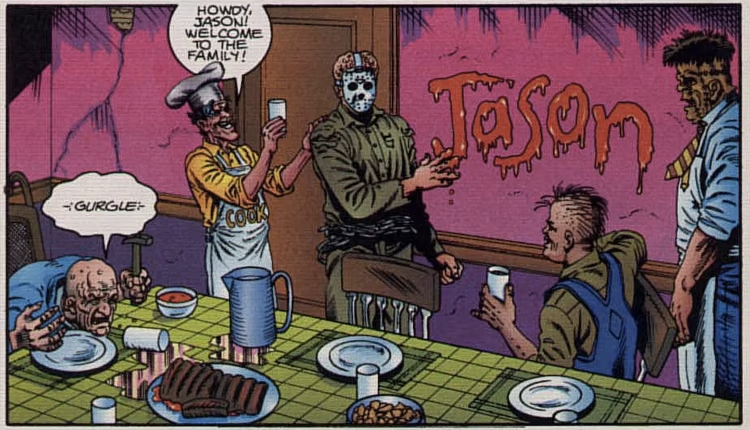
The family that lives together kills together
Jason isn’t horrified by the Sawyer family’s murderous rampages. Given his background, they’re partly why Jason feels comfortable.
But Leatherface is as much a victim to his brothers as the people they slaughter. The only difference is that they don’t kill him.
Haunted by the protective instinct his mother modeled for him, Jason can’t stand by and let the Sawyers continue to bully and abuse Leatherface.
That’s right, even Jason Voorhees won’t tolerate homophobia
Covering the entire comic mini series, Gayly Dreadful (offsite) writes, “Jason finally snaps from witnessing all the abuse of Leatherface and goes Voorhees on the older Sawyer brothers, who need their little brother to save them from his wrath…
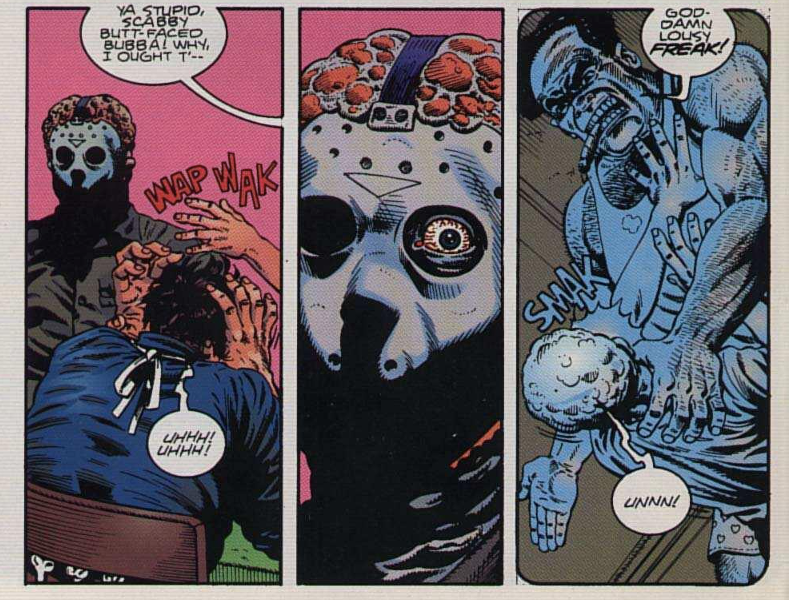
“His building resentment towards [Leatherface’s family] is always accompanied by his memories of his father. In one such memory, we see Jason’s mother kill his father with a machete to defend Jason. What his father says right before he meets his end sticks out.
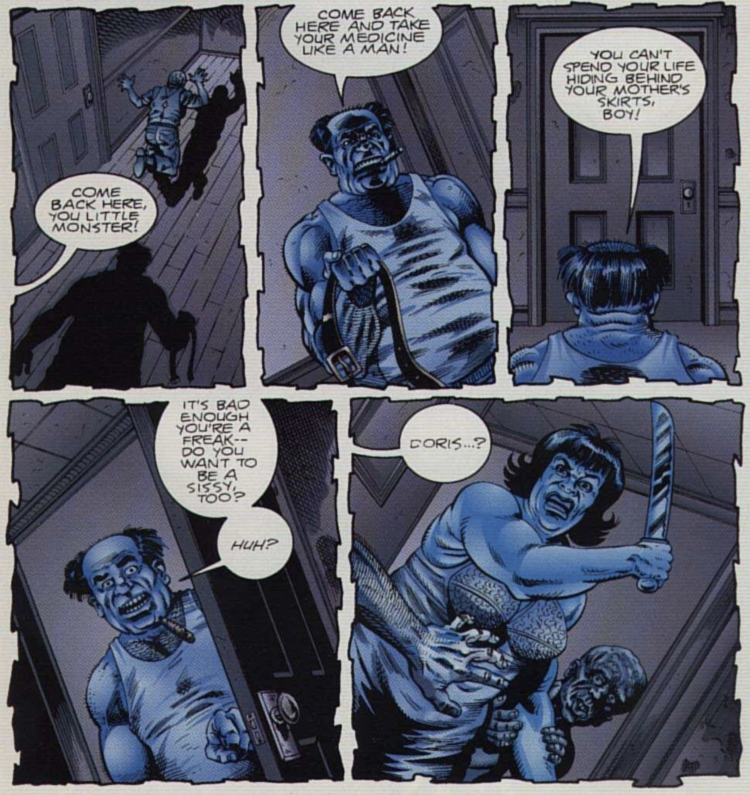
Jason’s last memory of his father’s abuse is specifically and expressly homophobic in nature. As a child, Jason is misunderstood and bullied because of how he looks, and punished by his father for not being “manly” enough. He remembers these words as cruel. As hurtful to him” (Gayly Dreadful).
It’s that unhealed wound that pulls Jason toward Leatherface. That wound has grown into the barely-remembered feeling of love. It has festered into the lingering desire for what he’s secretly wanted. It has sliced itself open in an awkward attempt to claim what Jason can never have.
Friday the 13th still kills
Gayly Dreadful said it best: “LGBTQ+ horror fans know what it’s like to relate to the outcast who just wants some understanding, what it’s like to recognize the anger that builds up facing so much cruelty and rejection. We can cry for these monsters. Jason vs. Leatherface takes the premise of your basic crossover horror comic and turns it into a strange, morbid little love story.”
Almost none of us can ignore the pull to find the one who feels like home. Even fewer of us can resist what happens when we find them.
When we find our person, their past doesn’t matter. Hopefully, neither does ours. What truly matters, at least at first, is how that person brings our blood-soaked hearts back to life.
To anyone else, that person might be as horrible as a movie monster. But for you? They could be perfect.
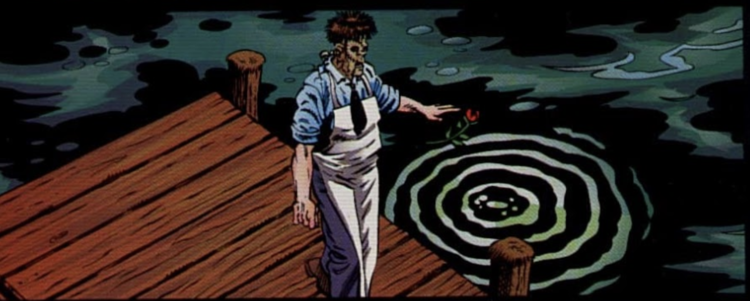
At least until you defend your sweetheart from their mutant brothers. Then your best hope is that they club you unconscious and drop you back into the Crystal Lake from whence you came.
*Note 1: Jason vs Leatherface is a real comic series but isn’t considered canonical with the movies (yet!!!)
*Note 2: A million thanks to agented horror author Megan Davies-Ostrom (Twitter) for their late-night/early-morning talks about horror and brainstorming the Top 10 Jason list this article started out as
Further reading
- Here’s What Makes Friday the 13th Popular Enough For 12 Movies (MovieWeb)
- Betsy Palmer Obituary (The Dissolve)
- ‘Friday the 13th’ Is So Much Gayer Than You Think It Is (Hornet)
- [Pride 2020] The Weird Wild Love Story Of Jason Vs. Leatherface (Gayly Dreadful)


