
‘Shuggie Bain’ By Douglas Stuart
Counter Arts Book Club 2023
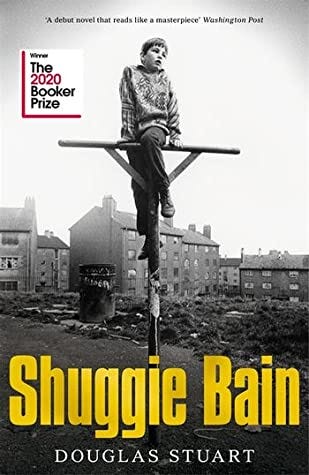
‘Shuggie Bain’ was awarded The Booker Prize for Fiction in 2020.
“Stuart’s Shuggie Bain is a Mcbildungsroman set in working-class Glasgow in the febrile 1980s and the character of Shuggie reflected something of the author’s own difficult childhood.” — The 2020 Booker Prize | The Booker Prizes
The following contains spoilers
Hugh ‘Shuggie’ Bain (Jnr.) grows up with his alcoholic mother, Agnes; on a ‘scheme’ (or project) of tenement housing, among the remnants of mining families who with the closing of the mine no longer have wages coming in the hold them together. They have been abandoned there (along with Shuggie’s half-brother, Leek, and half-sister, Caff) by his taxicab driving father ‘Big Shug’ — who for some reason got them to move there under the ruse of a ‘new start’ (away from Agnes’ parents, Lizzie and Wullie, who’s flat they had all been sharing) before immediately getting back inside his taxi and driving off to live with his mistress, Joannie.
Agnes had previously been ‘the other woman’ herself. She left her first husband, Catherine and Alexander’s father, for Shug with whom she’d been having an affair consisting of torrid sex in his cab, before pushing her claim and insisting on something more. They do often say a leopard doesn’t change it’s spots, and Big Shug in this respect seems extremely spotty. Of course, Agnes isn’t really any better, as finding that life with Shug was really no more exciting than the one she previously had, she had taken to drink, sliding further and further into insensible irresponsibility to the point of setting fire — purposely — to their bedroom in her parents flat, then lying blackout drunk on the bed clutching five year old Shuggie tightly in her arms as the room began to blaze around them. This act not only endangered the lives of her child and parents as well as her own; because Agnes and Wullie lived in a block of flats, every family who lived in that building was endangered.
We know all too well the potential for how badly that could have ended (Marc Barham):
As a single mother, living on minimal welfare benefits, alcohol-dependant and with mounting catalogue debts, Agnes gets by however she can in Pithead. This includes allowing local men sexual favours if they are only willing to supply her with a ‘carry out’ of beer cans. Essentially prostituting herself and choosing alcohol any time as a priority over money for electric or food and clothing for her children. The older two do their best to stay away from home as much as they can, but little Shuggie is still dependant upon his mother — while she in turn becomes increasingly dependant upon him.
When Agnes does have the strength to get herself sober and stay that way for a whole year, she finds a steady boyfriend and all begins to feel more normal. The reader feels somewhat optimistic for the future, until said boyfriend, Eugene, goads her into ‘taking a drink’ when they are out for dinner one evening, so that he feels they are more of a ‘normal’ couple. He doesn’t understand the nature of alcoholism, of addiction, and nags at her to just have a little one, just a wine, just a sip. Of course, when Agnes’ willpower cracks and she begins to believe Eugene might be right, one sip easily turns to the full glass and is quickly followed by several more.
By this point in the novel, Catherine/Caff is married and has emigrated to South Africa, cutting off all contact with her mother as she went. Alexander/Leek is working on a YTS (Youth Training Scheme — big in the UK in the 1980s) and trying to keep an eye on things at home at the same time as keeping away as much as possible. Shuggie misses a lot of school. And a lot of meals. While much is made of Agnes managing to maintain both her own outward appearance (‘all fur coat and no knickers’ as it was said in my area) and that of the home, in reality Shuggie looks after her as much as she looks after him.
I don’t want to give away everything, so rather than say any more about plot and how everything turns out by the end of the novel, let’s look at some themes Douglas Stuart weaves through his story.
Obviously, the setting is very important in exploring this aspect of the novel. Set as it is in 1980s Glasgow (Scotland), we can see that although ‘Shuggie Bain’ isn’t autobiographical, Stuart is definitely drawing on personal experience and his own background, given this is where and when he grew up himself. Consequently, when he writes about tower block living and the poverty of ex-mining communities, we can be sure that what we are reading is accurate. Thatcher’s Britain of the 1980s was far from easy on working class communities, especially those traditionally based around mining. It could be, as we see in this novel, a bleak, grey existence; filled with hardship, debt and violence.
I was more of the age of Shuggie’s half-siblings during that time, living not in Scotland, but a similarly hard hit area of the north of England. My county’s last deep coal mine, Haig Pit, was at the heart of our community, along with the (at that time) British Steel works at which my own father was employed.
Haig Pit was finally closed down in 1986, not long after the long battle of the Miner’s Strike was forced to an end:
“By the time of the miners’ national strike of 1984, Haig Colliery was the only deep mine remaining in operation in Cumbria. Shortly after miners elsewhere started walking out in protest at the NCB’s planned pit closures in March 1984, the men at Haig heard that 80 per cent of them would be losing their jobs. They knew that the pit was increasingly uneconomic and appeared resigned to their fate. Despite this, NUM members at Haig voted to work through the strike, so that they could protect their redundancy terms. However, flying pickets came to Haig Pit from Northumberland and elsewhere.
On closing in March 1986, 3,500 jobs were lost. The shafts were capped and the surface was cleared, albeit with some buildings and the pit head gear surviving above one of the shafts.” — Haig Colliery — Wikipedia
I can personally attest to the accuracy of Douglas Stuart’s descriptions of this world. While we didn’t have a cityscape with multistorey blocks of flats to compare, there were council estates and old pit communities, Working Men’s Clubs (no women allowed), and many of the families in the area scrabbling to survive on ‘dole’ money. School friends (undernourished and grubby looking, with badly fitting uniforms), who stayed away from home as much as they could and never invited anyone back with them. We knew where they lived, that their parents only affordable pleasures remaining were alcohol and cigarettes — and that any money the family had was often spent on ‘booze and fags’ (cigarettes), which meant that food, clothes and heating weren’t being provided for their families. So reading this about Shuggie and his family immediately rang true.
‘Shuggie Bain’ is a novel with a political edge, a commentary on the economic situation in the UK four decades ago. I imagine Stuart saw the way the future was unfolding in both Britain and America (where he now lives) and so his writing takes in deeper cultural meaning too. A reminder, a foreshadowing as well as a stellar award-winning piece of fiction.
Folded delicately into the story here, is what seems to me to be the true focus of the author’s efforts. No matter how hard life is, how badly Agnes behaves and how much she neglects poor Shuggie, her character is written in such a way that while we might well despair at her and certainly feel pity and anger on behalf of her young son (and the two older children, though to a slightly lesser degree), it is extremely difficult if not nigh on impossible to not feel sympathy and warmth towards her. We see that she tries, she battles her hardest against her problems with alcohol, presents a decent front even though everyone knows the depths she falls to and the neglect her family endures. She makes mistakes — and some terrible decisions — that is undeniable, but through it all there is love. Agnes loves them and they love her. Even if they can’t live with her, or in Catherine’s case even bear to be in contact with her. She is the Sun and Moon to Shuggie, as all mothers are to their little children. and the two are bonded in a tight co-dependence.
“We follow them, the “wee poofter” and his “hoor” of a mammy, through roughly a decade of heartbreak and squalor, a more or less Jobian arc of things going from bad to worse to excruciating, and the book would be just about unbearable were it not for the author’s astonishing capacity for love.” — https://www.nytimes.com/2020/02/11/books/review/shuggie-bain-douglas-stuart.html?smid=url-share
The quotation above broaches something else which is woven through the novel. Masculinity, social expectations of certain homogenous ways of behaving, sexuality and navigating those feelings of ‘difference’ whilst surviving childhood in a tough environment like the one inhabited by young Shuggie Bain.
Though Shuggie’s sensitivity; love of playing games with girls and dolls over rough and tumble ball games with the boys; and unusual walk which has a certain sway to it, (despite Leek’s desperate attempt to teach him how all the other boys walk and Shuggie’s hours of practice going round in a circle in a field) seems to make everyone else instinctively ‘know’, Douglas Stuart (who is gay himself) doesn’t make a huge deal out of sexuality in this novel. It’s there: a confusing, brief encounter with another young boy; a lack of interest in girls as a teen; the suggestion of being preyed upon and using his sixteen year old body as a commodity when needing money (just as Agnes had done) by the end of the novel. However, despite the novel taking Shuggie’s name and his status as ‘Outsider’ as well as him being the main character here, this story is about childhood, survival in tough circumstances, and a reflection of the reality of growing up different in that time and place.
The way the book ends, I really expected that Stuart’s sophomore publication would continue with the same character. It doesn’t, but in ‘Young Mungo’ (2022) — which almost carries on where his first novel left off, only with a different main character in a different area of Glasgow — we do see some of the themes in ‘Shuggie Bain’ pulled to the fore, and here much more is made of the homosexuality of the titular character. Mungo is a few years older than Shuggie and the story centres on his developing relationship with another boy.
As if that isn’t enough for him to cope with, given his family and when/where he lives, Mungo is Protestant, but his ‘love interest’ James is a Catholic — a source of social tension also touched upon but not fully developed in his debut novel. And here we have the other issue which even now, nearly forty years on, is still sadly alive and well in Scotland. When we think of sectarian violence in UK, it will no doubt be ‘The Troubles’ in Northern Ireland which spring to mind, but it’s also been a problem in Scotland too. More particularly, in Glasgow and centring in on the fierce rivalry between the supporters of Celtic and Rangers, the cities two main football clubs.
The Perfect Hat-trick: Celtic, Rangers, and the Death of Sectarianism — Glasgow University Magazine
Yet that is a story to continue another day.
For now, I’ll say do read ‘Shuggie Bain’. The story is good, emotionally involving, and you’ll definitely want to keep the pages turning to see how things turn out for Shuggie, Caff, Leek and Agnes. You might also want to go right out (or onto your favourite internet bookstore site) to buy ‘Young Mungo’ — I know I did, extra money for a hardback be damned!
Thank you for reading. You are appreciated as always.
To read more of my work and that of thousands of other writers worldwide, consider signing up for a full membership. You could do that through my referral page and I would receive a portion of your monthly fees:
Join Medium with my referral link — Sadie Seroxcat
To read more of my writing on my favourite subject (it’s books if you’re new, always books), try here:
Stay safe. Stay well. With love — Sadie


