avatarSharon Hurley Hall

Free AI web copilot to create summaries, insights and extended knowledge, download it at here

3892

Abstract

f the Black experience, not a whole person.</p><div id="5628" class="link-block"> <a href="https://readmedium.com/the-loneliness-of-the-sole-black-employee-working-while-black-2fd59e1bfbd5"> <div> <div> <h2>The Loneliness of the Sole Black Employee (Working While Black)</h2> <div><h3>Being the only Black employee can be pretty lonely — true stories of the Black experience in office life</h3></div> <div><p>medium.com</p></div> </div> <div> <div style="background-image: url(https://miro.readmedium.com/v2/resize:fit:320/1*pr7GvwPLxyjgZklJ7xDZbg.png)"></div> </div> </div> </a> </div><p id="95f1">It’s the same in an office setting. Assuming you get past the interview panel and actually get a job, you’re seen as different the day you set foot there. Different, and lesser, as I’ve said before.</p><div id="39c2" class="link-block"> <a href="https://readmedium.com/surprise-im-qualified-working-while-black-6a90c4d0eb29"> <div> <div> <h2>Surprise, I’m Qualified! Working While Black</h2> <div><h3>True stories of how white employers underestimate Black employees’ education and ability</h3></div> <div><p>medium.com</p></div> </div> <div> <div style="background-image: url(https://miro.readmedium.com/v2/resize:fit:320/1*mj_UO4o9DZ-gXM1iIO4Ugw.png)"></div> </div> </div> </a> </div><p id="6072">In no situation do you feel free to be all that you are. Instead, you keep quiet, don’t make too many waves, and hope you’ll survive each day with some of your dignity and self-esteem intact. There are many days when that doesn’t happen.</p><div id="c1d6" class="link-block"> <a href="https://readmedium.com/pardon-your-bias-is-showing-working-while-black-1bab7e59fc08"> <div> <div> <h2>Pardon, Your Bias is Showing (Working While Black)</h2> <div><h3>True stories of racial microaggressions in the workplace — part of Sharon Hurley Hall’s “Working While Black” series.</h3></div> <div><p>medium.com</p></div> </div> <div> <div style="background-image: url(https://miro.readmedium.com/v2/resize:fit:320/1*8X8jO0s4jSaRByI16wraUA.png)"></div> </div> </div> </a> </div><p id="3019">All of those experiences happen offline, but they inform our online interactions, too. When I started freelancing online, having seen the double-take, experienced the paternalism of white liberals (even from women) and been sexualized and discriminated against in different settings, it made perfect sense to me to let my anglicized name do the talking for me, rather than let my Black skin prevent me from getting the work I needed to help support my family.</p><div id="8aa6" class="link-block"> <a href="https://readmedium.com/black-women-stereotypes-and-fetishes-while-black-10d6ab3ed92a"> <div> <div> <h2>Black Women, Stereotypes and Fetishes (While Black)</h2> <div><h3>How the white gaze endangers Black women</h3></div> <div><p>medium.com</p></div> </div> <div> <div style="background-image: url(https://miro.readmedium.com/v2/resize:fit:320/0*Fi6epF3dkU7g2DRL)"></div> </div> </div> </a> </div><p id="6ade">A couple of early experiences validated this decision, because there were people who discovered I was Black, then tried to use that as a reason to pay me less. Never mind that when I started freelancing 15 years

Options

ago, I already had a solid 15+ years as a journalist under my belt. They couldn’t see past my Black face, and lowered their compensation offer accordingly.</p><p id="a4e1">Another time, in comparing notes with a fellow writer, who was less experienced, I discovered that she was actually earning more.</p><p id="a875" type="7">People have actually said to my face that I must spend a lot of time hanging out on the beach. As anyone who knows me knows, it’s actually completely the opposite.</p><p id="c29e">I can’t remember exactly when my approach changed. It’s probably when I started writing more about social media, and implementing those best practices, which included using a photo. But at some point, I finally decided to put my face out there.</p><p id="2f21">Of course, I still wasn’t showing up with my whole self, because I didn’t tell people where I was. That’s because, for many, being Black and living in Barbados equals not up to the job. I’m not making this up. People have actually said to my face that I must spend a lot of time hanging out on the beach. As anyone who knows me knows, it’s actually completely the opposite.</p><p id="582d">Newsflash #1: I’m a professional writer with a journalism background, so I work from a home office, and respect and meet all my deadlines.</p><p id="4c27">Newsflash #2: Sand, sea and laptops don’t mix. I’m not going to risk damaging the tools of my trade for the sake of a swim. I can do that when I’m not working.</p><p id="e780">For a long while, I only interacted with clients by email so they couldn’t hear my hodgepodge of an accent, born of growing up in various Caribbean countries and living in England. And I never showed my face on camera.</p><p id="115f" type="7">As a Black professional, you have to be better than the rest to be equal, right?</p><p id="e90c">There wasn’t a single moment that led to that changing. Rather, it was an incremental process. Once I’d posted my photo on my social media profiles, where I was sharing my work, there was no reason not to put it on my website. Once my photo was on my website, there was no reason not to take a video call.</p><p id="4b1f">And once I’d participated in a couple of video calls, there was no reason not to share more. So, when clients asked where I was based, I started telling them.</p><p id="6142">Of course, I still frame it carefully, because as a Black professional, you have to be better than the rest to be equal, right? That means highlighting my credentials and experience when I have a call with a new client. I make it clear that I’ve been writing for big name companies in the US for 15 years, and that I have a background in trade journalism in the UK.</p><p id="449d">This year, I’ve taken an additional step by writing more about my actual experiences as a Black woman, online and offline. A couple of people have mentioned that for a long time I was the only Black woman writing about marketing they knew. My photo helped them to know that it was possible for someone who looked like them to build a successful career. If for no other reason, I’m glad I did it.</p><p id="80f7">Now, I’m happy that I’m able to share my other experiences, too. I hope they will serve as solidarity and inspiration for my Black and BIPOC colleagues. And I hope my stories will show white people just what their Black colleagues face every day. Who knows? Maybe one day showing up with your whole self as a Black person will no longer be exotic or strange.</p><p id="9a79"><i>© Sharon Hurley Hall, 2020</i></p><p id="a2f8"><i>Read more stories like this in my book <a href="https://books2read.com/tiredofracism">I’m Tired of Racism</a>. If you found this article interesting or insightful, I invite you to <a href="https://antiracism.substack.com/">subscribe to my anti-racism newsletter</a> to see more of my articles on racism and anti-racism.</i></p></article></body>

While Black Series

Showing Up With Our Whole Selves

Why that’s not always an option when working while Black
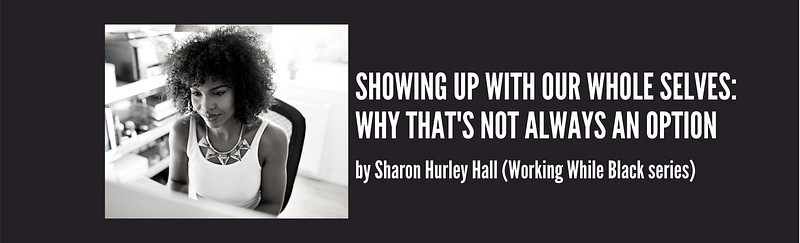
Photo courtesy of Canva

As a Black person, bringing everything that you are to work is a tough decision. After all, if you’re in a country where you’re in the minority, what you are isn’t seen as a “good thing”.

Let’s face it, even in countries where Black people are in the majority, what you are might not be a “good thing”, as I mention in my article on BlackLivesMatter and Barbados.

Hiding part of yourself isn’t always a conscious decision. Instead, it happens over many little microaggressive moments.

White people, hear this, however exotic a name may sound to you, for Black people certain names are as common as John or Jane. It’s culture, not exotica.

The idea of wrongness can start early, like the first time you go to school and people claim not to be able to understand or pronounce your name. Or when they manage to pronounce it, but other you by commenting on how exotic it is.

White people, hear this, however exotic a name may sound to you, for Black people certain names are as common as John or Jane. It’s culture, not exotica.

When you’re in class at college and a topic that relates to Black people (which is every topic, but again, that’s another story) comes up, then every eye will swivel to you, as if you’re some sort of Oracle of the Black experience. Take it from me, it’s an uncomfortable place to be.

Hiding part of yourself isn’t always a conscious decision. Instead, it happens over many little microaggressive moments.

This happened to me in England, where though I could talk with authority about my experiences as a Black woman from the Caribbean, I was NOT an authority on the Black experience in Britain, except for stories from my parents, who lived there in the 1960s.

In no situation do you feel free to be all that you are. Instead, you keep quiet, don’t make too many waves, and hope you’ll survive each day with some of your dignity and self-esteem intact.

Really, you can’t win. If you don’t feed the beast, then you’re not really Black. If you do, then that’s all you are — a representation of the Black experience, not a whole person.

It’s the same in an office setting. Assuming you get past the interview panel and actually get a job, you’re seen as different the day you set foot there. Different, and lesser, as I’ve said before.

In no situation do you feel free to be all that you are. Instead, you keep quiet, don’t make too many waves, and hope you’ll survive each day with some of your dignity and self-esteem intact. There are many days when that doesn’t happen.

All of those experiences happen offline, but they inform our online interactions, too. When I started freelancing online, having seen the double-take, experienced the paternalism of white liberals (even from women) and been sexualized and discriminated against in different settings, it made perfect sense to me to let my anglicized name do the talking for me, rather than let my Black skin prevent me from getting the work I needed to help support my family.

A couple of early experiences validated this decision, because there were people who discovered I was Black, then tried to use that as a reason to pay me less. Never mind that when I started freelancing 15 years ago, I already had a solid 15+ years as a journalist under my belt. They couldn’t see past my Black face, and lowered their compensation offer accordingly.

Another time, in comparing notes with a fellow writer, who was less experienced, I discovered that she was actually earning more.

People have actually said to my face that I must spend a lot of time hanging out on the beach. As anyone who knows me knows, it’s actually completely the opposite.

I can’t remember exactly when my approach changed. It’s probably when I started writing more about social media, and implementing those best practices, which included using a photo. But at some point, I finally decided to put my face out there.

Of course, I still wasn’t showing up with my whole self, because I didn’t tell people where I was. That’s because, for many, being Black and living in Barbados equals not up to the job. I’m not making this up. People have actually said to my face that I must spend a lot of time hanging out on the beach. As anyone who knows me knows, it’s actually completely the opposite.

Newsflash #1: I’m a professional writer with a journalism background, so I work from a home office, and respect and meet all my deadlines.

Newsflash #2: Sand, sea and laptops don’t mix. I’m not going to risk damaging the tools of my trade for the sake of a swim. I can do that when I’m not working.

For a long while, I only interacted with clients by email so they couldn’t hear my hodgepodge of an accent, born of growing up in various Caribbean countries and living in England. And I never showed my face on camera.

As a Black professional, you have to be better than the rest to be equal, right?

There wasn’t a single moment that led to that changing. Rather, it was an incremental process. Once I’d posted my photo on my social media profiles, where I was sharing my work, there was no reason not to put it on my website. Once my photo was on my website, there was no reason not to take a video call.

And once I’d participated in a couple of video calls, there was no reason not to share more. So, when clients asked where I was based, I started telling them.

Of course, I still frame it carefully, because as a Black professional, you have to be better than the rest to be equal, right? That means highlighting my credentials and experience when I have a call with a new client. I make it clear that I’ve been writing for big name companies in the US for 15 years, and that I have a background in trade journalism in the UK.

This year, I’ve taken an additional step by writing more about my actual experiences as a Black woman, online and offline. A couple of people have mentioned that for a long time I was the only Black woman writing about marketing they knew. My photo helped them to know that it was possible for someone who looked like them to build a successful career. If for no other reason, I’m glad I did it.

Now, I’m happy that I’m able to share my other experiences, too. I hope they will serve as solidarity and inspiration for my Black and BIPOC colleagues. And I hope my stories will show white people just what their Black colleagues face every day. Who knows? Maybe one day showing up with your whole self as a Black person will no longer be exotic or strange.

© Sharon Hurley Hall, 2020

Read more stories like this in my book I’m Tired of Racism. If you found this article interesting or insightful, I invite you to subscribe to my anti-racism newsletter to see more of my articles on racism and anti-racism.

Race
BlackLivesMatter
Equality
Work
Women
Recommended from ReadMedium