
Shoulder hike during exercise?
The cause and cure

As a personal trainer, I have often witnessed firsthand the negative effects of poor posture and muscular strength imbalances on human movement. These factors inevitably lead to exercise compensation patterns the client is unaware of and ultimately, possible injury. Since no one is perfectly balanced or symmetrical, extra attention must be given to proper form during exercise and faulty movement patterns must be identified early and corrected. This article will offer a rudimentary treatment of a common compensation pattern: shoulder hiking during exercise.
Exercise compensation pattern
An exercise compensation pattern will occur when neuromuscular imbalance exists. The main reasons for this are:
Poor posture resulting in a misalignment of joints
Repetitive movement resulting in an overuse of certain muscles and an underuse of others.
Physical (structural) considerations including prior injuries
In response to the above conditions, the brain will reorganize muscle fibre recruitment so that movement may continue.
What are upper cross syndrome and forward head posture?
Upper cross syndrome refers to the condition whereby the muscles of the chest and upper shoulders are overactive and the mid-to-lower trapezius, rhomboid muscles and cervical spine flexors are under-active. You may have upper cross syndrome if you have rounded shoulders, shoulder pain and/or forward head posture.
Forward head posture refers to the condition whereby the head is out of alignment. An individual whose head protrudes an inch out of alignment essentially is holding and moving a 24lb head due to the mechanical disadvantage of this posture. Not surprisingly, this can lead to muscle tension and is often accompanied by rounded shoulders or excessive thoracic (mid-spine) kyphosis (curvature).
Simply put, the conditions mentioned above may cause shoulders to hike up during exercise in an attempt to stabilize the scapulae, shoulders and arms due to the under activity of certain support muscles.
How to correct: What to stretch and what to strengthen
If we follow the description of the aforementioned conditions, it would appear we need to stretch potentially overactive muscles such as the pectorals (major and minor), upper trapezius, and, in all likelihood, the lats (latissimus dorsi).
Concurrently, the following muscles need to be strengthened: rhomboids (upper back), mid and lower trapezius (mid-back), serratus anterior (underneath muscle), and the cervical flexors (anterior neck muscles).
What the mini program would look like
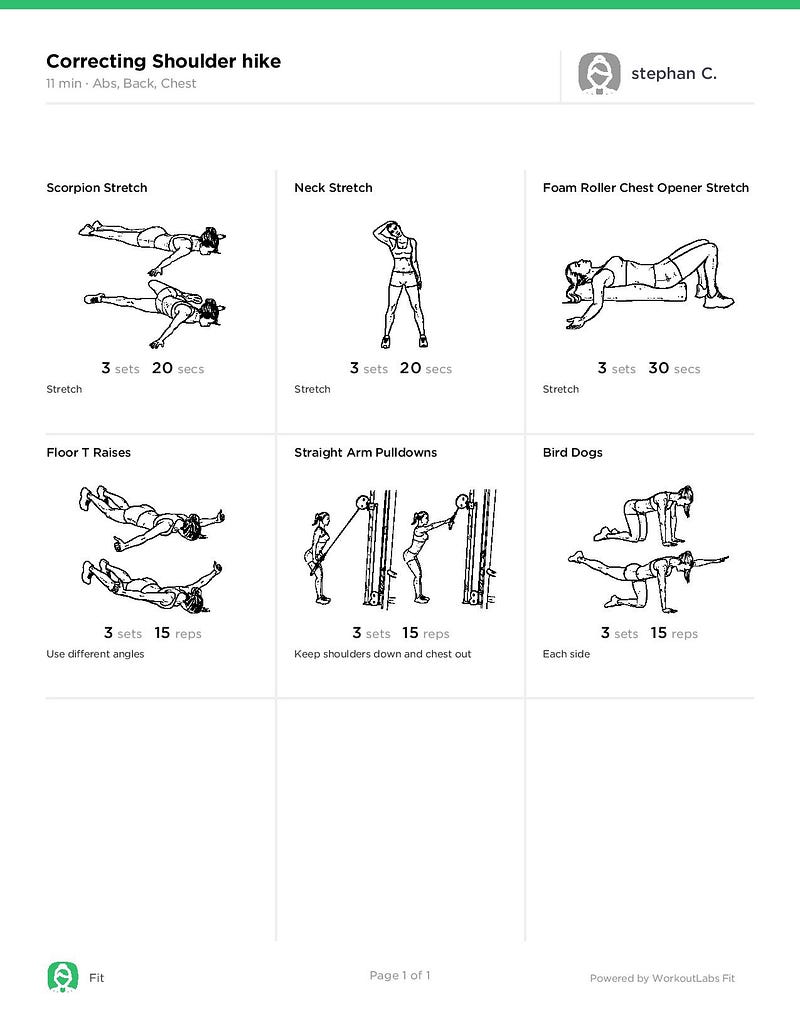
This short program can be performed several times per week until the targeted muscles begin firing again. In the meantime, be mindful of shoulder movement during exercise.
The wrap up
Much has been written about the effects of increased screen time and stress on posture and consequently, exercise. Shoulder hiking is a common gym affliction. If you notice it creeping into your exercises, you may need to incorporate a little targeted rehab work to restore proper movement.
This article is by no means an exhaustive analysis of this particular exercise compensation pattern but is meant to raise awareness and provide possible quick solutions. More severe dysfunction should be addressed by a competent fitness consultant.
Fitfully yours.


