
Should Your Blog Be on Medium, WordPress, Substack, or Ghost? | 2023 Update
[2023 Update] A realistic comparison of 2020's top blogging platforms

You have a blog, you’re starting one, or you’re planning on migrating platforms. We’re all in one of those camps, and there’s a world of manure to sift through to figure out what’s right for you. Blogging in 2020 is more business than hobby, and just like any good business, we want the best for it — so what do we consider when selecting the platform?
- Potential for eyeballs 👀
- Potential for earnings 💰
- Ease of use 👌
- Scalability 📈
These variables are definitely not mutually exclusive. Eyeballs mean earnings, and ease of use is usually inversely proportional to scalability, but regardless, all these platforms have their place, so let’s start with Medium.
Medium
When someone asks where to read my blog, I tell them “Medium” and 80% of the time they’ll reply “what’s that? ”
To which I reply, “It’s YouTube, but for writing.” With this one sentence, people understand the gist of how you publish, get viewers, and make money on the platform.
- You write and publish content.
- Medium uses an algorithm to put your content in front of people.
- Medium makes money off this content and gives a portion of this to you.
Unlike with YouTube, this isn’t with ad placement, but exactly like the YouTube Red program, it’s with a portion of member view time — The Medium Partner Program.
With the ease that’s brought to you as a blogger through:
- creating a free profile,
- writing within the sites own editor,
- being ‘discover-able’ straight out of the gate,
- and not needing to own a domain or set up anything,
comes some hefty downsides depending on your goals.
You’re at the whim and woe of the Medium gods — this is a platform, you don’t own the platform, and you need to adhere to the rules. There’s inherently a cap on how far you can go, scalability and earning potential are not unlimited.
If you want Medium to curate your article, it needs to be member-only. And member-only articles were* the only way you could monetise specific content.
In 2020, you couldn’t
- Use Google ads
- Use any affiliate links
- Add private advertisers
- Promote/sell products
- Control the look and feel of your profile
- Get deep insights in terms of data by linking analytics apps
But in 2023, a few things have changed.
- You can use affiliate links — and disclose this in your articles.
- Medium now has a referral program where you have an entirely new income stream that’s Medium-approved.
- Promoting and selling products is all good, but advertising with images and third-party Google-Adsense-type plugins is no good.
So Medium still inherently has a grip on your earning potential — you can’t create an in-platform shop or turn on ads, or customize your profile to enhance the look and feel to exactly what you want, but it’s gotten a lot better.
By default, your RPM (revenue per 1000 views/clicks) is dependent on member read time, and member read time only. In 2023, on an experimental basis, the member-read-time-only calculation will change. Writers will also get paid for external views, but we haven’t heard much about this yet.
I’ve found for me the average RPM is about $10, give or take. Note this is heavily dependent on where your traffic is coming from.
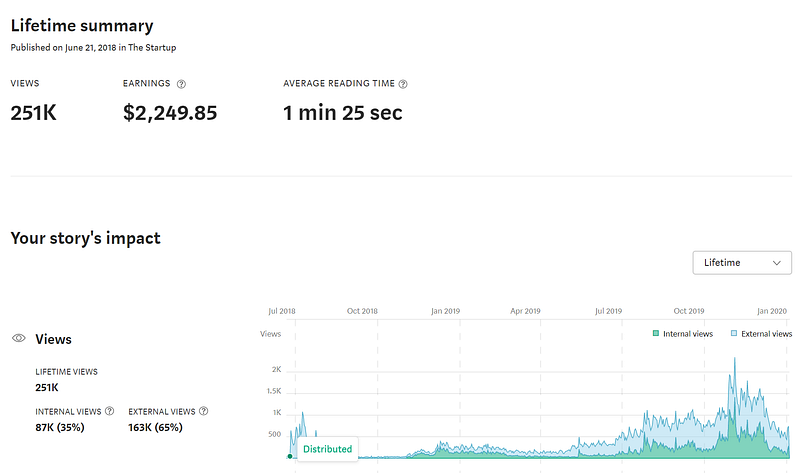
For example, 2/3 of the traffic for the article below comes externally from Google searches mostly — meaning a lot of it is from non-members.
I may get paid for this when the new changes come in, but right now, I don’t. This would be a different story on a WordPress/Ghost site.
Yet here I am writing for/on Medium, even though I can’t monetise my content using the countless different methods above. The fact is that Medium, like YouTube, offers visibility. It’s easier to get people to come into your shop if it’s in a mall, rather than on the side of the road on an unnamed street. The latter requires a lot of time, effort, money, and skill.
But of course, if you’re looking to go beyond being a freelance blogger or selling a course/other services to your email list, and you want scalability and have larger business aspirations— Medium might be good for some things, like promotion, but not as a stand-alone blog. You need your own real estate.
And don’t get me wrong, you can be a very fulfilled writer/blogger and make a killing on Medium. And for blogs like my personal one right here, that’s perfect.
WordPress
In 2014, it was estimated that ~19% of all self-hosted sites on the internet were WordPress — impressive to say the least. That number is now at 35%, according to a study by W3 Techs. And that’s ludicrous.
WordPress doesn’t only power blogs across the internet, but with the extraordinary growth of the community, it has extensions to turn sites into platforms, shops, paywall content publications, applications, and more.
Unlike Medium, installing WordPress means the site is your own real estate. You’re not in the beautiful lake that is Medium; you’re not at the whim and woe of the Medium gods, and you don’t have to follow their rules.
Instead, you’re in open sea, international waters, practically speaking there’s no rules — unlimited potential. But you’ve ditched the Medium gods for the deity that is the unholy combination of Poseidon, Zeus, and Sauron — Google is your new master.
With your own real estate comes the scalability that you’ll need in later stages. You want to expand into eCommerce? You’ll be able to create a store right there on your site. Do you have a product recommendation? Affiliate links are completely fine.
But it’s up to you to get those eyeballs. A small slice of a massive pie is the name of the game here.
WordPress is the easiest CMS to install on a standalone site. The perks being:
- Very well-documented tutorials on every platform
- Ubiquitous one-click installs supplied by hosting sites
- Best “out-of-the-box” SEO available in a CMS
- Extremely customisable — huge community supplying themes and extensions for every conceivable need
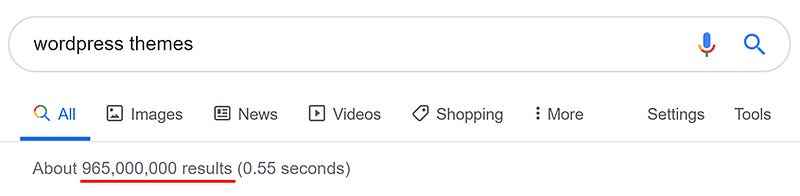
So what’re the issues besides being in open water? There’s a few, let’s start with a particularly annoying one.
Bloody. Slow.
WordPress has an extension for everything, and with all those options, it seems like every blogger is using at least half a dozen. The themes are bulky and clunky, and the extensions have a lot of unnecessary fat to be trimmed. And the average user, not being a developer, tries to fix these issues by, wait for it… installing more extensions to speed-up load times.
If you’re going to use WordPress, stick to the basics and install only what you need for each leg of reaching your desired scale — until you’re able to afford a developer.
And speaking of affordability, this is your own real estate, it goes without saying that there will be costs involved, unlike Medium and Substack.
- Domain
- Hosting
- Themes/extensions
- Development
When it comes to development, what you don’t pay for, you’ll have to learn. Luckily with WordPress, there are tons of resources to help you along the way.
Substack
Substack is a direct competitor to Medium, with combinations of more upside in certain areas, and more downsides in others. It’s a platform, like Medium, but it’s more of a garden with a fence and plenty of entry/exit points, rather than a walled one — yes, I’m in an analogy mood today.
Substack makes their money from subscriptions, just like Medium, but unlike Medium, it’s on a per-blog basis. People don’t subscribe to Substack, they subscribe to your particular blog, or should I say — your email newsletter.
Substack is a platform for sending emails; your content is delivered to your audience in this way. It’s free to use, but they bank on the fact that you will eventually make premium emails that are only for subscribers (taking a portion of these earnings) — it also provides the infrastructure to manage these subscriptions and publishes them on your profile, on the platform.
In the three years between 2020 and 2023, they’ve added a metric shit ton of features.
- Videos and Podcast functionality.
- Subscriber chats (enabling a type of paid community feature.)
- Better Stats
- Functionality for featuring/recommending other publications
- An Editor on steroids — easy tables, paywall feature, and in-built polls
It’s covered a lot of ground and functionally blown past Medium, WordPress, and other newsletter-based platforms if we’re talking about a Newsletter vs. Newsletter fight.
You can see the top 50 recent posts right on the site.
The perks:
- It’s got its own editor, is free and easy to use (like Medium)
- It’s your own list of portable followers (unlike Medium)
- You can link out to anywhere and promote practically anything without consequences
- You can add analytics software for deeper stats per blog post/email
- Your blog is your email list, so you don’t need to worry about promoting it constantly
- You have infrastructure to monetise via subscriptions like Medium, but you get a bigger piece of the (smaller) pie when someone subscribes
The cons:
- The visibility of your content isn’t increased for being on the platform, except if you’re in the Top 50 for a particular post — so less reach
- You still can’t monetise through affiliate programs or ads, but you can link out as mentioned prior
- In the fashion of strength in numbers, it’s harder to convert someone for only your content than it is for converting someone for many author’s content and taking a smaller piece of a larger pie
All in all, drawing inspiration from the 1000 true fans manifesto by Kevin Kelly, Substack is about finding your true fans, delivering to them, and making your money that way.
Email is truly one of the only (almost) untouched ways to directly reach your audience with no middleman. Yes, the platform is at the mercy of Google and the public-facing side of Substack, but those are only the cherries on top of the sundae that is your own list with your own audience. If you’re going for quality of reader, as opposed to quantity, this might be for you.
Ghost
A direct competitor to, and sometimes very vocal about, both WordPress and Medium.
Ghost is Medium, if Medium was a standalone product that I could install on yout own self-hosted site, so almost WordPress, but not quite.
It’s an open-source publishing platform that you can add writers to, edit the code of, add subscriptions to, and have full scalability and control over — it’s also as light as a feather.
In 2023, the changes that it’s brought in and the ground it’s covered is so impressive that I’ve had to re-write this section to cater to some of the awesome features and the new creator-focused landscape adopted by Ghost.
Here are some game-changer features over the last three years:
- It’s both a blogging platform (like Medium) and an in-built emailing platform (like Substack).
- It’s got a membership/paid subscription functionality.
- It’s got native comments and native search that’s actually fantastic — unheard of, right?
- It’s got pay-walls, lead magnets, and all the goods that Substack’s just launched as well.
Ghost, like WordPress, has its own managed install version called Ghost(Pro) which can get expensive but might be worth it for you depending on your needs — at least it was that way in 2019 until they revised their pricing structure.
The new pricing structure is a actually creator friendly — it encourages you to get paid members and charges you accordingly.
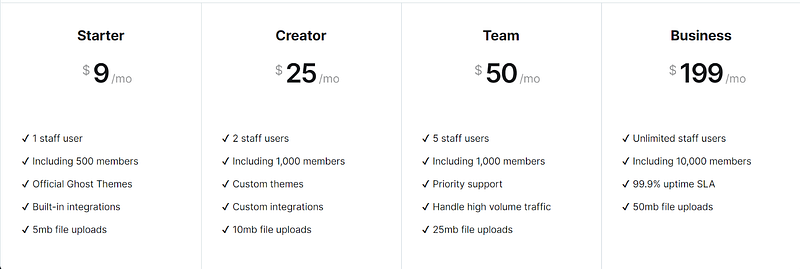
Even though it’s paid version is the thing the organisation wants you to get, it’s inherently an open-source platform that you can install and edit for free — but it will drive your head in if you’re not a developer.*
* Granted this has gotten a lot better.
It’s well-documented, and there are plenty of resources available; however, it most definitely is not WordPress.
- There are very few 1-click installs. Even DigitalOcean’s one isn’t hassle-free, and they’re the ones that manage Ghost(Pros) infrastructure.
- You need to have a trivial knowledge (at least) of contemporary JS, SSH, and how server architecture works for your own install.
- There aren’t unlimited themes or extensions, as there seemingly are for WordPress.
- Fixing trivial problems like making your external links open new tabs requires knowledge that you otherwise wouldn’t need on WordPress.
- To avoid these problems, you’d need to pay a developer, and learn to develop, or use the pro version — each has problems when you look to scale the site.
- Updating is also a bitch.
With all this in mind, it’s still a very good option. In fact, the only external standalone blog I run is actually on Ghost. Why would I do this?
As a blogger, it provides you with everything you want to launch a publishing site with scalability in mind — and like I said before, Ghost, the organisation, gives a shit.
They’re entirely creator focused.
- Increasingly committed community of devs making templates.
- Lots of resources and integrations both nativ and Zapier-ready.
- It’s built with Node.js — a massive pool of developers to help with scale.
- Super lightweight and doesn’t have the bulk of WordPress.
- Has all the built-in features of Medium that matter and more.
I used to say: Think about Ghost like the middle ground between WordPress and Medium.
But now, I’d say its something between WordPress and Substack. You don’t have the reach of Medium, you don’t have the community of Substack, but you have the robustness of WordPress. You’re independent from a platform, and sometimes that’s worth it’s weight in gold.
All in all, each option has its perks and drawbacks. This is where having a view of the future with some broad goals will ensure that you make a decision that’s more or less in the direction you want to go.
Are you just looking to blog and love writing? Are you looking to expand your writing into a fully-fledged content business? Are you a solo entrepreneur and don’t need scale but more after a quality audience?
Your answers will determine the right platform for you. I hope this little analysis helps you out.
Keep going,
Sah