
Should You Trust Financial Advice From Social Media?
There’s a right way to interpret and use “free” investment advice.
Social media platforms have become hotbeds for investment discussion.
Twitter users can browse trending investments by searching stock tickers preluded by a dollar sign. The portmanteau “fintok” has become a popular hashtag for financial advice on TikTok. And just look at the subreddits r/stocks and r/investing, which have over two million collective followers.
Surely, something so popular has some credibility, right? The information disseminated through these channels has to be legit?
No, you should trust your research and that of professionals.
Not u/savvymcsavvington.
Social proof isn’t enough of a justification to jump on the bandwagon of a particular publicly-traded company. It doesn’t matter if thousands of people upvote, heart, or retweet a post that lauds an up-and-coming tech stock. You worked too hard for your savings to throw your money away on a whim.
The world has never been so interconnected. In our digital age, anything can go viral — tweets, YouTube videos, TikToks, LinkedIn posts, and so on. The same can be said for stocks.
But virality doesn’t guarantee stability or returns.
I’ll give you an example.
Back in June, a friend sent me the following text:
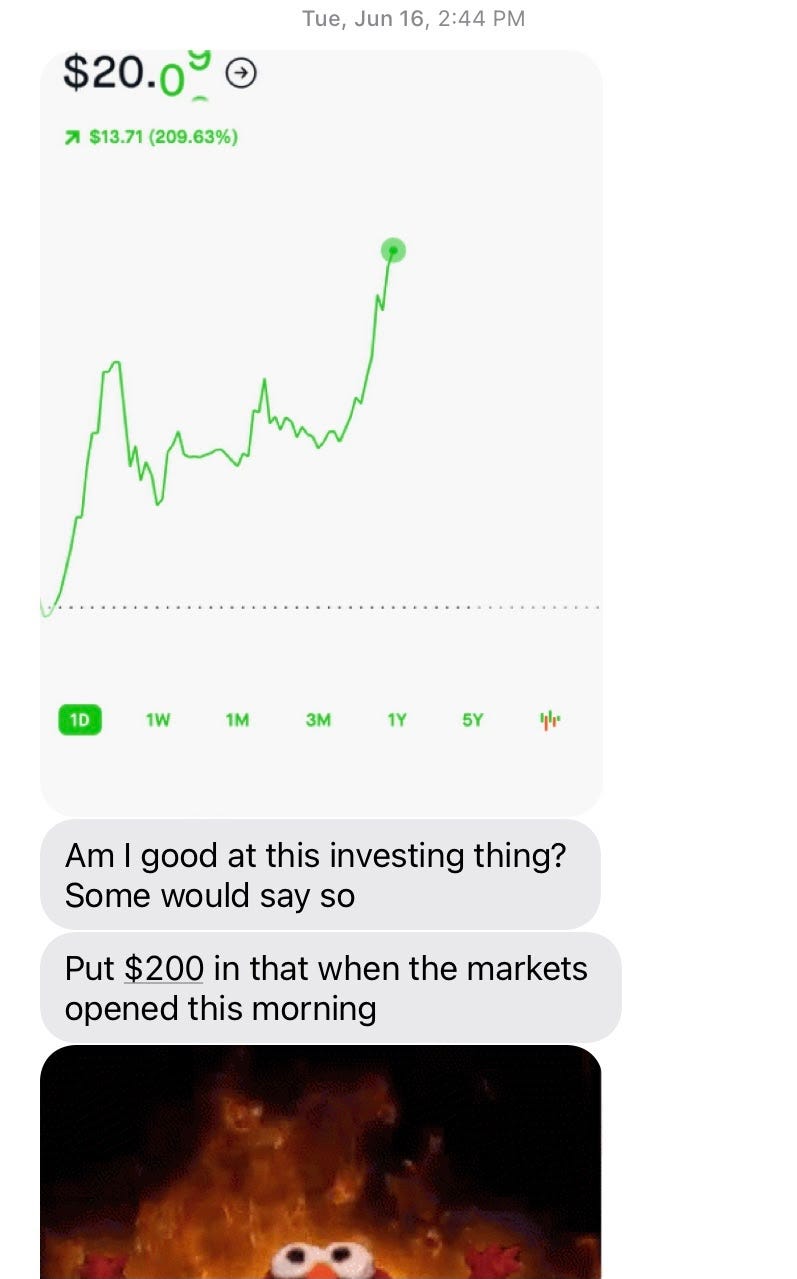
My speculative friend purchased shares of Urban One, Inc. (UONE). Thanks to Robinhood’s daily promotion of top moving stocks, he stumbled upon a company riding a wave of social momentum.
For context, UONE hadn’t done anything revolutionary to deserve an influx of purchases. They didn’t make an industry-shifting investment or acquisition. They didn’t announce a huge, unexpected spike in earnings. In fact, on June 11, Brigade Capital Management sold all of its 3.9 million class D shares of Urban One, which is usually a bad sign.
In reality, the stock rode a massive wave of social momentum that brought a bevy of new investors. How much social momentum? Enough to drive a 4103% share price increase in a matter of 13 trading days.
On June 1, shares of UONE were worth $1.32. By June 19, shares had skyrocketed to $54.16.
Before June, this media company’s average daily trading volume hovered around a million. In the midst of the meteoric rise, UONE experienced 58 million trades — in one day.
Of course, pumping money into a social media star can succeed in the short-run, but it’s likely to hurt you once share prices normalize.
Seven months later, UONE trades around $6.
But there is something you can take away from social media musings and predictions.
How to use social media to improve your investment strategy
When I’m first learning about a company, I’ll see what people are saying on Twitter and Reddit. I avoid the people who laud a stock or predict some ridiculous outcome without any evidence or support.
That said, there are usually a few users who’ve done some digging already and share valid points worth exploring.
For example, I was curious about biotech companies in the genomics space. After some googling, I came across Pacific Biosciences (PACB), so I transitioned to Reddit and perused a few threads. One particular thread asked about genome editing stocks. Sifting through the replies, I found two tidbits of helpful information.
- Another biotech company, Bionano Genomics (BNGO), had an upcoming symposium on January 12.
- PACB is the largest holding within the ARK’s genome ETF (ARKG).
I used this newfound knowledge to continue my search and explore ARK’s ETF.
You can use these channels to find useful information or discover stocks in a particular industry that haven’t hit the mainstream media — just remember to perform your own due diligence.
Prepare to pick through a lot of bad advice
The fact of the matter is that for every crumb of good investment advice on social media there’s a pile of crap. It’s like finding a needle in a haystack.
Why? Because people are often wrong.
To give you an idea, here’s the verbatim response within the aforementioned genome stock thread:
“I truly know zero about the space but I did read an article once so…I’ve been using a small amount of gambling money with DTIL in the $7-$8 range. Maybe it’ll blow up. Probably it’ll drop to $4.”
I don’t mean to pick on this user — at least they admitted to lacking the proper know-how about this particular industry. But most of the people pumping stocks aren’t forthcoming about their expertise. Just because someone writes with conviction and depicts a bright future for a diamond-in-the-rough stock doesn’t mean they know what they’re talking about.
Don’t assume you’re listening to a forum of wealth advisors.
Do you want to learn more about personal finance? But without the complicated jargon and dry explanations? Sign up here for Bits — our personal finance newsletter.
Note: I have nothing against u/savvymcsavvington, it’s just a fun name I came across.
Disclaimer: The information in this post should not be misconstrued as investment advice. Under no circumstances does this information represent a recommendation to buy or sell certain securities. Although I write about personal finance, I am not a financial advisor. If you need personalized financial advice, I recommend speaking with a certified advisor.
In other words, do your own research, and please don’t sue me.