
How Should You Publish Your Precious Book?
Considerations, and the rise of ‘hybrid publishing’

As the closing sentence came together, I bounced from my leather chair and danced like a crazy woman around the kitchen.
Oh, joy, oh, bliss!
My masterpiece was complete.
The process started as a cathartic healing experience but miraculously turned into 39 chapters that discerning eyes said was an excellent memoir.
Had I found my passion — yes!
Did I have a clue what to do with it?
Nope.
Oh, I celebrated and told everyone I’d written my story, but the obvious next steps had me paralyzed in self-doubt.
Although my ‘precious book’ was a testament to my healing and finding my purpose in life, it ended there.
As a new writer, I didn’t have enough experience to understand what my best publishing options were. Let alone how to tackle marketing myself or my book.
Save yourself a load of time, money, and frustration with my detailed first-hand experiences below. The good, the bad, and the ugly!

The Middle Ground of Publishing

I’m sure you’ve noticed the publishing landscape has changed considerably in the last decade, so deciding how to publish your book can prove to be overwhelming.
On the flip side, as writers, our biggest desire is to make an impact with our words. What’s the point of typing until your fingers bleed if your manuscript gets forgotten in a filing cabinet — right?
Using free services like Apple’s iBook Author or Amazon’s KDP are good choices, but did you know there’s another option out there?
I’m referring to the middle ground of publishing that has emerged in the last seven years, called Hybrid Publishing.
Hybrid publishing came to be for two main reasons:
- The big publishing conglomerates exclude most emerging and independent authors, so hiring an agent can be a waste of time.
- Self-publishing is a complicated business, especially without the help of experts who know the industry.
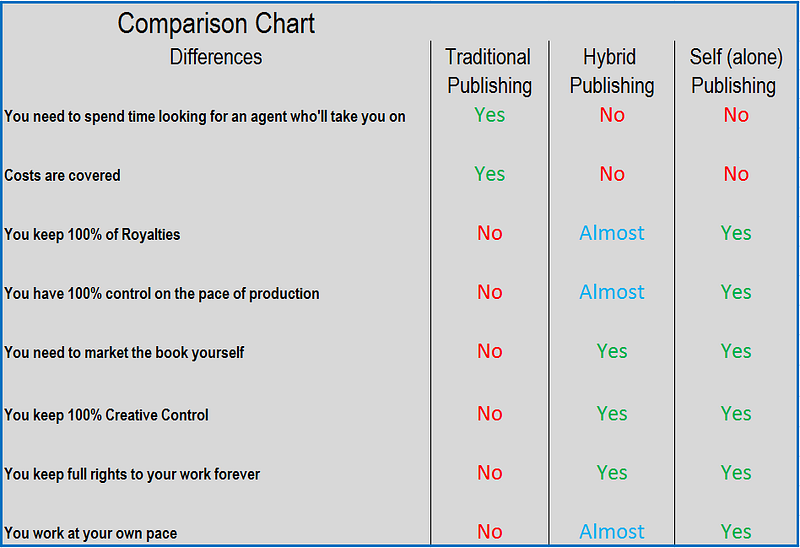
The other difference is that professional hybrid publishers commit to work they think has potential, rather than accepting anything that comes their way.

Talking With a Hybrid Publisher
Desperate for insightful information, I decided to contact a hybrid publisher to pick their brains.
I settled on a group that specialized in memoirs written by women. I watched Brooke Warner on a Ted Talk, but her excellent credentials as a former executive editor for Seal Press sold me.
Great information Brooke confirmed for me
- Unless you’re already a New York Times best-selling author, incredibly good-looking, or famous, it’s next to impossible to get picked up by traditional publishers with an agent.
- Today most significant publishing houses find new writers by scanning self-published books that are selling well. If it’s an acceptable risk, they’ll approach the author to make an offer.
- Win, win for them as the sales are already proven. That also means the author is adept with the marketing aspect of selling their book. Although it might be an ego boost, the loss of control over your work and the decrease in royalties may not be the best option.
We also discussed the many pitfalls of self-publishing on your own
- Lack of professional editing — Grammarly can’t do it all.
- Copy-editing is a different beast and requires a different skillset.
- Professional looking artwork for the cover, spine, and back cover is essential to stand out.
- Proofing the entire project needs another set of eyes.
- Loading the files properly online but also understanding all the nuances of the set-up — like tagging for search results.
- A lack of marketing skills will kill your sales.
- Picking a perfect title requires experience and research.
- Knowing how to choose the correct price point is essential.
Brooke’s immense knowledge of the industry cleared up my concerns but made me realize how much I didn’t know.
I decided to go with a hybrid publisher thinking the professional help would be worth the expense.
But was it the right decision?
I started by submitting my 70,000-word manuscript to Brooke for a detailed evaluation. The publisher will do a complete readthrough, providing feedback and answers to your questions before committing to anything else.
Each service is offered a la carte, allowing flexibility and choices rather than paying a full package price.
- The detailed evaluation I mentioned above was billed hourly and provided in writing. It was full of great detail, well thought out, and encouraged continuing the process. Cost: $640.
- She did recommend a developmental edit to develop the story and my characters further. I decided to use her detailed evaluation as a guide and do the work myself, which saved me an estimated $1,200. That meant putting another 100 hours into my book, but the trade-off was worth the experience.
- Next, they did a copy-edit — a process that took 35 hours plus countless more on my end to approve each correction. It was a fantastic transformation and worth every penny. Cost: $2,450.
- The layout, cover, back cover, interior, and the spine went way over budget. Cost: $2,350.
- You must also purchase your own ISBNs (an identifying SKU) in the United States for $125 each; you need one for the print version, another for the digital. Luckily for me, they’re free in Canada.
- The last step was proofreading and what they refer to as production/management services. Cost: $650.
My Memoir, “Silent Fright,” was available for sale mid-January 2020.
The grand total was $7,290 — wow!
My pre-launch goal date of Oct 1, 2019 (to capture holiday spending) was missed by a long shot. This timing issue was disheartening, but unfortunately, out of my control.
The Great Stuff
- Getting honest feedback and assistance from a professional writer, editor, copy editor, and cover artist was priceless!
- They taught me the specifics of writing a memoir.
- I paid for their services “a la carte” and chose what I needed as I went.
- I paid for each service on completion, not all upfront.
- The proper formatting and file uploading/book revisions were all done for me.
- My cover, back cover, layout, and spine were put together by an artist — which was more critical than I thought!
- They knew my legal rights as a memoirist and guided me accordingly.
- They handled all the copyright details inside the book.
- They did a digital file upload to Ingram Spark, KDP, Barnes & Noble, Kobo, and Smashwords.
- They provided excellent feedback on my title selection.
- Brooke was available for me when I got stuck.
The Not So Great Stuff
- My pre-launch was held back by their schedules, holidays, and unexpected sick days, which hurt my initial sales.
- I caught billing errors on their end.
- There were communication issues by email, and things slipped through the cracks.
- After my initial call, our conversations were considered one on one coaching. I was charged $100 for 30 minutes — hence the many emails.
- Surprise costs popped up (due to estimated editing hours) because they were basing them on the original manuscript of 70,000 words.
- The cover designer couldn’t relate to my vision, so I ended up getting a professional photo of myself done. That was a complete pain in the butt.
- They had mad publishing skills but weren’t adept at running their online business.
Things You Should Avoid
- Choosing a hybrid publisher outside your country. Converting U.S. funds to Canadian sucked, plus she wasn’t familiar with the rules in Canada. I ended up doing the additional research required.
- Paying too much for services based on hourly estimates.
- Not getting the whole picture upfront.
- Being too lenient about your launch date requirements.
Things You Should Consider
- Know what questions to ask before you start the process — share this article or use it as a guide for your free call.
- Do thorough research on the hybrid publisher’s credentials — like all businesses, some are rip-offs.
- Knowing what items are worth paying for will depend on your expertise, but from my experience, if you can only afford one thing — make it a copy edit.
- The what, how, and why of marketing your book takes time and effort.
- It’s not a get rich quick endeavour — let that sink in.
- Make sure the publisher is a good fit for your genre.
- The whole process is hard work — really hard.
- Hybrid Publishers are in business to make money just like everyone else.
An Inspirational Wrap-Up
The money I spent has not been recovered to date in sales, but I’ve chaulked that tidy sum up to my continued education, therefore writing it off as a business expense.
My lack of sales is directly related to my disinterest in marketing — those who’ve read my memoir loved it, and the most consistent feedback from readers is that they couldn’t put it down.
Therefore, the editing costs was money well spent.
I don’t regret the experience because I learned so much, but I wouldn’t spend that kind of money a second time.
Please don’t go into the process blind like I did; use this information to guide your research and do what’s best for you.
Cheers to your success!