
Should You Publish an Ebook in 2022?
As writers, it’s our duty to connect with readers from every corner of the world

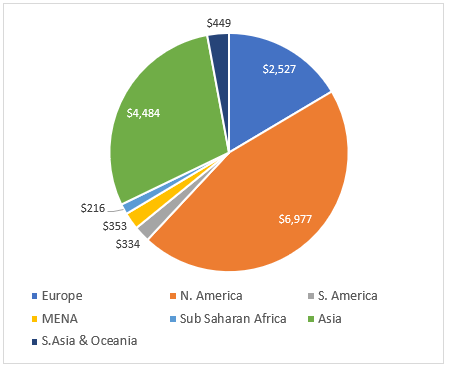
According to the Digital Printing Press, the global book market is estimated to be somewhere between $120 and $130 billion per annum.
- Europe — $40 billion
- US — $25 billion
- China — $20 billion
- Japan — $15 billion
- India — $4 billion
- ROW — $20+ billion
Plus, “roughly US$3Bn across Central and South America” (Winston, 2022).
Isn’t it ironic that the owner of the most famous eReader in the world is named after the longest river in the world?
The Amazon — a region, rich in natural resources — has the lowest market potential for eReaders, despite a huge population.
So let’s explore this further, shall we?
The eBook Market
The global eBook market, as a segment of the entire book market, is estimated to be as big as $30 billion a year. So quite significant. In fact, the global eBook market is “bigger in its totality than the entire US book market.”
Given that this figure is based on shared data from major retailers only, with even Amazon figures hard to come by these days, the actual size estimates of the total independent eBook market are at least twice as large as what is reported (Catalano, 2018).
This indicates that the global ebook market is “simmering under the surface, one at least US$30Bn in size”.
Lovers of print are simply confusing the plate for the food. — Douglas Adams
But even with this data to hand, “the potential of a digital book market is underestimated”, considering penetration in multiple markets around the world” that’s very much in its infancy, “suffering from relatively easy to overcome adoption barriers.” (The DPP, 2022)
Analysis
So it’s clear that there is a massive market out there. A complex marketplace with “multiple entry points and a variety of profit margins.”
As such, there’s massive “room for growth in a number of countries, including what would be considered the more mature”, with adoption in mind.
The US for example, is still only at 24% ebook usage, meaning there is plenty of room for growth — Phil Winston
Other regions tend to be lower than the US, with some markets representing “up to 90% of customers available as the first time and potential repeat readers of your work.” This includes non-English speaking countries:
- Germany — 11% adoption, but a high $37 average unit price.
- Spain — A “fertile market for testing the waters in Latin markets also, with 14% adoption and $29 per unit” on average.
Establishing a reader base in high-adoption counties could light the way “to perfect a book or series, and even a marketing strategy, before expanding into the much bigger but lower revenue-generating markets”, like Latin American countries (The DPP).
Conclusion
The ebook market opportunity is therefore not simply “a function” of consumer preference, but rather a byproduct of “access, for readers and authors alike, where little to no e-reader distribution exists,” as a result, very little or no ebook adoption and consumption occurs.
Books are no more threatened by Kindle than stairs by elevators. — Stephen Fry
This aligns with the DPP’s proposition, which is based on the fundamental premise that “the lack of money made by authors is clearly not due to a lack of money in the market. But of structure.”
No doubt hard-copy books will continue to be popular around the world unless, of course, you live in a country where paper equates to heat, warmth, cooked food, basic survival needs.
You cannot read words through flames!
So the onus is on us, the Authors, to enable the world to read our work.


