
The Reflective Eclectic
Should You Choose a Therapist By Their Credentials?
I can tell you about mine
If you’ve ever looked for a therapist, you have seen their credentials. They take the form of acronyms after their name that are shorthand for all the relevant diplomas, licenses, and certifications. If you’ve gone to a therapist’s office, you’ve seen some important looking documents hanging on the wall, the actual diplomas, licenses, and certifications. What do they mean? Can they tell you the therapist knows what they’re doing?
Well, I can’t tell you about the ones your therapist has, but I can tell you mine and what they mean to me.
Diplomas
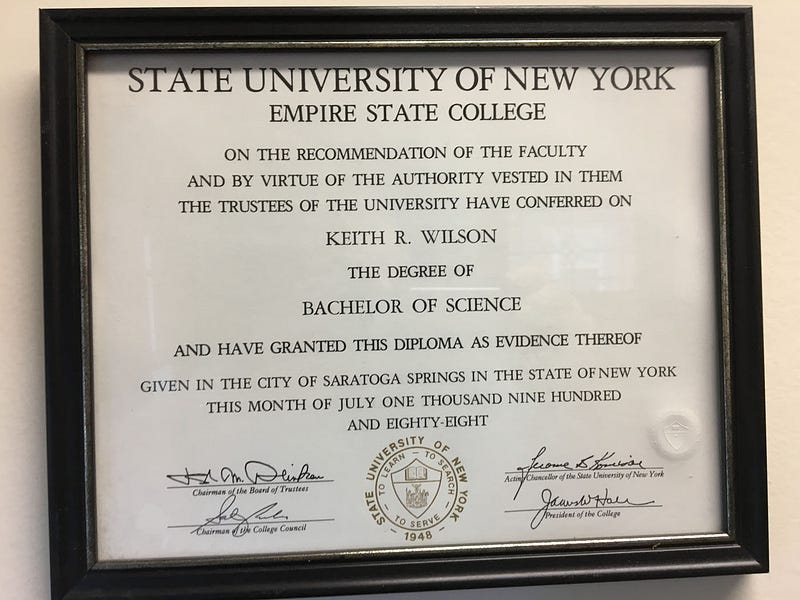
The first is the least consequential, but it’s the one I’m the most proud of. It’s my Bachelor of Science degree from Empire State College. Empire, a SUNY school, is the most innovative concept to ever come out of an educational bureaucracy before online learning. Students get their degrees largely by independent study. The college hooks you up with an expert in your subject area and together, you plan how you’re going to study it and how you will demonstrate your learning. I had field experience, read books, and wrote papers; but I attended very few lectures and no symposiums with other students. I also never lived in a dorm, played Frisbee in the quad, or experienced other aspects of college life. I wouldn’t have minded any of that, but I was working, had a family to think about, and was living in a rural area; so, the usual college scene was not for me.
Empire was the ideal choice for me because, not only did I live way out in the country, but I also had a family and a sawmill business. The college allowed me to enroll and dis-enroll frequently to accommodate my busy times. It also allowed me to claim two years of college credit for extensive learning that occurred before I started college. You see, when you live in the sticks with no internet, no TV and, for many years, no electricity, you do a lot of reading.
I started to go to school because I was sick of making little pieces of wood out of big pieces of wood in the sawmill, but I didn’t know what to major in. Therefore, I started out studying literature because that’s what I loved. Invariably, as many students of literature can attest, people started asking what I was going to do with my degree, so I switched it to counseling. The story of how I came up that must wait for another day.
I began working in the counseling field even before I got my degree and was a full-fledged, if unofficial therapist long before I finished my masters, which is supposed to be the ticket to entry into the profession. I could do that in a rural area because there was such a crying need that they took anyone. Still, I knew a master’s degree would be necessary to be official and, as Empire had no appropriate graduate program, I prepared to do a lot of driving.
I began my studies at Mansfield University in Pennsylvania, majoring in rural psychology, but when I got an unofficial therapist job in the opposite direction from Mansfield, I was able to transfer to Alfred University.
My second degree, Masters in Education with an Emphasis in Counseling is from Alfred. Here it is.
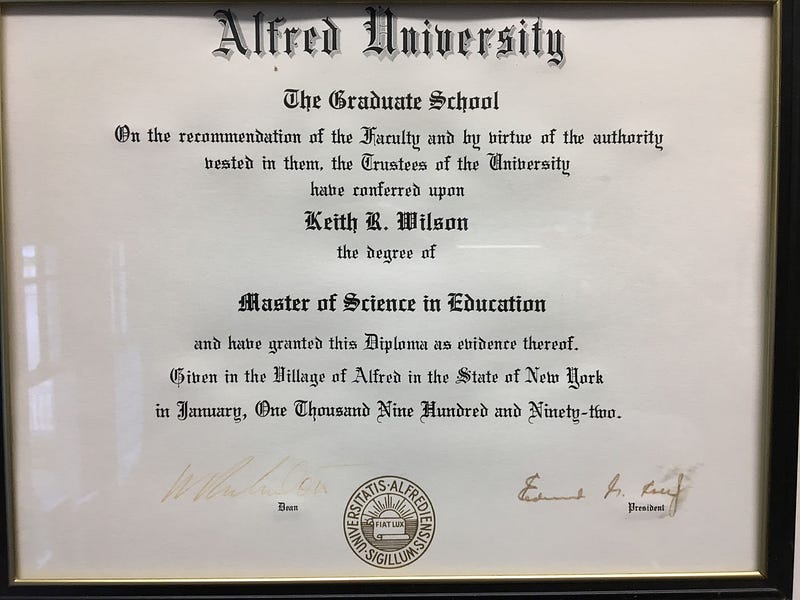
I liked Alfred, but I can’t say I learned much that I later used. I was really trained on the job, in clinics by people profoundly impaired by mental illness and frustrating addictions. There should be a sheepskin for that.
I seriously considered getting a PhD, so I could have another diploma to put on my wall, but counselors with PhD don’t get paid a nickle more than those without. I might have wanted one so I could teach; but when you have a non-traditional academic background like mine, you can’t assume you’d enjoy academia.
After Alfred, I moved to the big city and did some post-grad work at the Family Therapy Institute in Rochester, New York and learned all about substance abuse treatment from another SUNY program in Brockport. If I ever find those certificates, I’ll put them on my wall. I also don’t have documentation on my wall for the hundreds of conferences, workshops, and other brief trainings I’ve completed, but here’s a picture of the folder I keep them in.

I keep the Empire and Alfred diplomas up because some people look for them and would be worried if they weren’t there. People like their therapists to be well educated. I’m proud that I have them, especially for the fact that I was the first in my family to get diplomas, but do I really think they’re important? I think it’s important that a therapist knows a lot of things, has experiences, and can talk intelligently. I also think it’s necessary that a therapist take the profession seriously and not just start doing the work without considering how to do it well.
If you have a way to tell that a prospective therapist knows a lot of things and takes their profession seriously without looking for diplomas on the wall, go with that.
Licenses
Now, I’d like to tell you more about objects that are hung nearby. These are the licenses.
The first one, strictly speaking, is not a license, it’s a certification. It’s a document that attests that I am a Credentialed Alcoholism and Substance Abuse Counselor, or CASAC.
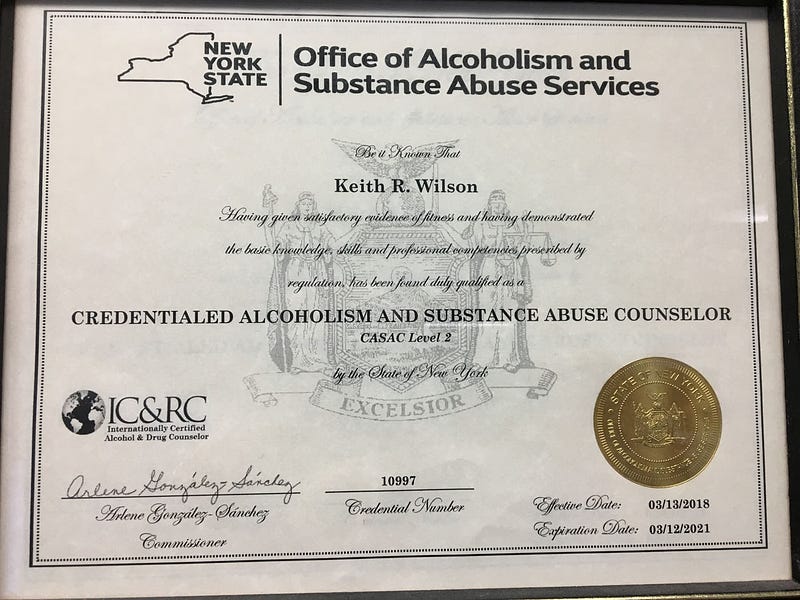
Most people don’t know the difference between a license and a certification. A license gives me permission to set up an office as a counselor. In the substance abuse field in New York, individuals don’t have licenses. Substance abuse treatment is very highly regulated by the state and they only give out licenses to big clinics that they can regulate more thoroughly. The certification is supposed to verify that I know how to provide treatment, but it doesn’t give me permission to actually provide it outside of a licensed clinic. Luckily, I am able to set up an office as a counselor because of my license in mental health counseling.
Even though the CASAC is not worth much to me now, it was a hard thing to get. I had to complete a long training program, thousands of hours of supervised experience, take a test, get fingerprinted, pay a bunch of money, and present a case to a panel of judges. The last part was the hardest. I flunked the orals two or three times before I passed. The final time, on Halloween, I walked in and one of the judges was already wearing his costume, a Star Trek uniform. I took the hint that I was taking the judges far too seriously and I would do better if I dumbed it down a bit. Later, I took the course to become an examiner myself and found that when I had been trying to blow them away with my sophisticated erudite formulations; I was blowing myself away; or, shall we say, blowing myself. They were looking for simple answers. Substance abuse treatment in those days was all about simple answers to a very complex problem.
I’m happy to say that substance abuse treatment and substance abuse counselors were beginning to change when I got my certification. It used to be that you barely needed training to enter the field. The strongest qualification was that you had a problem with alcohol or drugs yourself. No wonder they didn’t want to give them licenses.
The true license I have on my wall is one to be a Mental Health Counselor, or LMHC.
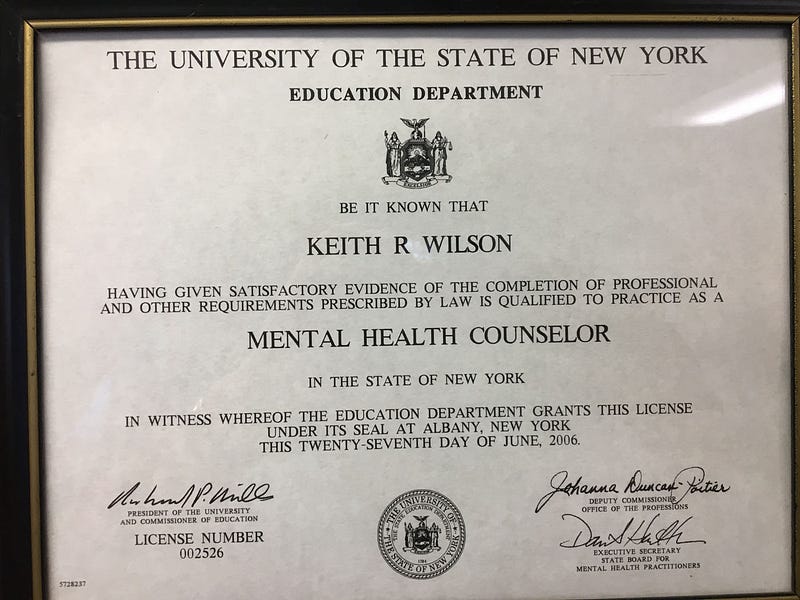
This is the meaningful one that allows me to practice my profession. Ironically, it wasn’t hard to get at all. The New York State Legislature created the profession after I had already been in the field many years, working under the license of a community mental health clinic. I got grandfathered in. I understand people who get an LMHC these days have to go through a lot to get it, as much as I did for the CASAC, minus the oral exam.
The law obligates me to display my license, so that’s why it’s up on the wall; but I’m not sure how I feel about it. I’m not ashamed that I have one; I’m ashamed I participate in licensing. You see, the purpose of any license is to keep people out of a profession, so the people in the profession can charge more for their services. If this sounds like a big racket, it is; although, to be fair, it also protects the tremendous investment of time and money counselors must make to learn to perform their profession well.
People in favor of licensing are always going on about how it protects the consumer from people who say they know how to do counseling, but don’t. I’m not sure I buy that. Just because you’ve been taught how to counsel, doesn’t mean you actually do it well.
The license gives me permission to call what I do counseling. If I didn’t have a license, I could still do counseling, I just couldn’t call it that. I would call it something else, like coaching. You can get some perfectly good counseling from a person who calls himself a coach and isn’t licensed and hasn’t gone through all the rigamarole I did. Can you trust that your coach is competent? I don’t know, but I don’t suppose he or she would be in business long if she isn’t and the word spread. A licensed counselor, on the other hand, could stay in business as long as he doesn’t do anything blatantly unethical. Even if he was incompetent, people would trust him because he has a license.
The CASAC is an interesting case. If all I had was a CASAC, I would be certifiably competent to counsel people about their alcohol and drug use, but I wouldn’t have permission to call it counseling. Try to wrap your head around that one. If you can, then I think you’d be a lawyer; but I believe you’d have to graduate from law school to be able to call yourself one.
By the way, sometimes what I do is called counseling, sometimes it’s called psychotherapy. I’ve never been able to tell the difference between the two and the law doesn’t seem to be able to tell the difference, either. Mostly, I like to call it head shrinking because that term punctures the arrogant aggrandizement of many in my profession. We tend to take ourselves and our credentials far too seriously.
Keith R Wilson is a mental health counselor in private practice and the author of three self-help books, two novels, and innumerable articles. He managed to find something to do with studying literature, after all. A third novel, Who Killed the Lisping Barista of the Epiphany Café? is currently being published one chapter at a time in Medium.


