
How To Manage Your Next Doctor Visit
A Bit More Doubt Can Help Everyone
I was shocked last week when I heard my partner describe me as…
“…a little against medicine.”
Wow, I had never thought of myself as against medicine!
If not for the medical advances of the last thirty years, I would have died sixteen years ago or, at the least, faced a disastrous quality of life.
Medicine allowed my super-preemie brother to survive. Had he been born a decade earlier, he would not have lived to tell the jokes that kept my family going in the 1980’s.
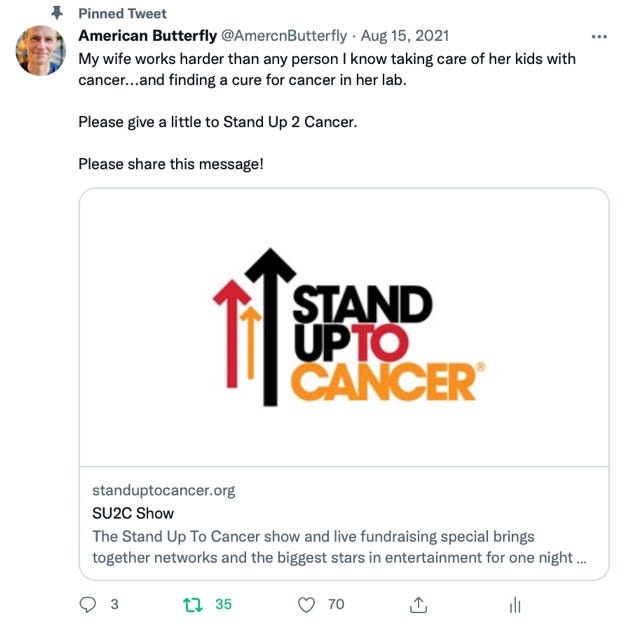
I regularly celebrate the medical research done by my spouse and her care for children with cancer. I have pinned this request on my Twitter account:
I am not a scientist, but I like to think myself a scientific thinker when it comes to organizational processes. A scientist around getting work done well and efficiently. And in the last five years, a tinkerer about ways to better engage many people, bigger groups, and the broader society.
How could I be “against” medicine?
We had just brought my teenager into the dermatologist’s office.
My spouse had seen a small “intradermal” mark on a big toe. She didn’t like its looks. A standard mole or “nevus” is generally not cause for concern. But when they grow rapidly, change color, or change shape, we should have them looked at by an expert.
This spot was small and of a consistent color. One side of our family had no history of skin cancer — despite pale skin, a tendency towards excessive sun exposure, and a history of other types of cancer. The other side reported one case of a rare skin cancer in an indirect relative.
Before any observation was made by the dermatologist, my spouse described the situation. Our child had noticed the spot. My partner — given the wonder of the hand-held computers we still persist in calling “phones”— had taken a picture of the spot. A week later the next picture suggested the spot may have grown a little and may have changed color.
You and I know the reality of pictures.
Pictures, though worth a thousand words, can be extremely valuable but also deceptive. The person who coined the “thousand words” phrase in 1921, Fred R. Bernard, was an advertising executive who knew how to promote his business. We need merely watch a few minutes of today’s news, and we know how pictures can distort truth.
Words can be even less perfect. By including certain words and omitting others, a story can twist wildly.
One word in place of a similar one can change meaning almost as much as adding a “not” to a sentence. We all tell stories with subtle inflections. Sometimes we mean to. Often we don’t.
After the picture and the story, the dermatologist had made a diagnosis before directly investigating the questionable spot hiding underneath the socked toe. The next step of the treatment plan had already been made. We would biopsy the spot, cutting out the offensive tissue in a wide circle, and send it to the lab for evaluation.
A week later we were relieved when the diagnosis returned a verdict that the tissue was wholly non-cancerous, completely benign. Not even a mole. Just blood from a bruise.
We tell ourselves that the doctor visit, missed school, missed work, risk of infection (shoes are warm, wet places beloved by nasty bacteria), missed soccer practices, and the significant pain experienced over a tournament weekend (pivoting on stitches felt like jumping on splinters) was all worth it. Even the cost of the in-room, ten-minute outpatient procedure and the basic suture removal kit — certainly billed to the insurer at a price of multiple thousands of dollars — is thought justified.
The decision to biopsy the region was well within the standard practice of modern medical care.
Nonetheless, the standard of care is rather broad and tilted towards more exams and more visits as long as there is confidence in the ability to pay.
This bias towards more visits, more exams, more scans, more treatments, and more medications is completely understandable. We want to FIX problems. We want to DO something. We feel we must to TAKE ACTION.
The act of doing nothing other than waiting and watching will almost always be viewed as a surrender, a cop-out…even when it can be the better option.
There are times when we absolutely know we should visit the doctor: broken bones, big cuts, high fevers that stick around for many days,…
These all make sense. A medical visit can easily keep an arm healthy and save a life. I can recall late night visits to the emergency room for a fractured collar bone, ankle ligament injuries, and one busted knee: “Sorry for all that lost sleep, Mom!”
Much harder are the vaguer aches and preventative care visits.
In my early thirties I reluctantly visited my primary care doctor after feeling waxing and waning pain in my groin. When I described it to the nurse, saying I had felt it for some months, they openly berated me, “You could have scrotal cancer! Why did you wait so long?!?”
The physician examined me. They ordered tests and ultimately diagnosed it as indeterminate pain, possibly diet related, nothing to worry about.
A few years later, after a month of bleeding, another physician, an expert in such disorders, diagnosed me as suffering from advanced ulcerative colitis, a yucky disease where the immune system attacks the colon. “You’ve probably had it for a decade.”
The nurse who had yelled at me for waiting a few months would have lost their mind at my father. During an unrelated medical procedure in his late sixties, a nodule in his lung was found on an x-ray and deemed worthy of a follow-up visit in six months.
Already struggling to pay his medical bills and being frankly anti-medicine, he did not follow up. Dad had always been extremely healthy. In his family, the hospital was a place for sick people, something to be avoided.
You know how his story ended. Three years later he succumbed to lung cancer.
When we feel certain that something is wrong, please, go to the doctor!
Nonetheless, we need to be thoughtful. And to recognize that medical visits and medical procedures do have downsides.
The medical system remains a fairly blunt instrument.
Physicians, like all of us, know mostly what they have seen in the past. They can find themselves fighting today’s battles based upon yesterday’s experience and science.
Naturally, too, each specialty is equipped with biases.
A pediatrician can’t react to everything they encounter. Otherwise, our children would all be scheduled for way too many tests and excessive specialist visits.
An oncologist focused on young people is in the opposite place. They should be hyper vigilant. They have seen the oddest of things turn out to be cancer, and children — with so much life ahead of them — are worth the effort.
An oncologist who treats the aged can find themselves on the other extreme. A seventy year-old has had a good life, and there is only so much money to be spent on any one person. As a result, they are less likely to seek out cutting edge treatments after the basics have failed.
The medical system remains imperfect.
Physicians, nurses, technicians, and medical management work extremely hard!!! Nonetheless, errors are certain to happen.
The National Academy of Sciences funded research described in To Err Is Human: Building a Safer Health System. This work explains that around 3% of hospital admissions result in adverse events. Over 50% of those are due to preventable errors. These preventable errors alone resulted in an estimated 44,000 to 98,000 additional hospital deaths in the year 1997.
Hospital errors killed more people in 1997 than automobile accidents. Automobiles deaths are typically just outside the top-10 causes of American deaths.
My immediate family — which is medically savvy — has experienced the following:
- A top physician demanded strenuously that he operate on a young child to remove a “pre-cancerous body.” That “body” turned out to be a wooden splinter that was naturally working its way out of the skin. At the time we were terrified most about their first exposure to anesthesia. Anesthesia was thought at the time to be harmful to the young brain.
- A mother very nearly died from post-birth bleeding that for days physicians insisted was inconsequential. The junior physician who performed the emergency operation on a Sunday was so traumatized that they refused to meet with the patient to explain what had happened after the “30-minute” surgery ended up taking 3-hours. Thank goodness for the anesthesiologist who stayed long enough to explain that, “We almost lost you. You are a strong woman!”
- After making an assessment based upon imaging — even though clinical logic suggested otherwise — physicians insisted on treatment that led to days in the hospital, a painful drug reaction, and tens of thousands in expenses. After seeking out a second opinion, new imaging and a senior radiologist reversed the assessment. Admirably, the senior radiologist explained to the resident their error and apologized to our family.
Many of us have experienced times when medical care was NOT worth it. When it was harmful.
This is an extremely hard message to know how to follow:
Go to the doctor only when you truly need to. Avoid medical procedures when you don’t truly need them.
We crave easier guidelines like…
- Change your car’s oil every 5,000 miles.
- Leave your house in case of a fire.
- Don’t cheat on your taxes.
Still, even these can be nuanced and subject to multiple interpretations. It can be reasonable to attempt extinguishing a kitchen fire yourself. Jeff Bezos almost certainly employs “tactics” to manage his taxes that some think are cheating.
So, what tactics get the best out of America’s medical system?
The long answer could easily stretch into a book.
We should begin by living a “healthy” life. The people of Nicoya, Costa Rica are among the longest-lived in the world even though they have access to less medical care than most Americans.
What else can we do?
- Use simple words when talking with medical professionals. Avoid medical terminology. In our era of information we want to believe that we can be educated on most issues. Realistically, though, medical terminology often has implications and interpretations that patient cannot easily know.
- Don’t ignore medical problems and clear issues. As much as we may want to believe that healthy living is the key, avoiding known issues can be deadly. Follow up.
- Approach possible medical treatments with a little doubt, a healthy skepticism. Ask “Why?” Not in an argumentative way…but as an equal partner in the decision-making process.
Please follow J. Andrew Shelley to read more. Let’s experiment with better ways to help our world.
Be well


