
Should My Sister Be Forced to Stay in a Nursing Home?
She was determined to go home, and nothing was going to stop her.

When I visited my sister this week, her stairlift was broken. It was a used one my husband and I bought, and it worked like a champ for two weeks.
Now she was stuck upstairs with a mini-fridge and a microwave, and I was on the stairlift company’s helpline with a man named Walter. He talked me through 30 minutes of plugging and unplugging, checking wires, pressing buttons, and reading error messages that blinked sporadically on the lift’s screen. When nothing helped, he said maybe the motherboard was shot. A technician would need to come out and replace it.
Later that day, my husband and I followed Walter’s recommendation and purchased a $595 service contract that would be cheaper than paying for everything piecemeal.
I’m relating this story to let you know that my sister’s decision to leave a nursing home rehab facility two months after her stroke has not been without its challenges.
Her stroke left her paralyzed on her right side. After one week in the hospital, she was transferred to an intensive rehab facility for two weeks. There, she learned to maneuver a wheelchair using one arm and one foot, and to take wobbly steps leaning on a Hemi cane designed for right-side paralysis.

She could only remain in the intensive rehab unit for two weeks. After that, she moved to a combination nursing home and long-term rehab facility. From the day she arrived there, she wanted to go home.
I tried to talk her into staying. “The food is good. You get to interact with people. You’re improving.”
Determined to Go Home
But nothing deflected her from her fierce determination to go home. She hated having a roommate who stayed up all night watching television. She hated her lack of privacy. She loved her home and missed it. She was bored.
Looking beyond her arguments, I sensed her deep-seated fear that she would never go home.
Her daughter was adamant that she not leave the nursing home as long as Medicare continued to pay. We both urged her to stay the full 100 days of her coverage.
But our arguments were futile.
My sister, who has always been determined and stubborn, checked herself out of the nursing home. Because the stroke did not affect her cognitively and because the doctors considered her to be of sound mind, the facility released her. She arranged for a wheelchair and cane, paid for by Medicare, to be at her house, and someone stocked the refrigerator.
The Blow Up
She told me her daughter was supposed to pick her up the morning of her release. I offered to help, and this is when things blew up. The daughter, furious at her mother’s decision to leave rehab, decided she would no longer be involved.
I had to sign the nursing home release papers and get my sister home. My niece is not communicating with me now, nor is she speaking to her mother.
I need to add that the daughter had been handling everything up until this moment. She had been at the hospital every day, had made arrangements for the rehab facility, had taken my sister’s two dogs home with her, installed an emergency system in the house so that she would be notified in case of problems, had the house cleaned, and made arrangements for doctors and prescriptions.
I could understand her being angry and upset. But sometimes we need to accept other people’s decisions, whether we agree with them or not.
A Month Later
My sister has been home for a month and is happier than she was in the nursing home. During the first week, before the stairlift was installed, friends from church brought meals.
When I was on a two-week trip overseas, my daughter-in-law visited her. My sister also has a steady stream of visitors from the neighborhood and from church. Medicare pays for occupational and physical therapists to work with her several times a week.
She can make her bed, dress herself, and do her laundry. A nurse’s aide comes by and washes her hair.
The Challenges
When I visited last week, a large box had been sitting outside in the Georgia heat for more than a day. I dragged the box inside and cut into soggy cardboard. Stacked in the box were meals provided by Medicare. I was going to throw them away since the dry ice had melted, but discovered they were still frozen, so put them in the freezer, instead.
This is not an ideal situation. I would have preferred that my sister remain in rehab for as long as she could. However, she is happier at home, and is resting better. She is not independent, but an operable stairlift will help toward that goal, and the lift is supposed to be repaired next week. Groceries can be delivered, and doctor’s appointments can be virtual.
Maybe when she can get downstairs, she’ll be able to go on short outings. While she was in rehab, I checked her out and we drove to Waffle House, which was good for her mentally.
I live almost an hour away, so I can’t drop by all the time, but we talk on the phone every day, and my sister says she’s fine.
The estrangement between mother and daughter grieves me.
The daughter lives only minutes away, and could do so much to help. She gave one of her mother’s dogs away and adopted the other one. She could bring the dog she adopted for visits, or pick up prescriptions, or drop by just to chat. She could have moved the box of meals inside before the dry ice melted.
I understand the daughter’s position, because she has experienced her mother’s stubbornness and determination many times over the decades. They have never had a placid relationship. They both only see things from one point of view.
Yet, when you love someone, you accept their decisions, even if you don’t agree. Forgiveness is necessary.
Most of the time, people don’t change.
Are we willing to relinquish relationships because they are difficult, or because we don’t agree with another person’s decisions? Those are questions each individual has to answer. We all have our own emotional baggage, and what one person tolerates might push another person over the edge.
Was I wrong to help my sister live at home? Am I an enabler? I don’t know, but yesterday I went to an upstairs bedroom I seldom use. It used to be my son’s room, and I wanted a private place to rest.
Memories and Love
My sister, who has a flair for decorating, helped me remodel the room several years ago after my son moved out. The walls are painted bright yellow, and cheerful pillows decorate the white comforter she bought for me. We went thrift store shopping and spotted some great chairs and art to complete the decor.
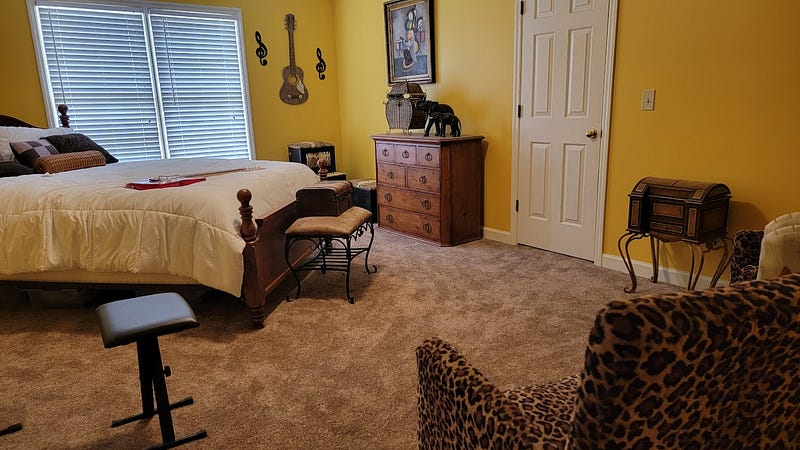
Every time I’m in that room, memories of times with my sister resurface. For the past 20 years, she has come to my house for Christmas and brought fun gifts for my kids and grandkids. We used to meet at Bonefish Grill for peach martinis and dinner when one of us had a birthday. Not long before her stroke, the restaurant went out of business, and we talked about finding a new place to celebrate.
Life surges forward, sweeping us along. Nothing stays the same, but we still have our memories and our love.
I hope my sister and her daughter reconcile. There might come a time when it’s too late.
Should my sister have been forced to stay in a nursing home? At this point, that question is irrelevant. She made her choice. The question now is, can we be tenderhearted and forgiving enough to accept each other’s choices?
Bebe Nicholson is a graduate of the UNC School of Journalism, former newspaper editor, flight attendant, nonprofit director, and publisher of 4 books, the latest being Bebe’s Bladder Book. She has also published a Kindle version of Anna Long Thomas Fuller’s Journal, a Civil War diary that sold out of its first two printings and is no longer available in print form. She and her husband split their time between Georgia and South Carolina. They have three children and 12 grandchildren.


