
Should Men Have a Curfew to Make Women Safer?
Women constantly have to change their behavior and they are still getting killed. Maybe it’s time to focus on men instead.

She was just walking home. Nine days later, her remains were found 50 miles away. A police officer has been charged with abducting and murdering her.
Sarah Everard was 33-years old and worked as a marketing executive. She had an entire life ahead of her. She had just started a new job and met a new boyfriend. She phoned him as she left her friend’s house and started the walk towards her home in Brixton, South London. Then she disappeared and was never again seen alive.
“She was sunshine and light, and made you feel warm and good and safe,” one of her friends told New York Times. Sadly, she would never be safe, not in this world.
She was 33 years old.
It was 9:30 pm.
She was just walking home.
These facts have been echoing in my head ever since it happened, carrying with them an ache of heartbreak and anger.
In the UK, where I am originally from, the event has launched a movement akin to #MeToo. Women are taking to social media to talk about their own experiences of being harassed, followed, and scared. Many also took to the streets of London for a vigil, before the gathering was torn apart by police officers.
It’s not a good look, when one of your colleagues has been charged with abducting and killing a woman, to manhandle the protestors peacefully standing vigil for their stolen sister.
She did everything right
Something that the media were quick to point out is that Sarah did everything ‘right’, and yet she still got killed. Because yes, in our society of victim-blaming, there is a ‘right’ and a ‘wrong’ way to walk home, as a woman. There is a list of guidelines that women are expected to incorporate into their routine.
Sarah did it right because it was only 9:30, she was wearing sensible shoes and easily recognizable clothes. She phoned her boyfriend as she walked. But the fact is no amount of personal choices or comfortable footwear allows women to outrun a society that does not protect them.
The fact that Sarah Everard did everything ‘right’ is also what has drawn so much attention to this case. Of course, Sarah deserves every bit of the attention, but so do too many other disappeared women who get left out of the narrative for not being the perfect victim:
If Sarah had not been white, if it had been two in the morning, if she had been a sex worker, it would have been easier to blame her.
Even in victimhood, women better be on the right side of society’s definition of tolerable femininity.
Even more heartbreaking than the fact that women are expected to do — or not do — so many things to stay safe, is the fact that even when they do so, they still get murdered. Yet the burden of staying safe is placed on their shoulders.
A curfew on men?
This is what led Baroness Jenny Jones of the Green party to suggest in the house of commons that introducing a curfew for men would “make woman a lot safer.”
If only as a thought experiment, the idea is tempting. Imagine walking home from a party without jumping at shadows, going for runs after dark without a second thought.
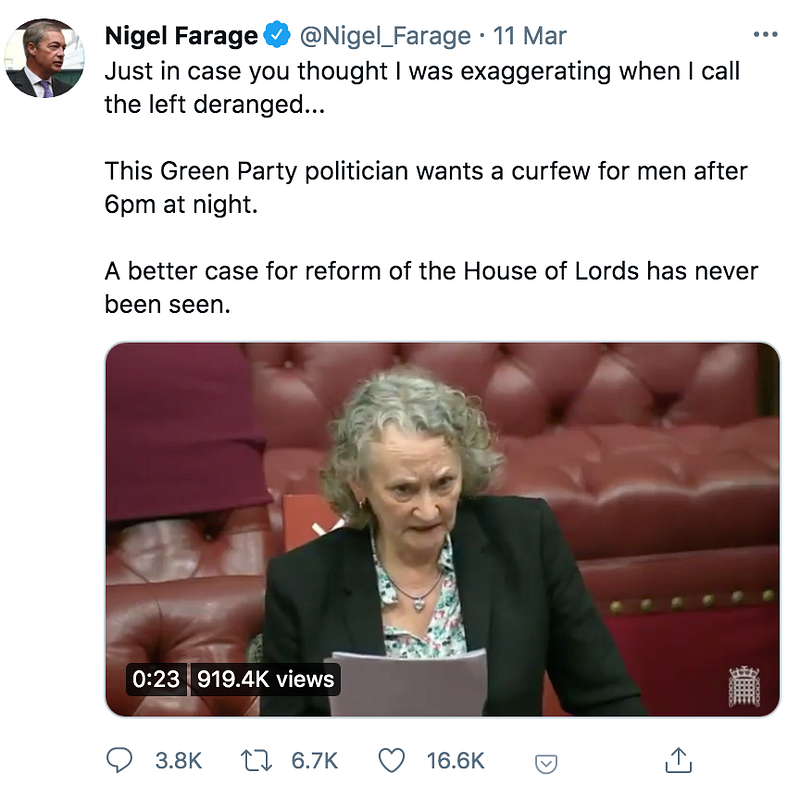
Social media was outraged at the idea. Nigel Farage tweeted that it was an example of the left being “deranged”. Mark Drakeford, the Welsh first minister, described the idea was “a sad distraction when what’s needed is a proper discussion about women’s safety and why a woman is killed every three days by a man in the UK”.
Of course, no one actually thinks a curfew of men is a good idea, or at least not a sustainable or practical idea. Not least because domestic violence is so prevalent that it’s not like keeping men at home is going to make women safe.
What Jenny Jones really wanted was to draw attention to is our society’s double standard: how easily we accept restrictions imposed on women, even to the point when we blame them for falling victim to violence, while the idea of men, the perpetrators of that violence, having to change their lifestyles, is outrageous.
Women face lifelong restrictions, and no one bats an eye.
The fact is, women are subjected to an informal curfew for their entire lives.
They are constantly forced to police their behavior to remain safe. The anger that comes at the suggestion of a curfew for men should make us realize that women’s rights and freedoms are under debate in a way that men’s are not. No one seemed to bat an eyelid when London police advised women “not to go out alone” after Everard’s disappearance.
When you think about all the restrictions that women are subject to, the idea of a man’s curfew becomes less absurd. If 2020 has taught us anything, it is that governments are able to make life-changing, sweeping decisions when they decide something is a priority. Violence against women is endemic, and if politicians considered it important, it would be possible to put restrictions on men to prevent it from happening.
Of course, there shouldn’t be a curfew on men. There should also not be an unspoken curfew and an entire set of rules for women on how to not get attacked. The only way to solve this problem is to make it a priority for everyone in society, to work together to give women back their place and their safety in the streets.
Surely, we can do better as a society than decorative panic buttons and rape whistles shaped like lipstick. Women deserve better.