Should I Kill My Roommate?
Why Is it So Difficult to Convince People to Do the Hard Thing
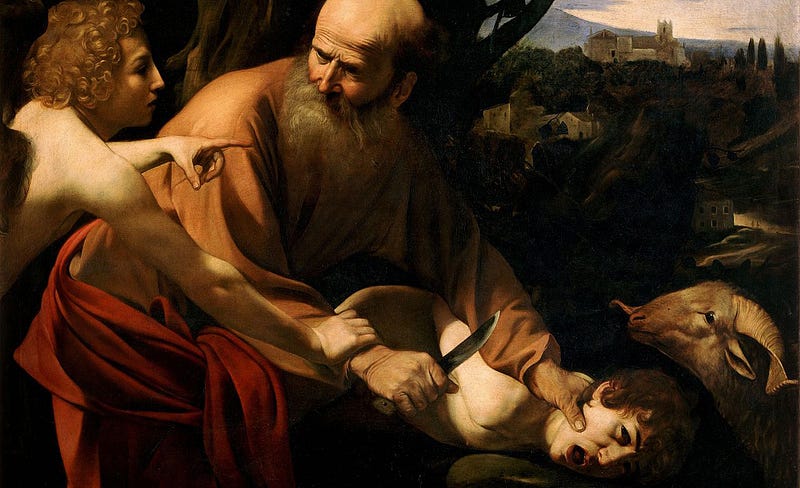
He bound up his son, tied up his hands and feet. With trembling hands, he removed the small blade from his hilt. With fear, he moved it towards the throat of his only son. He heard whimpers. He looked up, doubted if the voice from above. He closed his eyes. With a fleeting moment, he charged his blade towards the poor boy’s throat.
We all know how this ends. God sent a lamb running into a tree trunk, committing suicide, and giving it up as a sacrifice. Aside from the trauma, Isaac would be fine for the rest of his life. Everything went well.
Ask anyone if Abraham was right in doing this, you’d get mixed responses. Ask anyone to explain the story, and you’d get a different interpretation each time. But when I asked the same people if I should kill my roommate, they’d laugh and dismiss my sarcasm. It is sarcastic (of course), but I didn’t dismiss it as they did.
Back in the days when people didn’t fly aeroplanes into buildings, the sacrifice of Isaac was an adequate ethical conundrum to consider. With recent history etched deeply in our minds, we’d likely dismiss cases like this as radicalism or extremism. We wouldn’t even entertain such a thought.

Soren Kierkegaard, the Danish philosopher (also, the father of existentialism), however, didn’t think like us. He noticed something profoundly wrong with the way we think about moral actions. He wondered about how moral actions and decisions truly take form in our being. What is it that made Abraham such a faithful and ethical figure when all he did was try to kill Isaac?
If we cast aside radicalism, we can, and should, ask ourselves a crucial ethical question: Why do we do the things that we shouldn’t? And why don’t we do the things that we should?
My life is filled with conundrums like this. I’ve done many stupid things. Most are senseless and regrettable. Some, however, are more complicated. I don’t give to charity. It’s not because I’m completely broke, nor am I a loathsome selfish prick who likes being sadistic. But when people ask, I help more often than not. Here’s a recent encounter.

A scruffy man approached me one day as I was walking to work. He wore ripped jeans, a wrinkled t-shirt, and a pair of dirt-ridden shoes. He looked like he was in his late 40s. He walked briskly past me, stopped, then turned around. He asked if I could give him $5. He needed a ride back, but he lost his wallet.
I had my suspicions. He had his phone. He should’ve called for help. So, as an empathetic human being, I asked him about his predicament. He told me a ‘good enough’ story for me to believe him. He was visiting a friend and lost his wallet as he was walking towards the train station. He justified $5, as his ride home was a long one. He said he’ll make a report once he gets home. He didn’t want to alert anyone about his predicament. He wanted to be discreet about his mistakes.
As a Gladwellian intellect, I defaulted to the truth. I took out my wallet. The smallest denomination was ten. So, I gave him $10. He thanked me, continued our conversation until we departed ways.
To this date, I don’t believe his story entirely. There were loopholes. But he only asked for $5, so he couldn’t be cheating. But that’s how a fraud would’ve maintained his ‘credibility’. If he’d asked for anything more, I’d be skeptical. I didn’t know if he was telling the truth, or I’m just another victim.
Since young, I’ve been bombarded with news and personal recounts of people getting cheated off their money. Beggars on the streets aren’t actually beggars. Charity workers and monks aren’t who they say they are. Every time I went out with my family, my parents always choose to decline helping strangers. This was the world I grew up in. I shouldn’t have given my money, but I did.
People often debate about moral principles. We philosophers sure do. A utilitarian would say that I’m morally obliged to give him that money. A Kantian would do the same. I wasn’t thinking about moral principles then. Only that I had money to spare, and I defaulted to the truth. It was convenient and natural to help.
However, all I had was a semi-believable story from a stranger to decide on my action. And the truth is, I’ve barely reasoned about any of this. My actions were mostly impulsive, emotional, and psychological.
Humean ethicists and moral psychologists would stick their thumb on this. After all, reason didn’t compel me to act. I acted on impulse, and I tried justifying my actions later. Only, that’s not true as well. I didn’t give him the money immediately. I listened to him, thought about it, and only then did I give him money.
So, should I have given him the money? Should I have just said ‘no’? Should I have asked for more details? Am I justified in giving him the money?
Having studied moral philosophy, done a couple of research, and written several papers on morality, I’m honestly lost. Objectively, we should know what to do. But, in the real world, it’s never this simple.
Okay, it might be inapt to compare cases like mine with a wild case of extremism. But to Kierkegaard, and to me, there isn’t much of a distinction. Not because he isn’t a consequentialist (he isn’t), but that he noticed that behind every moral decision lies an idea that moral philosophers often overlook: faith.
Faith isn’t easy. That’s why moral decisions in the real world are never easy. Think about it. Faith asks us to believe in something in the future now. For those of us who go to religious training camp every now and then, it wouldn’t be that hard. For my encounter, I would’ve needed to believe that the man was telling the truth, that my money wasn’t being cheated, and importantly, that I was right in giving money to a shady stranger with a half-decent story. To give or not to give, it’s difficult either way.

Moral Actions Require Faith
Kierkegaard thinks that behind every significant moral decision in our life lies a paradox. This paradox is precisely the question I set out: should I do the things I’m not supposed to? Here, Kierkegaard juxtaposes what we are objectively (or socially) obligated to do and what we are subjectively (or personally) obligated to do. The truth is, these two hardly ever align. Kierkegaard notices this.
Let’s think about another popular philosophical argument utilitarian Peter Singer made. He argues that we are obligated to donate a portion of our money to charity regularly. First, we contribute to the overall well-being of our world. Second, it doesn’t cost us greatly to do so. But most of us don’t do this.
If we understand Singer’s reasoning, it would be close to infallible. We have very strong reasons to contribute to charity regularly. We would do well in living less lavish lives so that others can have barely liveable lives. Do we have any reason to do so? Yes, plenty, in fact. Do we have any reasons not to? Intuitively, not really.
I say ‘intuitively’, as most of us don’t genuinely believe that our donation would contribute to anything. Sure, you’d probably say it’ll help some random starving kid get a week’s worth of food. But in the grander scheme of things, I wouldn’t stake my life on that donation having any significant impact. I would think neither do you. That’s why I don’t give to charity. Or rather, that’s why I don’t subscribe to any charity programmes.
This is also a reason why many people are reluctant to vote. They do not believe in the significance of their votes. It is also why people are reluctant to recycle or turn vegan. I’m not vegan, because I sincerely think that my consumption of animal products has nothing to do with their suffering — fight me. But I do vote. On occasions where we are detached from the outcome, we often find it hard to believe that a single person can change the outcome — despite being constantly reminded that it does.
As we can see, one of the greater motivations behind action and change is belief. It even trumps reason. But it’s not just any belief. It’s faith in particular. It’s the belief in the unknown. Precisely because we cannot experience the consequences of some of our actions, we find it difficult or impossible to believe in our actions. We lack faith. So, we lack conviction. Thus, we don’t do it.
Faith is generated when we believe in our personal obligations. Vegans genuinely believing that they not consuming animal products spares them the responsibility of animal cruelty (it does), so they don’t consume. People who regularly and indiscriminately give to charity genuinely believe that their actions can save lives in some distant place, so they do it.
In cases like these, our objective obligation to do certain things exists; our personal obligation doesn’t. These tend to lead to frustrating outcomes where people aren’t doing what they should be doing. It’s also the reason it’s difficult to convince people to do supererogatory tasks. You got to make them believe in something they genuinely don’t — tough luck.
This is Kierkegaard’s critique of modern ethics. It tends to forget that moral actions and decisions require moral agents to have faith in what they do.
More interesting cases happen when objective obligations contradict with our personal obligations. It’s when Timmy wants candy, but mommy says he shouldn’t. It’s when I’m inclined to give that man my money when I really shouldn’t. It’s when Abraham attempting to sacrifice his son for God when he really shouldn’t.
Should I Kill My Roommate?
Studying abroad for many years taught me one thing: it’s better to have a room to yourself. I’ve had several roommates, I’d thought of killing most of them on many of my sleepless nights — I’m a very light sleeper. They’ve all done crimes that went undetected by man. One liked to drag chairs, creating a choral of screeches. One liked to sing (if ‘sing’ is even the right word) at 3 am while doing his economics assignment. Another liked mangling plastic bags when I’m asleep. They must be brought to justice.

I’ve had voices in my head telling me to sacrifice them to the God of Slumber in exchange for good rest. To assure you my sanity, my conviction wasn’t as strong as Abraham’s.
Any sane person would deem that a preposterous thing to say or to even think about. But the interesting thing about thinking about dark things like these makes you wonder why, indeed, do I not kill my roommate?
I had very strong reasons not to kill him. But I also had very strong reasons to kill him. Philosophers like to say that if the overall reason to kill my roommate outweighs the reason not to kill, then I can or ought to kill. When it comes to evaluating the reasons, I couldn’t be sure which one actually takes precedence. I really want my beauty rest.
See, if I kill him, I’d end up in jail — if I get caught. I’d have a guilty conscience, and I’d have more sleepless nights. If I don’t kill him, I’d definitely not get any rest any time soon. I couldn’t be sure of either one of the outcomes. Which one was actually important to me?
So here, I’d need to believe in something that is unbeknownst to me: that I’d get my rest eventually. That’d the torment of lying awake at 2 am when I should be asleep will end soon. I wouldn’t have to kill him. I believed in not killing my roommate (fortunately, but boringly). And I don’t believe that killing my roommate would indeed give me a good rest.
But it’s not surprising that some egomaniac or religious fanatic in my position would have killed their roommates. We’ve had people blowing up buildings and killing magazine authors because they’d believe murdering people would give them ‘good rest’ when they go upstairs. Retrospectively, I wasn’t so different from them only that my conviction wasn’t as strong as theirs.
For faith is just this paradox, that the single individual is higher than the universal … having been in the universal, the single individual now sets himself as the particular above the universal. — Kierkegaard
True moral decisions are difficult. Yes, reasons, emotions, impulses, and psychology are all there to guide us through. But let us not forget that faith has equal, if not, stronger force in doing so. Kierkegaard saw that engaging in objective morality often falls short in explaining how we take moral actions. He argues that, in the end, moral faith is the last barrier to action or inaction.
‘Should I Kill My Roommate’? isn’t a question about action, sanity, or right and wrong. It’s actually a question about belief and faith: Do I believe killing my roommate is actually what I should do? When I gave that stranger my $10, I believed him, and I believed in my doing so is right. When I decided not to kill any of my roommates, I believed in not killing them. More importantly, I believed that I did the right thing. I had faith, thus, conviction.
Belief First, Action Later
The reason why so many campaigns for social change fail is that they are attempting to shift people’s beliefs with action. It doesn’t work.
If I offered you a million dollars for you to genuinely think you’re made of glass, could you do it? No. If I showed you hundreds of pictures of glass-made humans, you still couldn’t do it. So what makes showing you thousands of photos of animals being tortured turn vegan?
Belief leads to faith. Faith leads to a conviction. Conviction then translates to action. If we want people to act, we need to give them something to believe in.

If we want to convince others to go vegan, we cannot just present them with reasons to go vegan: pictures and videos of animals being tortured, or spreadsheets on how much gases cattle produce. It doesn’t work. It didn’t work for me, nor did it for any of my friends. We’d watch a documentary about how bacon is harvested from pigs and then go for McDonald’s. We need people to believe that them going vegan promises them all of the said benefits. We have to give them faith.
If we want people to give to charity, we cannot go around with a clipboard and asking them to donate to poor, hungry children in some distant third-world country. More often than not, we pay so that these people go away. We cannot, like Singer, drive the nail of reason into thick skulls hoping to hang the message in people’s heads. We need them to believe that their money actually helps someone. We have to give them faith.
Easier said than done.
Just think of how much money religious institutions are making. And how easy it is for them to garner action from the masses. Pass a red bag around during Sunday, and everyone automatically puts in part of their disposable income for God. Followers have faith and conviction. And for that, they’d happily do what their religious leaders tell them to.
Think of the times that you’ve voluntarily done something supererogatory, what did you believe then? Then think of the times that you’ve voluntarily not do something that you should have, what did you not believe in then?
Kierkegaard’s critique of modern ethics sheds light on how we should think about moral actions. We’d usually think morality has to do with reasons, psychology, or duties. That’s correct. But philosophers have left out one very human aspect of action: faith. As humans, we need to believe that our actions actually mean things before we act. And we oftentimes act by those beliefs. It’s hardly ever reasons or emotions that guide our actions, but belief.
The next time you read about someone murdering his or her roommate, you can be sure that he genuinely believes doing so will give him good rest.