
Should I Finally Sell My Intel MacBook Pro?
Part of me wants to keep it, part of me doesn’t…
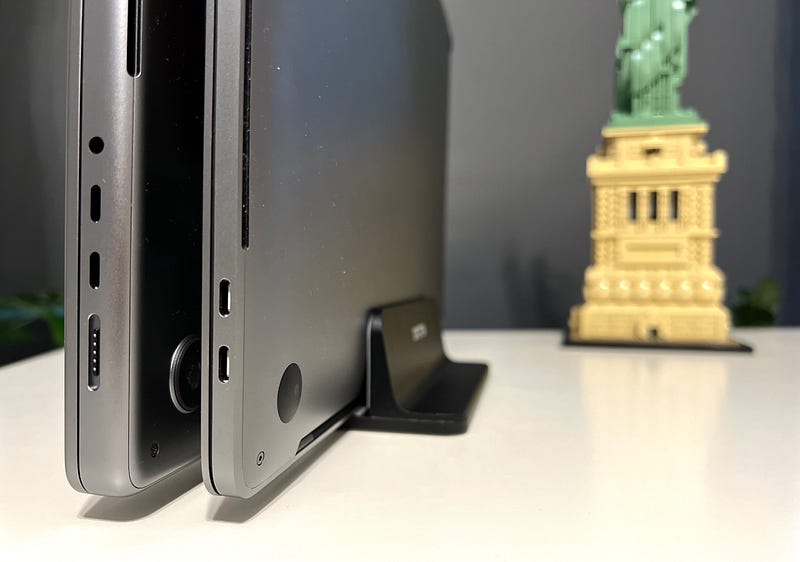
The fact that this is in every way beyond 1st world problem to have, has not been lost on me. But I will be honest. I have not been this torn about something in a long time. I am good at pragmatic decisions and choosing things. When it comes to beer, it’s likely going to be an IPA, if it’s a burger, likely beef and if it has to be vegetarian, then most likely pizza. I know myself, I am quite good at balancing the pros and cons, heck even being my own devil’s advocate. This, however, … deciding whether I should sell or not my 15” 2018 MacBook Pro, proves to be a very-very tough one.
When I purchased my newer 16” MacBook Pro M1 Pro last October, I actually went back on my own word, and against my own initial rationale and advice, went for it.
Half the reason was curiosity, the other half was experimentation. Not so much with the laptop itself, but rather to see if I could recoup the cost of it through writing on Medium. For those incredibly curious whether I did or not, long story short, I did by the end of January this year. What can I say? I won’t give you earnings reports like many do here, but writing about tech can be a rewarding niche. It won’t make you rich, but it will cover your occasional tech purchases, like a new MacBook.
When in 2018 I bought the 15” MacBook Pro, it replaced a 15” 2012 Retina MacBook Pro, which I managed to still sell for nearly 500 euros. When I bought my 13” M1 Pro in 2020, it replaced a 2019 13” MacBook Air, which I traded in for like 700 euros. That makes the 16” M1 Pro the only MacBook I never traded anything in for, and makes the 15” 2018 MacBook Pro the object of a tough decision.
Reasons to keep…
I always have two machines. I have been doing this for over 10 years. Needing redundancy in the tools I use daily is something uncharacteristically important to me. It is always a main machine — the daily driver, and then something very portable, but with just enough power to allow me to do web development on. As it stands, if I’d sell the 2018 Intel machine, I’d be left with just the 16” M1 Pro. That bothers the back of my brain in ways I am not comfortable with.
Another aspect if backwards compatibility. This is indeed a weak argument, but while I have yet to find something that doesn’t work on the M1 architecture, I still to some degree fear that I will find something, and I’ll be kicking myself for selling it. In fact, there’s definitely one thing the M1 doesn’t support. My Canon Pixma scanner/printer! I don’t print often, but when I do, my M1 is useless. I could, of course, sell the Intel, and use part of the money to get a new printer, but it feels so wasteful because my printer is perfectly fine, it does not need replacing, it’s purely a software issue.
While backwards compatibility does sound like a made-up excuse, software testing is a much more solid one. I write software for a living and for fun too. Web, mobile, desktop. I love it all. And software developers, like me, like to test their apps on actual devices. While I am fully committed to the Apple ecosystem, believe it or not, I actually own a couple Android devices too, for no other reason than testing. Emulators are great, but they can’t do everything. And on that note, the M1 cannot emulate Android well. But the Intel version can. On the Intel version, I can also test the new Flutter desktop apps and see differences between running natively on the OS or via Rosetta 2.
But is this all worth a little over 500 euros? That’s the current trade-in value of the 2018 15” MacBook Pro. Well, in the grand scheme of things, 500 bucks isn’t that much. Furthermore, in 20–30 years it might sell as a rare vintage for much more. Or it might not sell at all. As it stands, I keep feeling like it’s worth for all the above reasons keeping it, given how its trade-in value isn’t that high. Moreover, it’s a light (actual weight) machine compared to the 16” successors, both Intel and M1 Pro.
Reasons to sell…
You have to remember that the 2018 MacBooks Pros came with the butterfly mechanisms. While they weren’t the only ones, they certainly gained a less than stellar reputation and I remember buying it and worrying about it, yet did it anyway because my 2012 model really needed to be replaced. Now, I am thrilled to report that I had no keyboard issues, and that’s somewhat surprising because as a coder, I type about as much as a professional writer on any given day. I took the risk, thinking as soon as they either perfect the butterfly mechanism or come back with a new scissor keyboard, I’ll trade in the 2018 model. I obviously didn’t, but trading it in now would also mean I’d get rid of a potentially problematic machine.
Since October 2021, when I switched to the M1 Pro, I haven’t touched the Intel machine for anything else than to recharge the battery, every two months or so. One could thus argue that under the current circumstances I don’t seem to need it, and it is just wasting space in the drawer, so selling it for 500 quid would be a no-brainer. It’s not a ton of cash, but it would cover almost half of a potential new 2022 Air or 13” Pro.
Power-efficiency and battery-life is another aspect that the 2018 model was never remarkable at. While I could squeeze around 5–7h out of it under decent web development work loads, that machine gets crazy hot, very noisy and in no way compares to any of my M1 machines, which easily last 15+ hours even while running an emulator and developing Flutter apps in Android Studio. Not to mention, they’re dead silent and stay at room temperature.
As I was writing this article, I was hoping I would talk myself either into selling or keeping the 2018 model, but guess what? I’m just as undecided. 😆 I have a feeling it might become an easier decision once the M2 laptops get released, but who knows? It really could go either way…
If you were me, what would you do?
Attila Vago — Software Engineer improving the world one line of code at a time. Cool nerd since forever, writer of codes and blogs. Web accessibility advocate, Lego fan, vinyl record collector. Loves craft beer!


