
Management and Leadership
Should I give advice or ask questions?
Visual Learning
In an era where computers are getting better at answering our questions, we need people who are better at asking questions.
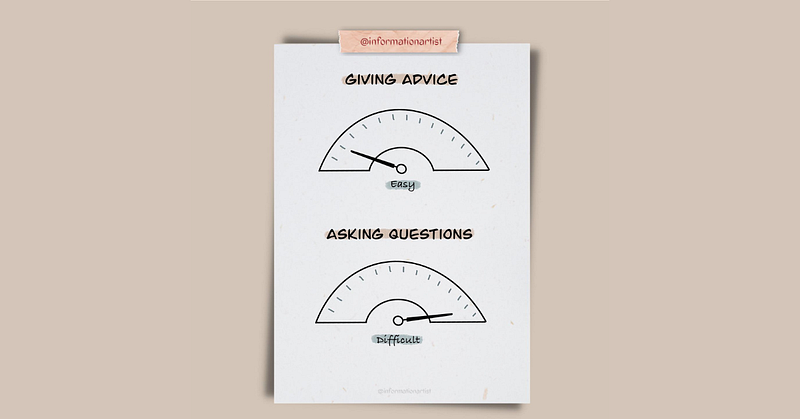
The biggest learning in my leadership & coaching development has been about asking better questions over giving advice. Giving recommendations helps when you have time constraints, need short-term gains or have high-risk decisions to make. Nevertheless, for any low-risk long-term objectives, deeper insights and explorations work wonders.
A good manager prescribes better solutions. A great manager asks better questions to the team, to enable them to find solutions themselves.
As a manager, whenever I gave a piece of advice, the curiosity of my team came to a standstill. Simultaneously, when I asked them thought-provoking questions, I instilled the light bulb moments. We hire the experts because they know the best solutions. All they need is one powerful question to ignite the path that leads to unlocking the door of possibilities, which exist within their imaginary hurdles.
It is not the answer that enlightens, but the question. — Eugene Ionesco
Do you know why asking questions is difficult? It needs deep and active listening, being present in the moment, staying curious to know more, and keeping your biases outside the door. It is an emotionally and mentally draining process.
On average, my coaching sessions usually last for an hour, and if I have two or three in a day, I’m enervated. That’s how much real focus depletes the energy. To conduct effective meetings, one needs preparation, agenda and insights.
It’s time to pause and reflect. Here’s some food for thought (for thinkers) and journal prompts(for writers),
💭 How often do you give advice?
💭 What stops you to ask questions?
💭 What is likely to happen if you don’t advise?
Let me know your thoughts in the comments. Happy learning!
If you’d like to go the extra mile to support me as a writer, please consider buying me a coffee or joining Medium using my referral link. Thank you :)


