
“How the Mighty” Chapter 8— Roland
Shot on a Shingle
The Omaha plan goes belly up
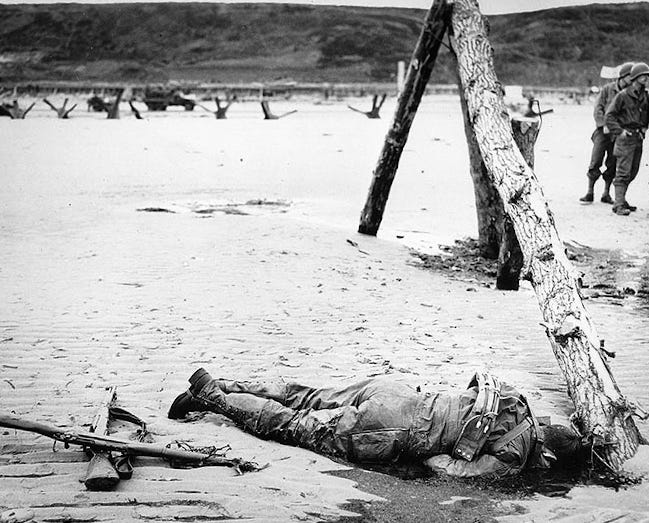
The thirty minutes after the ramp of the landing craft came down were an eternity that Roland never spoke of again.
There was nothing about Omaha Beach that was a surprise to the men wading ashore. Every rock, every building, every tree had been photographed. Each regiment had a closely guarded room where the soldiers were free to examine the maps, the photographs, the models. They learnt every contour of the ground by heart.
Every man had a task. A soldier might be one half of a team to carry a folding ladder to cross an anti-tank ditch on the left side of the defences around one of the few roads leading up from the beach. Another would have a satchel charge to throw in the second opening of the third pillbox of the fifth strongpoint. Yet another would be carrying five mortar rounds for the battalion’s heavy weapons platoon so that covering fire could be laid down as a team blew a gap in the barbed wire at grid reference such and such.
Roland had a bundle of marker flags to show the safe path through the minefield at the entrance to a draw leading up from the beach. Another man would identify the mines using probes, and Roland would follow behind, marking the mines with red flags.
Even these detailed tasks were just things to do if the battleships and the heavy bombers and the rocket barrages weren’t completely effective. The men were told that the beach defences would be pulverised by high explosive, and the few defenders would be dazed and eager to surrender. Get ashore, get off the beach, reach these objective lines, dig in, another job well done, boys. Next stop Berlin.
Everything at Omaha was a surprise. Nothing worked as intended.
The bombardment missed the beach completely. The rockets — thousands of them — made a bold show and a terrifying noise as they launched, but they fell short. The naval guns were ineffective against the reinforced concrete. Often a bunker had no direct exposure to the sea, but faced sideways along the beach, and the naval gunfire hit nothing but rock and earth. The bombers flew in over the landing craft and dropped their loads late. They made a lot of craters amongst the fields inland, but for all the good they did the crews might as well have stayed in bed that morning.
The landing craft drifted off course, taken by the strong tidal current. Very few soldiers landed as planned, and they were all mixed up when they arrived. The three boats carrying an infantry company with a detailed plan might land a mile apart, none of them near their objective.
The amphibious tanks mostly sank in the lumpy waves well offshore. The few that made it to the beach were easy targets for the anti-tank guns in their concrete emplacements.
The engineers tasked with destroying the obstacles were sent to the wrong places, their equipment was destroyed, and when they finally managed to lash a charge to a log or a hedgehog of twisted metal bars, they couldn’t set it off because there would be a dozen men sheltering behind it, clinging as close as they could get.
Men drowned in deep runnels, equipment and weapons were lost or destroyed or damaged, and the men themselves killed or wounded in their thousands.
Field Marshal Rommel’s plan was to stop any invasion at the water’s edge, and when the assaulting troops arrived at Omaha, every German soldier was at his post behind strong defences, firing down onto the sand onto targets registered months previously. Every part of the beach was visible, covered by fire from several directions, and made impassable by barbed wire and minefields.
The heavy guns aimed at the tanks and the landing craft, the machine-guns fired at the platoons, and the snipers picked off individual soldiers.
Roland never again spoke the phrase “military precision” without a sneer. His experience bore no resemblance to the detailed plans he, his company, his regiment, his division and the whole corps and fleet and airforce had trained and practised for. Every leader from the President on down had signed off on the invasion and it was a disaster.
Roland ceased to be a Baptist, or even a Christian, in that half-hour. His immersion into the water, the battle, and the chaos destroyed his faith and his trust in all the stories he had been told since childhood. When the captain who had been a devout churchgoer, never uttered an oath, prayed several times a day, and tithed his pay back home to his church took an artillery round on the cheek an instant after stepping off the landing craft and his heart, soul, mind, body, hopes and prayers were nothing but a cloud of red mist and tiny fragments spattered on the uniforms of his troops, then where was the loving God? Where was the glory? Where was the soul lifted up to heaven?
When a man stepped on a mine and his legs went in three different directions, when a man’s pelvis was shattered by a machine-gun burst and he dropped into waist-high water unable to rise, when shrapnel sent a man’s head bouncing and spinning over the sand, when a demolition charge blew five men into meaty chunks, then where was God’s thoughtful plan?
Of the thirty-five American soldiers in Roland’s landing boat, there were twenty who made it out of the water, ten who made the scant cover of a ridge of stones and shingle marking the reach of the high tide, and only five who were in any way fit for combat.
And the first thing they did was to pull their useless weapons apart to clean out the sand and water that clogged every opening, every hollow, every operating part.
Nothing worked.
Omaha was a disaster. Despite painstaking preparation and planning, Omaha was the one where it all turned to shit. The other four beaches and the airborne operations all had their foul-ups and the occasional heart-rending disaster, but Omaha was the one where nothing worked.
The best the assault waves could hope for was to make it to the scant cover of a bank of shingle after crossing hundreds of metres of sand completely exposed to the German defenders in their camouflaged concrete bunkers with elevated fields of fire.
The only cover available on the way were the obstacles that the Germans had placed to make landing difficult. Teams of assault engineers were tasked to destroy them, but those few who landed in the right places with their demolition supplies found terrified soldiers trying to shelter behind the logs and iron “hedgehogs” and other devices intended to rip the bottoms out of landing craft approaching the beach.
If you’ve seen Saving Private Ryan, you’ll have a pretty good idea of the conditions. The writer and production staff drew on the same sources that I did. The official histories, the encyclopaedia articles, the popular histories by writers such as Stephen Ambrose, fueled by eyewitness accounts from the survivors, who detailed the horrors that haunted their later lives.
That’s another reason for me to return to Normandy. I’d like to sit in the American Cemetery and quietly think about the men lying there, whose struggles and sacrifices fill the pages of the books I read on this road.
Britni
The whole story:


