
Short-Circuited Response May Not Always be Ideal
Sometimes it is better to take the long route.
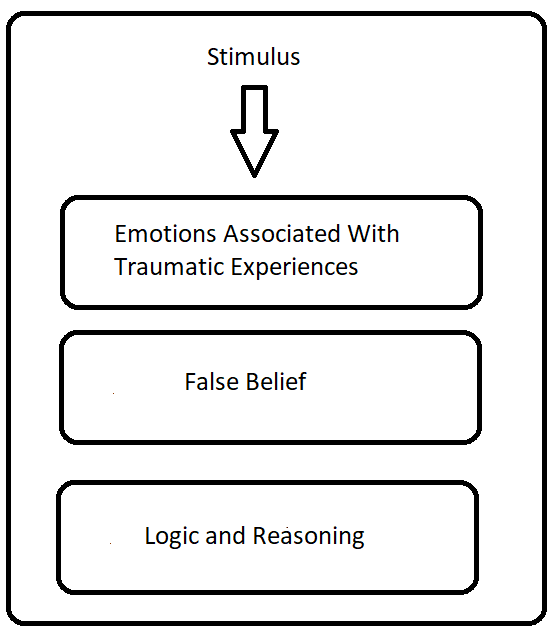
Whenever a person receives a stimulus, it is processed by mainly 3 layers as shown in the diagram above. If the stimulus instigates emotions related to traumatic experiences then the path to response is short-circuited there itself. This situation normally leads to an emotional response back to the other person or sometimes just an emotional turmoil within the mind of the person.
Example: Ram had a traumatic experience in the past where a bearded man tried to hurt him. With time Ram had forgotten about the incident and was leading a rather normal life. Then one day he came across a similar person with a beard during his team meeting. The stimulus of watching a similar person acted like a stimulus and instigated emotions related to the traumatic experience from the past. The stimulus was not processed by any other below layers and the immediate response of Ram was that of stammering. He also had an emotional turmoil within his mind that took quite some time to subside.
Now, if the person receiving the stimulus does not have a high emotional charge associated with the earlier related events then the next layer processes the stimulus. This layer is that of a false belief and is like fixed programming within our minds to interpret the stimulus in a certain manner. False programming is created in our minds based on some earlier incidents where we were fearful.
Example: Valentin grew up in France where arranged marriages were looked down upon. There were several incidents in his life where people in his community showed hatred towards this form of marriage and it instilled a false belief in Valentin that arranged marriage is oppressive. Later Valentin moved to the US and had an Indian friend named Shyam. Shyam told about him getting married to a girl via arranged marriage. This acted as a stimulus and passed through the various layers specified above. The emotional charge related to the traumatic experience was not quite high for Valentin as he personally hadn’t experienced arranged marriage. Thus, the stimulus went past that layer and was processed by the false belief layer. This layer interpreted the situation as being oppressive and created hatred against Shyam not realizing the fact that arranged marriages have served society for centuries. The response was short-circuited at this layer itself and didn’t go through the next layer which is that of logic and reasoning.
If the person receiving the stimulus does not have a strong emotional charge as well as false belief then it can pass through the first 2 layers and reach the final layer of logic and reasoning. This makes the processing of response take a long route but in my opinion, it is ideal in many situations where our judgment is not marred by emotions and false beliefs.
Example: Sara is an American girl who is quite open-minded. Once she saw her friend Ajay coming back from Yoga. This acted as a stimulus and went past the various layers for creating a response. There were no traumatic experiences related to Yoga so it went past the first layer. There was neither any false belief in Sara’s mind so the stimulus went past the second layer as well. Upon reaching the layer of logic and reasoning, Sara analyzed the situation and came to the conclusion that her friend Ajay is actually quite healthy both physically and emotionally. Thus she also resolved to go to Yoga class.
How to take the long route?
When the response to the stimulus is mainly processed by the first layer which is that of traumatic experiences then one must employ the process of catharsis to get rid of the emotional charge. Some other techniques like EFT (Emotional Freedom Technique) have also been proven to get rid of emotional blockage.
Example: Ram who had a traumatic experience involving a bearded man applied the process of EFT on the incident. Tapping at the various meridian points whilst thinking about the incident helped him in getting rid of the emotional charge associated with the incident.
People whose response is mainly processed by the second layer which is that of false belief also need to remove strong feelings that caused the creation of the false belief. Spirituality and getting a bigger picture also helps in replacing the earlier belief with a more open approach to handling the situation.
Example: Valentin was averse to an arranged marriage. To overcome his hatred he studied the various cultures where arranged marriages were a norm and found that it serves the society quite well. Valentin also removed the strong emotions associated with earlier events in his life that created the false belief. Eventually, he was able to have an open mind and have love towards people who did arrange marriage.
Conclusion
Short-circuited response may only be useful in situations where the emotions associated are that of excitement. One may respond back with a tone of excitement and that may help in creating better social bonds. But for situations where the stimulus instigates a negative emotional charge, one needs to apply the process of catharsis/EFT and allow the stimulus to go past that layer to the next one for processing. Spirituality and having a bigger picture will even make the person go past the second layer in processing the stimulus. Ultimately if the person is able to process the stimulus with logic and reasoning then it will create a society where there are no prejudices and people live life with more control over their responses. My best wishes to everyone traversing this path so that the route taken to process stimulus is long but definitely better than earlier short-circuited responses.


