
PHOTOGRAPHY | WRITING | CREATIVE WRITING
Shooting London
Is it time to stop looking upwards?
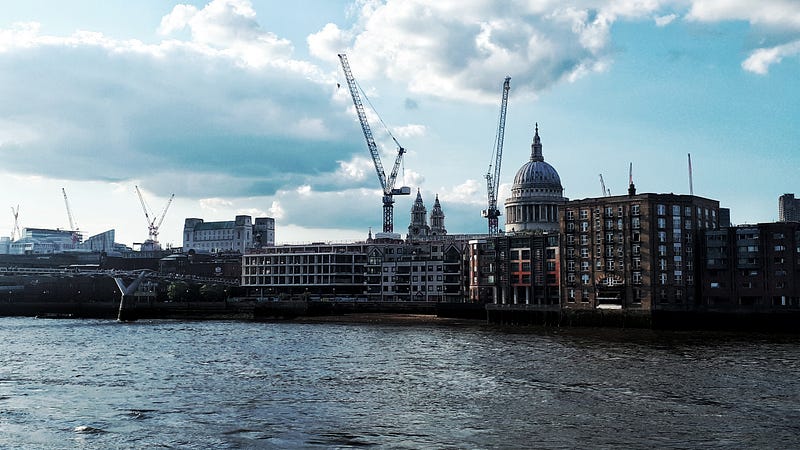
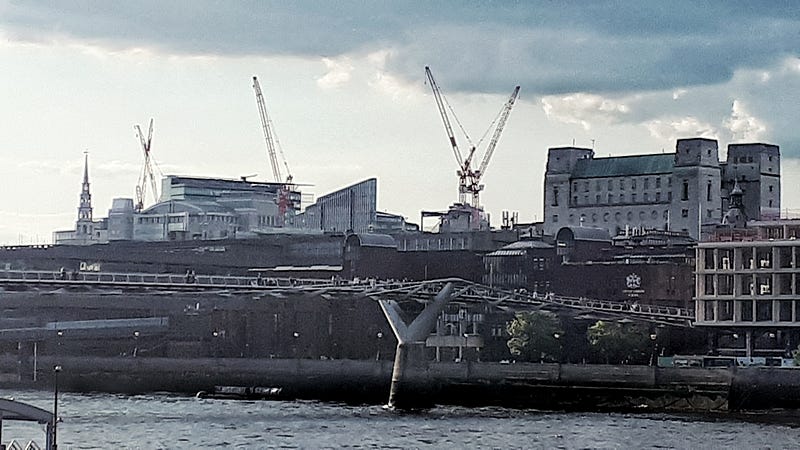
A mild early evening draped itself around the city. Central London was doing what central London does best: welcoming crowds to its narrow streets and centuries-old squares, whilst serving up a piece of culture and history, with a pinch of entertainment thrown in for good measure.
We walked westwards south of the river. As we passed Shakespeare’s Globe and I looked across the water, it dawned on me that if someone were to ask me now what came to mind when I thought of London, my answer would be different from the one I’d have given twenty years ago.
Two decades ago, as I was still getting acquainted with the British capital, my response would have focused on its landmarks, or its pub culture, or its diverse population. But more than a quarter of a century down the line, I have to say that the one feature I have noticed creeping into my thoughts is London’s ubiquitous crane-dotted landscape. And I’m not talking about the long-legged, long-necked bird.
Obviously, there were cranes in London when I arrived. But, their number has increased considerably in the last few years. The new skyscraper-driven building model has filled up the city with these heavy object-lifting metal monstrosities.
They’re easy to spot. All you have to do is sit on the wall in the Southbank and look around as I did before taking the two photos above. St Paul’s Cathedral looks as if it’s under siege. Funny and contradictory though it may sound, the cranes in the pictures remind me of Pink Floyd’s hammers in the movie The Wall. Never mind that the former are static and the latter in motion. They both advance menacingly.
Must we always look upwards? Highrises are usually sold on the view they provide. But if your otherwise spectacular view is blocked by machinery used to build another tower, then, what gives? I’m with The Observer’s architecture critic Rowan Moore, who said that “In Britain, tall buildings are signs of failed planning, which finds it hard to discover the space for more sustainable and humane ways of building homes.” I look at the cranes in the picture and I couldn’t agree more.
You can buy me a coffee here.