
Shiv-Ratri (The night when Shiva was born)
The Philosophy behind the Mythology
Tonight is Shiv-Ratri, the night when Shiv was born.
In Hindu mythology, Shiv is the god of destruction.

Brahm, Vishnu and Shiv go hand-in-hand as do creation, maintenance and destruction.
Over the years, I have metamorphized from a practicing Hindu into an atheist.
This means that I have stopped believing that Shiv is a super-human sitting half-naked on the top of Mt. Kailash with a snake around his neck and the Moon stuck on his head.
However, I see no problem in acknowledging the beautiful and deep philosophy behind each of the gods including Shiv. This is in accordance with great 19th-century Indian social reformers like Ram Mohan Roy and Dayanand Saraswati who turned into atheists after thoroughly studying the Vedas (ancient Indian philosophical texts).
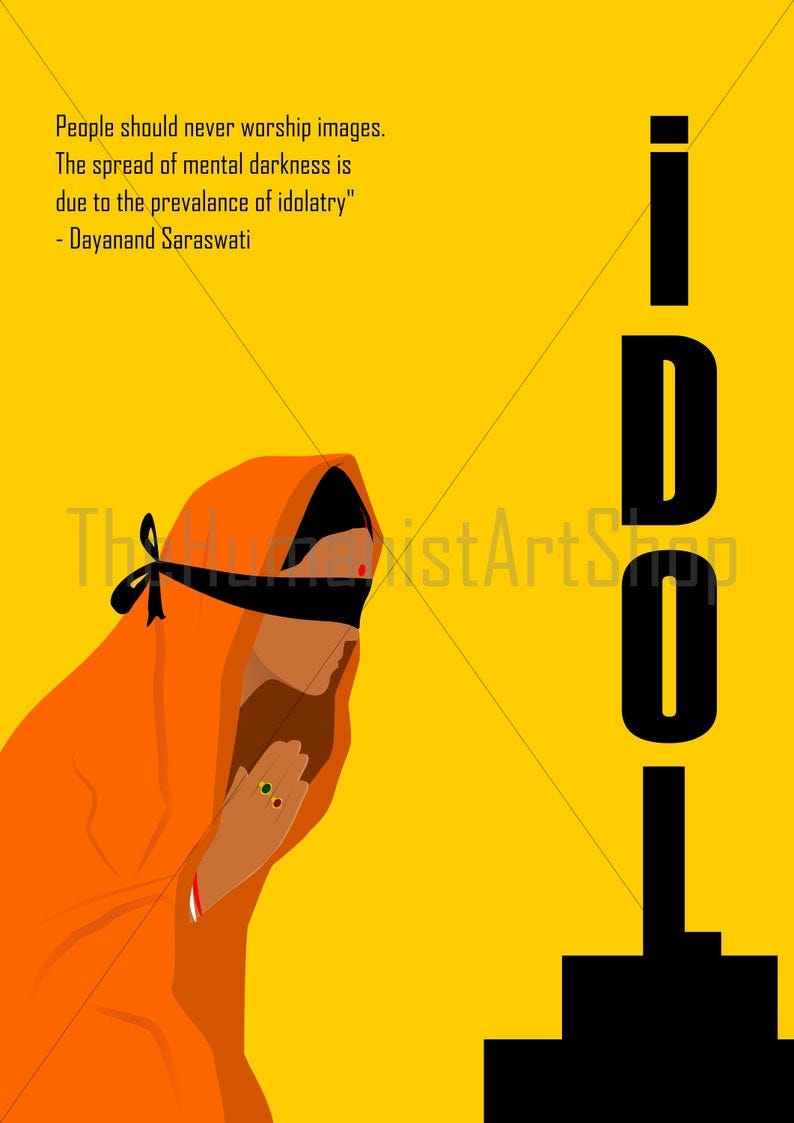
It is indeed quite puzzling that the ancient Aryan settlers around the Indo-Gangetic plains were capable of gift-wrapping their philosophy in exquisite metaphorical poetry, while most of the present day Indians are not able see beyond mere personifications and tokenisms!
Most of the practicing 1.2 billion Hindus around the world (my friends, relatives and parents included) must have celebrated Shivratri today, by keeping a fast and by visiting a temple, but I wonder how many would have thought about the meaning of the festival.
Do we as sensible and sane adults really think that there is a man sitting up in there in the Himalayas, who is watching and keeping a note of who kept a fast and who did not, who visited a temple and who did not? And do we really think that this person would or would not reward us accordingly?
So, if not these tokenisms, then what could be a better way to celebrate this philosophical idea?
To my mind, it could be by observing the world outside us as well as inside us, and spotting something which deeply troubles us because we think it causes suffering to humanity at large and then seek to destroy it.
It could be anything — a product or a custom.
It could be getting rid of (destruction of) your high emission diesel engine car, which causes suffering to humanity at large.
or
It could be getting rid of (destruction of) your habit of chain-smoking because it causes suffering to you and to others around you.
or
And it could be getting rid of (destruction of) any practice or tradition in your society, your personal or your professional space, which has carried on for ages, but you think it causes suffering and oppresses a certain section of society. Elaborating on this one might be controversial, hence, I will keep it at that. However, what I can dare to say is that this applies to all people across all religions, cultures, ethnic and geographical boundaries.
Philosophy has no boundaries!