
Productivity
THE PRACTICE — Shipping creative work
We don’t ship the work because we’re creative. We’re creative because we ship the work.

Knowledge is of no value unless you put it into practice. — Anton Chekhov
I recently read the book “The Practice” by Seth Godin. This book is a must-have if you’re going to do creative work and change the status quo.
Creative work is the generous act of making things better by doing something that might not work.
A therapist does creative work. He tries to engage a reluctant patient in the hopes of helping that patient. There is no guarantee that the patient will improve, but he does it anyway.
A leader does creative work. He volunteers to lead a cause. And there is no guarantee people will follow him.
Creativity needs courage and generosity.
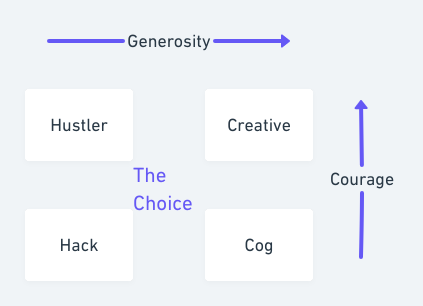
You and I have a choice every day. We choose to be creative or succumb to fear. And unintentionally become a Hustler, a Hack, or a Cog.
A Hack is afraid of trying anything new. So they copy what works without bothering to improve it.
A Hustler cares more about hitting their short-term targets. So they miss providing value to people. Hustler has the courage to try something that might not work. But he does it for selfish reasons.
A Cog is comfortable following instructions and doesn’t come out of their comfort zone. He follows the system without trying to improve it. He tries to be generous but couldn’t do it as he needs the courage to alter their system. As time goes, Cogs get left behind or replaced.
When we choose a creative path, we are choosing to be generous and courageous each day. It increases the odds of developing our voices, doing original work, and making meaningful change.
Be warned! You may feel like an imposter.
Imposter Syndrome
Albert Einstien described himself as an “involuntary swindler”, whose work didn’t deserve as much attention as it has received.
When you try something new in the hopes of making things better, you will inevitably feel like you don’t know what you are doing. You feel like people are judging you. And finally, you think you are a fraud.
The imposter is proof that we’re innovating, leading and creating. — Seth Godin
Ok, who else feels like an imposter?
Every leader who stands up for a cause, every artist who shows their work to the world, and every entrepreneur who tries to make their first sale feels like an imposter.
Prevent the imposter syndrome from killing your creativity is to build a creative practice.
The Practice
If you commit yourself to 1 hour of creative practice each day you will learn to trust yourself to keep moving forward despite feeling like an imposter.
Your creative practice is based on an area in which you want to develop a unique voice and provides value to others. It can writing, drawing, coding, or doing one-on-one coaching.
The goal of this practice is universal — Stop focusing on results and love the process.
“The practice is not the means to the output, the practice is the output, because the practice is all we can control.” — Seth Godin
Ok, but how can I measure the progress if I don’t focus on results?
Measure your progress using two metrics: how big is my discard pile? And how much work have I shipped in the last year?
Grow Your Discard Pile

“Good ideas come from bad ideas, but only if there are enough of them.” — Seth Godin
Nobody is a genius. Practice is all it takes. Most creative geniuses you’ll meet are willing to generate more bad ideas and do work they’ll probably throw in the trash, in order to get good ideas and successful work.
Your discard pile can be anything related to your work. It might be lines of code that didn’t quite work as you expected, might be ideas that never turned into best-selling products, it might be jokes that no one laughed at.
If you are not willing to grow your No pile, you will never grow your Yes pile.
Ship More, On Schedule
“We don’t ship the work because we’re creative. We’re creative because we ship the work.” — Seth Godin
Ship creative work on schedule, no matter how you feel. Make shipping work a rule, not a choice. Tell people, “I deliver _____ every _____. That’s just what I do.”
I deliver a blog post to my audience every week. That’s just what I do.
There will be days you don’t feel like shipping or don’t believe you can ship good work. However, after you make shipping on a recurring schedule, you’ll magically find the creative energy you need to ship good work.
Every ship date is a chance to improve upon your last work. By improving on your prior work, you naturally build skill and refine your taste. Start shipping with low stakes (ship to your mom or to a creative friend). Only take creative risks you can tolerate. Over time, with more skill and better taste, you will find the courage to ship to more and more people.
By learning to love the process, increasing your discard pile, and shipping more often, you are well on your way to producing original work and making things better.
“Better is possible. But not if we continue to settle, continue to hide, and continue to scurry along the same paths. We have more to do. We need your contribution. But it can’t happen and won’t happen if we can’t figure out how to trust ourselves enough to do the work.” — Seth Godin
Key Takeaways
- Creativity is just like any other skill, it needs practice. Creativity can’t be achieved overnight.
- Overcome imposter syndrome. Nobody gives a damn about what you are doing. Everyone is busy dealing with their own life.
- Trust the system. Don’t give too much weight to results. Instead, measure the progress of the process.
- Grow your discard pile. Perfection doesn't come in the first shot. Don’t aim for perfection, make the system that leads you to perfection.
- Deliver every time. Don’t make excuses. You don’t need to deliver the best work every time, but you do need to ship something. Don’t break the chain.