
Shia LaBeouf Should Never Have Got His Role in “Pieces of a Woman”
And watching his on-screen character commit violent assault is truly uncomfortable
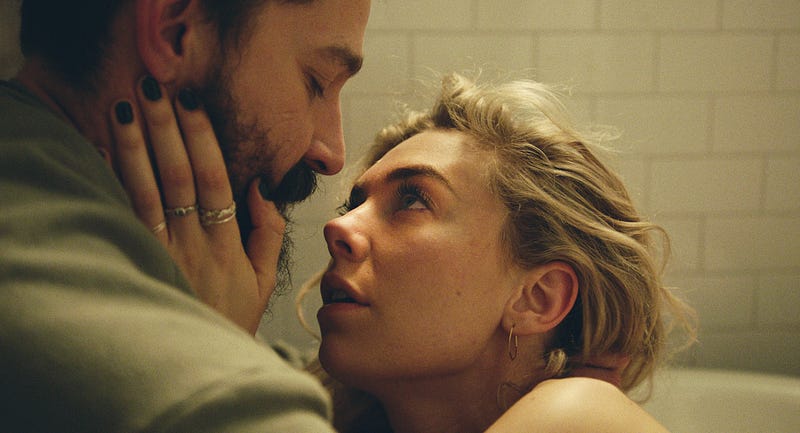
Pieces of a Woman, which has just started screening on Netflix, is a cinematic tour de force. It is an incredible film. It deals with the most traumatic, almost taboo of topics — stillbirth — but it does so in a sensitive, unvoyeuristic way that honours the parents who suffer this tragedy.
Its main star, British actress Vanessa Kirby, gives the performance of her life. The 24-minute scene that begins with her character Martha’s waters breaking in her kitchen is shot in a single, swooping, devastating take and within it, Kirby’s is the most realistic depiction of labour I have ever seen. It’s totally harrowing and she deserves every award going. (So, incidentally, does the cameraman, who apparently had to do strength training beforehand in order to hold the camera steady for the requisite length of time).
As her labour progresses, Martha’s partner Sean is ever-present. He is by her side, every step of the way. He helps her out of her wet leggings; he strokes her back; he supports her to and from the bath; and at last, he holds her strong in his arms while she pushes. He’s the stoic standby for that whole scene. When it ends tragically and not joyfully, he looks as lost as she does.
Later in the film, as it tracks month by bleak winter month the divergent paths of Sean and Martha’s grief, there is another uncomfortable scene. The couple are at home, locked in their separate misery when Sean clumsily attempts sexual intercourse with Martha. She lies passive and corpse-like in his arms, comatose with grief and apathy as he fumbles roughly with her underwear and eventually drags her into the bedroom.
When she fails to respond to his aggressive sexual overtures, he shouts at her spitefully and then throws her birthing ball violently at her face. Sean later turns secretly to alcohol after six years’ sobriety and then he cheats on Martha with the perky young lawyer they have hired to prosecute their midwife for negligence and manslaughter of their baby. He barely bothers to hide his tracks, leaving evidence of his affair in the car Martha’s mother bought them.
Sean’s character, in this film, is played by Shia LaBeouf. You might have heard of him recently.
LaBeouf is, of course, currently featuring in the newspapers not for his stellar acting performance but for the multiple allegations of domestic violence that have been levelled against him. His ex-girlfriend, singer FKA Twigs, is the most recent of his partners to stand up and speak out against the “relentless” physical and emotional abuse that she suffered from him during their relationship. Like many abused women, she held back for a long time from reporting the abuse, for fear she would not be believed.
She is supported though in her lawsuit by another of LaBeouf’s exes, Karolyn Pho, who has been vocal about his similar treatment of her during their relationship ten years ago. She also has an ally in the form of the singer Sia, who has called LaBeouf “a pathological liar” and “very sick”.
LaBeouf has not denied the abuse, although — in his eventual statement about it — he reduced its description to “aggression” and tried once more to excuse his behaviour by reference to his well-known alcoholism and to his troubled past. It is clear both that he has treated his ex-partners appallingly violently and that yes, he himself is troubled and in need of help.
So why is he still in the films that appear on our screens?
Of course, Pieces of a Woman was filmed before FKA Twigs’ lawsuit was made public. There is no reason to suspect that anyone involved in casting was aware of the treatment to which LaBeouf had subjected his partner. He is undeniably a skilled actor, and in many ways, he was clearly a good fit for the film. He doesn’t jar in the role, appearance-wise.
And yet, Twigs’ allegations are far from the first indicators of LaBeouf’s violent tendencies. He’d already been caught on camera in 2015 when he nearly turned violent on his then-wife, Mia Goth, at which point he said: “…I don’t want to hit a woman but I’m getting pushed.” His relationship with Kathryn Pho, which she has now spoken out about in support of Twigs, took place way back in 2010. Basically, LaBeouf has a long and documented history of problematic behaviour towards women.
His repeated misogynistic and violent behaviour, though, has never dogged his career. Not really. I mean, yes, his chaotic approach to drinking and his anger problems has, in the past, led to studios distancing themselves from him at points, but they never seemed to care about his cruel treatment of his partners. That didn’t ever seem to get mentioned, or not for long. When that was the only slur against his character, it didn’t seem to matter.
And so somehow he always popped back up again after a stint in rehab or after mumbling his apologies or after doing whatever else it took to get back in favour. Each time, he’d soon be Hollywood’s darling again, landing roles in big films, generating applause all around, and making money. For his bosses as well as for himself.
The age-old gender divide, no matter how much traction the #MeToo and #TimesUp movements may garner on social media, has never appeared as stark as it does when this light is shone on it. Because women are never treated this kindly, are they? You only have to look at the way that women have been blacklisted and gradually erased from Hollywood memory over apparently far more minor crimes.
For example, Katherine Heigl publicly dissed her Knocked Up character and criticised the lines she received in Grey’s Anatomy, and she disappeared swiftly from our screens — without so much as an arrest or a hint of a sexual assault claim against her, unlike Shia LaBeouf. When Megan Fox made some very ill-advised comments about the director Michael Bay, she apparently got sacked from her lucrative jobs too, and she was no longer Hollywood’s darling. Neither actress has been seen much since those episodes. No second chances, it seems, for them.
LaBeouf, though, is a white man. Perhaps that’s why he’s entitled to comeback after comeback.
This dichotomy, this age-old inequality between the treatment of men and women, of how seriously the world takes any allegations against them — that is not what angered me most when I realised that Shia LaBeouf would be front and centre of attention in one of this year’s most critically-acclaimed films. No. What really riled me this time — apart from seeing him act out sexual violence on screen, which feels disgusting — is my fear that by association, his reputation will tarnish the film and damage Vanessa Kirby’s chances of really winning big for her performance.
Because it is such a good performance. Kirby is not a mother, she’s never experienced labour and so she wasn’t drawing on personal knowledge, yet her portrayal of a home birth took me back many years to my last labour as though it was happening to me in real-time. The scene is incredibly and viscerally realistic.
Kirby is absolutely believable, too, as the film goes on; as a bewildered bereaved mother, grieving the baby she lost and finding her way in a world she never imagined, she just works. Her interactions with her family are exactly the way you’d expect them to be. But it’s not just her lines. It’s everything — the twitch of her face when she sees a mother and daughter in the street; the compassion in her eyes when she comes face to face in court with the midwife who delivered her baby.
It’s a stellar performance, and it’s one that the actress who brought it to screen deserves to be fully recognised for. It should be a part that makes her career, without detraction. That her co-star is attracting negative attention once again for his misogynistic violence, attention that might distract from the praise of the film, is beyond infuriating.
But that he was ever her co-star at all — given how many chances he’d already been allowed, and given how well-known his violent past was, and given the sexual violence in his character’s narrative arc — is not just infuriating but desperately unfair. Not surprising, no, not at all, because women pay this sort of price every day. But it’s desperately unfair anyway.