avatarJames Marinero, MSc, MBA

Free AI web copilot to create summaries, insights and extended knowledge, download it at here

3061

Abstract

require a much higher level of sophistication and systems integration. Hence the doubts over China’s plans.</p><p id="fced">The Chinese commitment to joining the fast-jet carrier club requires massive commitment — the US has been building carriers for eighty years, and the industry to build large carriers takes a long time to develop. The Chinese are leap-frogging — with a bare-bones carrier they can learn the fitting out process and replicate it, just as they have done with so many consumer items. Hulls are not difficult to build, and they do have a set of plans ready for the next one.</p><h1 id="172e">Serious Investment</h1><p id="370b">Those who have been watching developments in China have known for some time that China was serious about this investment. There have been plenty of jokes about the <a href="https://external-content.duckduckgo.com/iu/?u=https%3A%2F%2Ftse1.mm.bing.net%2Fth%3Fid%3DOIP.0RdLDj1l6BGQXNcqzLeZXgHaEK%26pid%3DApi&amp;f=1">Concrete Carrier</a> they built in the Oriental Park in Shanghai, but the fact is that building a carrier is one thing, operating one efficiently 24 x 7 in all weathers when under attack is quite another.</p><p id="dee5">And you have to have aircraft that can take off and land on carriers.</p><p id="c2d2">The operational management systems, avionics systems integration, flight deck management, re-arming, repairing and so on — all have to be flowcharted, written up in manuals and tested. And re-tested. Then, pilot, aircrew, maintenance and flight operations controllers have to be trained. That requires schools and teachers.</p><p id="561d">But first you have to train the teachers and build the schools. On top of that, a whole logistics infrastructure has to be created.</p><p id="8f57">It really is a huge task, and China is taking it seriously.</p><p id="dc42">China already has the Dong Feng 21-D carrier-busting ballistic missile, and now it has a carrier.</p><p id="5f51">China is clearly in the game, though it will be several years before an effective carrier group can be operational and a credible threat. China-watchers know that China plays a long game, with strategic planning which may look a century ahead.</p><h1 id="46fb">Re-birth</h1><p id="a503">China’s first operational aircraft carrier was bought from the Ukraine in 1998 for $20m at an auction. Her life started as a Soviet ‘Admiral Kuznetsov’ class ‘aircraft carrying heavy cruiser’, with her keel laid down in 1985. Two were built, the original ‘Admiral Kuznetsov’ being the only operational aircraft carrier in the Russian fleet.</p><p id="4c52">There was a sleight of hand in the design by Russia:</p><blockquote id="9b55"><p>In addition to aircraft, the ships were designed to carry P-700 Granit anti-ship cruise missiles that also form the main armament of the <i>Kirov</i>-class battlecruisers. This multirole capability allowed the ships to avoid classification as aircraft carriers, thus allowing them to pass through the Turkish Straits between the Black Sea and the Mediterranean Sea. — <a href="https://en.w

Options

ikipedia.org/wiki/Chinese_aircraft_carrier_Liaoning"><i>Wikipedia</i></a></p></blockquote><p id="af1e">The ship never became operational as the USSR collapsed, and by the time she was sold by the Ukraine to a ‘front’ Chinese company to ‘become a casino’, she had been stripped almost bare, and carried the name ‘Varyag’.</p><p id="41be">Over the subsequent ten or so years, China fitted her out in the Dalian Shipyard in northern China — the purchase also included a set of plans.</p><p id="b83d">Early August 2011 saw her first open-sea trials, carrying the name ‘Shi-Lang’, with a fully loaded displacement of almost 61,000 tons. In comparison, the latest US Gerald Ford class nuclear-powered supercarriers weigh in at around 100,000 tons fully loaded.</p><p id="d830">Shi-Lang is conventionally powered by 4 x 50,000 hp steam turbines. The original ship was capable of burning almost any <a href="https://www.businessinsider.com/russias-admiral-kuznetsov-aircraft-carrier-runs-on-dirty-fuel-mazut-2022-4?op=1">petrochemical fuel in her boilers</a>, but it is thought that the Chinese have opted for cleaner fuel.</p><p id="aa39">Some observers doubted that China would finish the project, but those who can begin to understand the Chinese mentality know that they seek to surpass the United States economically, politically and militarily, and have actively been building their strengths in all these arenas — that much has been obvious.</p><h1 id="206b">Shi Lang — the Taiwan Link</h1><p id="38c2">China’s trial of its new aircraft carrier is creating waves in naval and political circles, especially in the Far East. Shi-Lang was Commander-in-Chief of the Manchu fleet in the 17th century during the Ming-Qing dynasty. The admiral invaded Tungking (now known as Taiwan). Will the new carrier’s name prove to be prophetic?</p><p id="e38f">Taiwan has announced ( <a href="http://www.defencetalk.com/taiwan-developing-new-aircraft-carrier-killer-36380/">August 15, 2011 Agence France Presse</a>) that it is developing its own carrier killer missile based on the Hsiungfeng (Brave Wind) III.</p><p id="3f5f">Certainly, naval tensions in the Far East are increasing, and with the ongoing dispute with Taiwan over the Spratly Islands, and with Japan and Taiwan over the Senkaku Islands, further announcements are expected.</p><p id="8bfb">[update 2017: the <i>Shi Lang </i>carrier is now known as the <i>Liaoning</i>]</p><figure id="2b1c"><img src="https://cdn-images-1.readmedium.com/v2/resize:fit:800/1*XUGxwOdI3TcQxi8WAbDcfQ.jpeg"><figcaption><i>Liaoning</i> in Hong Kong in 2017. She carries a range of aircraft, including 24 x Shenyang J-15, NATO reporting name: Flanker-X2. Image credit: By Baycrest — Own work, CC BY-SA 2.5, <a href="https://commons.wikimedia.org/w/index.php?curid=60980675">https://commons.wikimedia.org/w/index.php?curid=60980675</a></figcaption></figure><p id="9532"><i>Originally published at <a href="https://www.jamesmarinero.com/shi-lang-chinese-aircraft-carrier/">https://www.jamesmarinero.com</a>. Edited.</i></p></article></body>

China

Shi Lang — the First Chinese Aircraft Carrier (2011)

The first step on another Long March for China, demonstrating huge commitment to a new geopolitical outlook
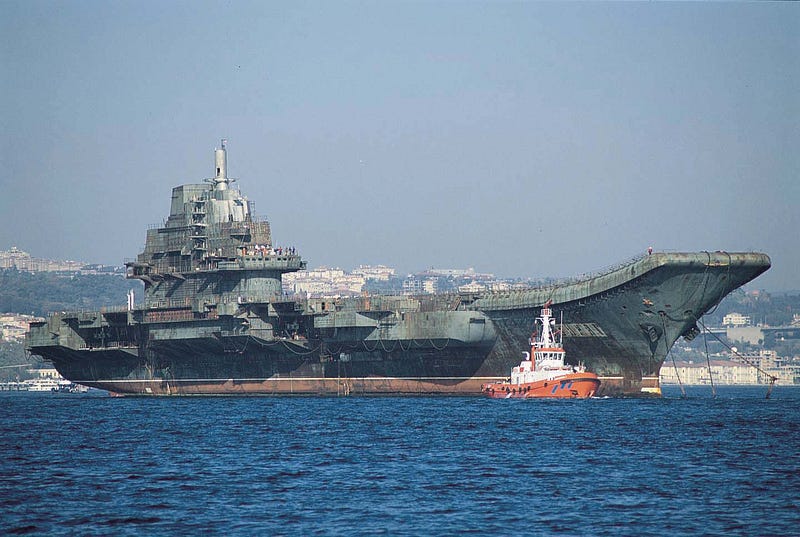
Varyag under tow in Istanbul on her way from Sebastopol to China. Image credit: By Original uploader was N328KF at en.Wikipedia. Public Domain, https://commons.wikimedia.org/w/index.php?curid=1634251

Editor’s note: I originally published this story in 2011 and it reflects a world view at that time. I have since edited it and extended it with some additional historical background. Since 2011 a lot has changed in China, geopolitics and naval power projection — and a few more steps on the Long March have been taken. The Shi-lang is now operational and re-named ‘Liaoning’. There’s more to come, much more.

A changed stance

As of 2011, the stance of the People’s Liberation Army Navy has been changing from that of a coastal defence force defending its borders from within and without, to that of a superpower with worldwide reach. Projection of power with a global reach requires air-power platforms.

The path to acquiring a fleet of aircraft carriers started way back in the 1970s with a typical long-term view.

They acquired the old Australian carrier HMAS Melbourne and studied her, and it has been reported that they built a land-based copy of the flight decks and steam catapults so that they could begin training pilots. China also acquired two old Soviet carriers and studied them before they became theme parks.

Also of course, they had to adapt and/or develop suitable aircraft for carrier landings.

Overt versus covert power — the need for both

Submarine-launched ballistic missiles are hidden weapons, but carriers are very visible and they present a powerful picture of naval and airborne strength.

Air power platforms equals aircraft carriers or land. Russia spans almost 12 time zones — half way around the world and therefore has minimal need for aircraft carriers — the Russian Bear never bought heavily into the concept.

The terra firma spans of the USA and China are more restricted land-wise. The USA has invested massively in supercarriers, and continues to do so. The UK is following in the shadows, and France’s commitment is wavering. Spain and some other countries build small carriers — little more than helicopter or Harrier platforms — but fast jet carriers require a much higher level of sophistication and systems integration. Hence the doubts over China’s plans.

The Chinese commitment to joining the fast-jet carrier club requires massive commitment — the US has been building carriers for eighty years, and the industry to build large carriers takes a long time to develop. The Chinese are leap-frogging — with a bare-bones carrier they can learn the fitting out process and replicate it, just as they have done with so many consumer items. Hulls are not difficult to build, and they do have a set of plans ready for the next one.

Serious Investment

Those who have been watching developments in China have known for some time that China was serious about this investment. There have been plenty of jokes about the Concrete Carrier they built in the Oriental Park in Shanghai, but the fact is that building a carrier is one thing, operating one efficiently 24 x 7 in all weathers when under attack is quite another.

And you have to have aircraft that can take off and land on carriers.

The operational management systems, avionics systems integration, flight deck management, re-arming, repairing and so on — all have to be flowcharted, written up in manuals and tested. And re-tested. Then, pilot, aircrew, maintenance and flight operations controllers have to be trained. That requires schools and teachers.

But first you have to train the teachers and build the schools. On top of that, a whole logistics infrastructure has to be created.

It really is a huge task, and China is taking it seriously.

China already has the Dong Feng 21-D carrier-busting ballistic missile, and now it has a carrier.

China is clearly in the game, though it will be several years before an effective carrier group can be operational and a credible threat. China-watchers know that China plays a long game, with strategic planning which may look a century ahead.

Re-birth

China’s first operational aircraft carrier was bought from the Ukraine in 1998 for $20m at an auction. Her life started as a Soviet ‘Admiral Kuznetsov’ class ‘aircraft carrying heavy cruiser’, with her keel laid down in 1985. Two were built, the original ‘Admiral Kuznetsov’ being the only operational aircraft carrier in the Russian fleet.

There was a sleight of hand in the design by Russia:

In addition to aircraft, the ships were designed to carry P-700 Granit anti-ship cruise missiles that also form the main armament of the Kirov-class battlecruisers. This multirole capability allowed the ships to avoid classification as aircraft carriers, thus allowing them to pass through the Turkish Straits between the Black Sea and the Mediterranean Sea. — Wikipedia

The ship never became operational as the USSR collapsed, and by the time she was sold by the Ukraine to a ‘front’ Chinese company to ‘become a casino’, she had been stripped almost bare, and carried the name ‘Varyag’.

Over the subsequent ten or so years, China fitted her out in the Dalian Shipyard in northern China — the purchase also included a set of plans.

Early August 2011 saw her first open-sea trials, carrying the name ‘Shi-Lang’, with a fully loaded displacement of almost 61,000 tons. In comparison, the latest US Gerald Ford class nuclear-powered supercarriers weigh in at around 100,000 tons fully loaded.

Shi-Lang is conventionally powered by 4 x 50,000 hp steam turbines. The original ship was capable of burning almost any petrochemical fuel in her boilers, but it is thought that the Chinese have opted for cleaner fuel.

Some observers doubted that China would finish the project, but those who can begin to understand the Chinese mentality know that they seek to surpass the United States economically, politically and militarily, and have actively been building their strengths in all these arenas — that much has been obvious.

Shi Lang — the Taiwan Link

China’s trial of its new aircraft carrier is creating waves in naval and political circles, especially in the Far East. Shi-Lang was Commander-in-Chief of the Manchu fleet in the 17th century during the Ming-Qing dynasty. The admiral invaded Tungking (now known as Taiwan). Will the new carrier’s name prove to be prophetic?

Taiwan has announced ( August 15, 2011 Agence France Presse) that it is developing its own carrier killer missile based on the Hsiungfeng (Brave Wind) III.

Certainly, naval tensions in the Far East are increasing, and with the ongoing dispute with Taiwan over the Spratly Islands, and with Japan and Taiwan over the Senkaku Islands, further announcements are expected.

[update 2017: the Shi Lang carrier is now known as the Liaoning]
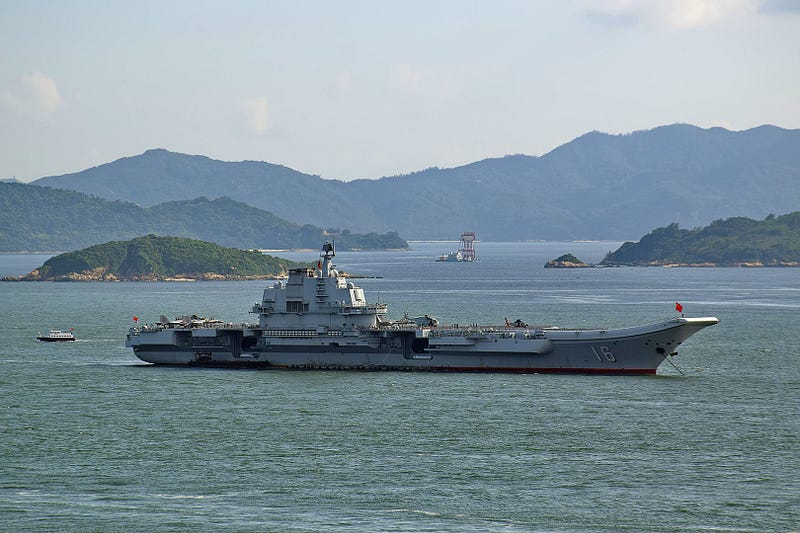
Liaoning in Hong Kong in 2017. She carries a range of aircraft, including 24 x Shenyang J-15, NATO reporting name: Flanker-X2. Image credit: By Baycrest — Own work, CC BY-SA 2.5, https://commons.wikimedia.org/w/index.php?curid=60980675

Originally published at https://www.jamesmarinero.com. Edited.

China
Geopolitics
Aircraft Carrier
Liaoning
Peoples Liberation Army
Recommended from ReadMedium