avatarJohn Emmerling

Free AI web copilot to create summaries, insights and extended knowledge, download it at here

5070

Abstract

do that:</p><div id="2e8b"><pre>eventHandler<span class="hljs-selector-class">.Handle</span>(event1, <span class="hljs-built_in">ExampleMiddlewareFoo</span>(<span class="hljs-built_in">ExampleMiddlewareBar</span>(handle)))</pre></div><h1 id="a8a5">Managing Events with Handlers and Middleware</h1><p id="f869">Most articles I read explain how to use this design pattern; this one deals with implementing the internal logic. So let's start coding.</p><p id="35c4">The full code for this article can be found <a href="https://github.com/xNok/slack-go-demo-socketmode/blob/main/examples/middleware/main.go">here</a> to help you follow along.</p><h2 id="0f88">Designing events</h2><p id="b622">First, we are going to enumerate the list of events that our system can handle. The way we create enumeration in Go is a bit different than in other programming languages. In Go, we are going to use a set of constants sharing the same <code>type</code>. Here I define a type <code>EventType</code>that represents a string with the event's name.</p><div id="b181"><pre>// <span class="hljs-keyword">type</span> <span class="hljs-type">used </span>to enumerate events <span class="hljs-keyword">type</span> <span class="hljs-type">EventType </span>string</pre></div><div id="4817"><pre>const ( event1 EventType <span class="hljs-operator">=</span> <span class="hljs-string">"event1"</span> event2 EventType <span class="hljs-operator">=</span> <span class="hljs-string">"event2"</span> )</pre></div><p id="e041">Next, we define the event itself. In our example, the<code>Event</code> as a type which can be selected among the list of <code>EventType</code> created above.</p><div id="2bc9"><pre><span class="hljs-keyword">type</span> <span class="hljs-type">Event</span> struct { <span class="hljs-type">Type</span> <span class="hljs-type">EventType</span> <span class="hljs-type">Data</span> interface{} }</pre></div><h2 id="df6c">Create an event sender (for test purpose)</h2><p id="60aa">To test our system, we will need to create a small function to send events every 2s. Each<code>Event</code> is transmitted via a <a href="https://tour.golang.org/concurrency/2">channel</a> and, the <code>eventSender</code> below sends a random <code>Event</code> of type <code>event1</code> or <code>event2</code> to a channel.</p><blockquote id="53f3"><p><i>Channels are a type which you can send and receive values, they are great for communication among goroutines. In other words, there are perfect for sending and receive event through your application.</i></p></blockquote><div id="ffd1"><pre><span class="hljs-function"><span class="hljs-keyword">func</span> <span class="hljs-title">eventSender</span><span class="hljs-params">(c <span class="hljs-keyword">chan</span> EventType)</span></span> {</pre></div><div id="7f57"><pre> for { // Send <span class="hljs-selector-tag">a</span> random event <span class="hljs-selector-tag">to</span> the channel rand<span class="hljs-selector-class">.Seed</span>(<span class="hljs-selector-tag">time</span><span class="hljs-selector-class">.Now</span>()<span class="hljs-selector-class">.Unix</span>()) events := []EventType{ event1, event2, } n := rand.<span class="hljs-built_in">Int</span>() % <span class="hljs-built_in">len</span>(events)</pre></div><div id="6101"><pre> c <- events[n] <span class="hljs-comment">// send event to channel</span></pre></div><div id="5285"><pre> // <span class="hljs-keyword">wait</span> a <span class="hljs-built_in">bit</span> <span class="hljs-built_in">time</span>.Sleep(<span class="hljs-number">2</span> * <span class="hljs-built_in">time</span>.Second) } }</pre></div><h2 id="000c">Handler and dispatcher</h2><p id="e562">We first need a struct to hold the list of events we want to listen to and which function to call whenever that event is transmitted. This struct also contains the channel used for communicating events.</p><div id="280d"><pre><span class="hljs-comment">// Create a struct to hold config</span> <span class="hljs-comment">// And simplify dependency injections</span> <span class="hljs-keyword">type</span> EventHandler <span class="hljs-keyword">struct</span> { <span class="hljs-comment">// Event channel</span> Events <span class="hljs-keyword">chan</span> Event <span class="hljs-comment">// hold the registedred event functionss</span> EventMap <span class="hljs-keyword">map</span>[EventType][]<span class="hljs-function"><span class="hljs-keyword">func</span><span class="hljs-params">(Event)</span></span> }</pre></div><p id="aa6c">Next, we need to provide an initializing constructor for our <code>EventHandler</code>.</p><div id="a4ed"><pre><span class="hljs-function"><span class="hljs-keyword">func</span> <span class="hljs-title">NewEventHandler</span><span class="hljs-params">()</span></span> *EventHandler { eventMap := <span class="hljs-built_in">make</span>(<span class="hljs-keyword">map</span>[EventType][]<span class="hljs-function"><span class="hljs-keyword">func</span><span class="hljs-params">(Event)</span></span>) event

Options

s := <span class="hljs-built_in">make</span>(<span class="hljs-keyword">chan</span> Event)</pre></div><div id="78bb"><pre> return <span class="hljs-variable">&</span>EventHandler<span class="hljs-punctuation">{</span> <span class="hljs-symbol"> Events:</span> events, <span class="hljs-symbol"> EventMap:</span> eventMap, <span class="hljs-punctuation">}</span> <span class="hljs-punctuation">}</span></pre></div><p id="98fe">Then, we can create our <code>Handle</code> function that associates the event with a callback function.</p><div id="308c"><pre><span class="hljs-comment">// register the handler function to handle an event type</span> func (h *EventHandler) <span class="hljs-built_in">Handle</span>(e EventType, f <span class="hljs-built_in">func</span>(Event)) { h<span class="hljs-selector-class">.EventMap</span><span class="hljs-selector-attr">[e]</span> = <span class="hljs-built_in">append</span>(h<span class="hljs-selector-class">.EventMap</span><span class="hljs-selector-attr">[e]</span>, f) }</pre></div><p id="e42a">Finally, we create the <code>EventDispatcher</code> function, the core of this mechanism. The <code>EventDispatcher</code>process any event sent to a channel, check its type, and if any function has been registering for that type, we call all registered functions.</p><div id="6597"><pre><span class="hljs-function"><span class="hljs-keyword">func</span> <span class="hljs-params">(h *EventHandler)</span></span> EventDispatcher() { <span class="hljs-keyword">for</span> evt := <span class="hljs-keyword">range</span> h.Events { log.Printf(<span class="hljs-string">"event recieved: %v"</span>, evt) <span class="hljs-keyword">if</span> handlers, ok := h.EventMap[evt.Type]; ok { <span class="hljs-comment">// If we registered an event</span> <span class="hljs-keyword">for</span> _, f := <span class="hljs-keyword">range</span> handlers { <span class="hljs-comment">// exacute function as goroutine</span> <span class="hljs-keyword">go</span> f(evt) } } } }</pre></div><h1 id="13e4">Using our system</h1><p id="4d4e">Everything is ready; we can start using our event handling system.</p><ol><li>Instantiate our event Handler</li><li>Register which event to listen to and what function to callback</li><li>Start the event sender</li><li>Start the event dispatcher</li></ol><div id="62ab"><pre><span class="hljs-keyword">func</span> <span class="hljs-title function_">main</span><span class="hljs-params">()</span> {</pre></div><div id="5b09"><pre> <span class="hljs-variable">eventHandler</span> := <span class="hljs-function"><span class="hljs-title">NewEventHandler</span>()</span></pre></div><div id="d244"><pre> eventHandler.Handle(event1, <span class="hljs-keyword">func</span><span class="hljs-params">()</span> { <span class="hljs-built_in">log</span>.Printf(<span class="hljs-string">"event Handled: %v"</span>, event1) })</pre></div><div id="5c56"><pre> <span class="hljs-variable">go</span> <span class="hljs-function"><span class="hljs-title">eventSender</span>(<span class="hljs-variable">eventHandler.Events</span>)</span></pre></div><div id="30f2"><pre> eventHandler<span class="hljs-selector-class">.EventDispatcher</span>()</pre></div><div id="9bf2"><pre>}</pre></div><p id="e590">The result should be along those lines:</p><figure id="5ee7"><img src="https://cdn-images-1.readmedium.com/v2/resize:fit:800/1*_D-GCRSu3K8CgTBXewJjJQ.gif"><figcaption></figcaption></figure><p id="19d6">Since we only handle an event of type <code>event1</code>, only <code>event1</code> shows as <code>Hansled</code>. All is good!</p><p id="d48a">The full code for this article can be found <a href="https://github.com/xNok/slack-go-demo-socketmode/blob/main/examples/middleware/main.go">here</a>.</p><h1 id="6f5e">Interesting Articles tackling the same topic</h1><ul><li><a href="https://drstearns.github.io/tutorials/gomiddleware/">Middleware Patterns in Go</a></li><li><a href="https://sathishvj.medium.com/web-handlers-and-middleware-in-golang-2706c2ecfb75">Web Handlers and Middleware in GoLang</a></li><li><a href="https://readmedium.com/lightweight-event-management-implemented-by-go-a654d59ac65">Lightweight event management implemented by Go</a></li><li><a href="https://readmedium.com/the-7-most-important-software-design-patterns-d60e546afb0e">The 7 Most Important Software Design Patterns</a></li></ul><p id="13e7"><i>Do you want <b>unlimited access</b> to all my content and many other writers’ content on Medium? Consider using my affiliate link to <a href="https://couedeloalexandre.medium.com/membership">become a Medium member today</a></i></p><h2 id="853a">Further reads</h2> <figure id="81d2"> <div> <div> <img class="ratio" src="http://placehold.it/16x9"> <iframe class="" src="https://couedeloalexandre.medium.com/embed/list/3f9d03f2cb8f" allowfullscreen="" frameborder="0" height="184" width="undefined"> </div> </div> </figure></iframe></div></div></figure></article></body>

Sheer Insanity at Merrill—In the Matter of 9 Cents

As the economy stumbles a financial giant grasps at straws
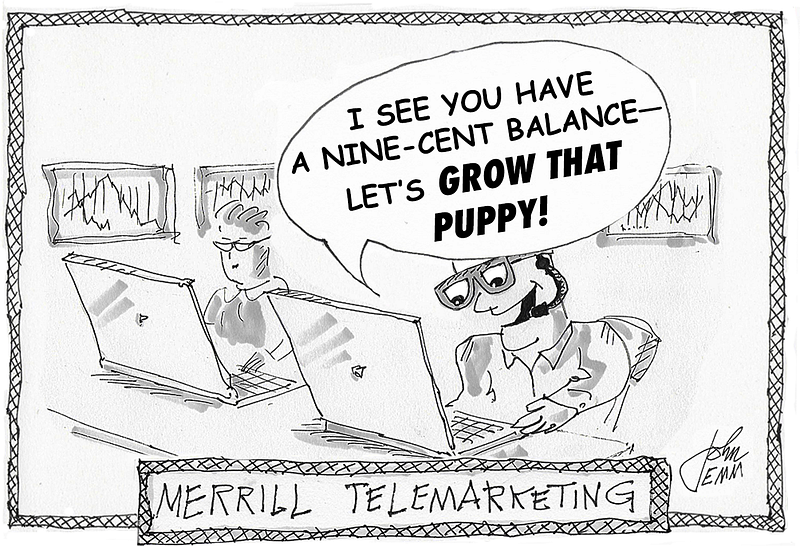
Motto — ”No Account Too Small.” Cartoon by John Emmerling

Back in May, my wife cashed in her Roth IRA at Merrill. She transferred the funds to an investment account at another institution. But the financial wizards at Merrill somehow left nine cents ($0.09) rattling around in her account.

She handles her financial affairs online. But still gets paper statements for all accounts. So guess what just happened? She received her 3-month summary statement from Merrill.

Here it is for her friends and family to see — proof that she is preening her feathers as she luxuriates in Fat City. This statement demonstrates that she has a Merrill account with nine pennies in it! (Try to control your envy.)
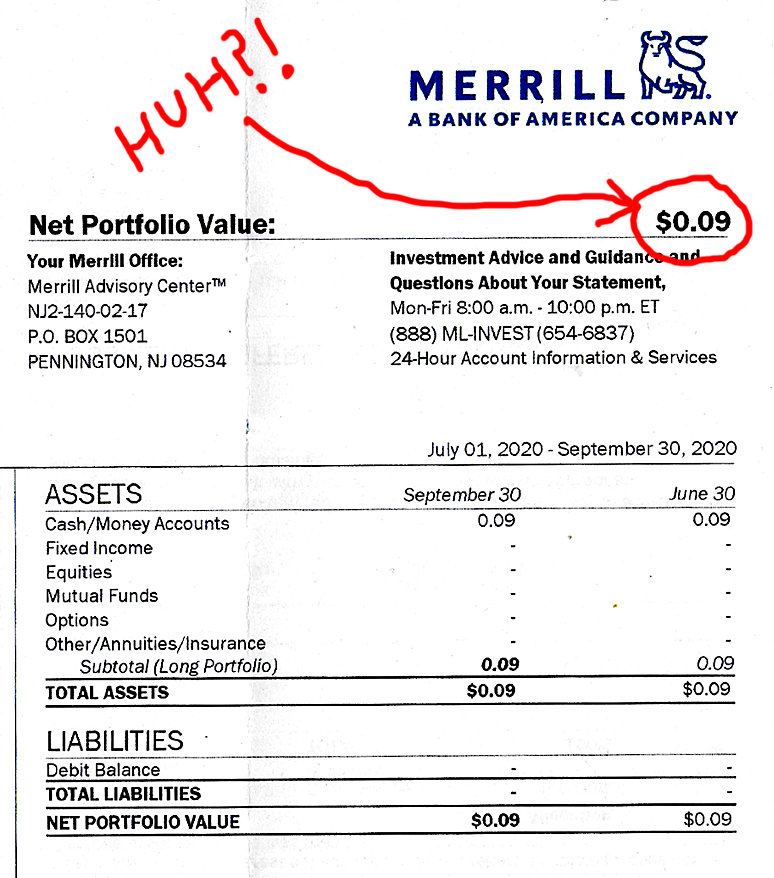
You may think 9 cents is insignificant—obviously Merrill disagrees. Image by author

Stop for a moment and consider the economics of this foolishness.

Presorted first class mail (in the event you haven’t used it lately) costs 38.6 cents to send a one-ounce envelope. Of course, the total cost of doing a mailing always exceeds the postage. Merrill must keep track of the account reconciliation. They must supply an envelope and paper. Then print a multi-page paper statement. Then stuff the statement into an envelope and put this vital packet into the hands of the U.S. Postal Service. I’ll be generous (to the genius whiz kids at Merrill) and estimate that those prep costs only add an extra dollar. That means each mailing costs Merrill $1.386. Projecting to next year at this time, Merrill will have mailed 5 quarterly statements. That will be $6.93 spent to keep their valued 9-cent client informed.
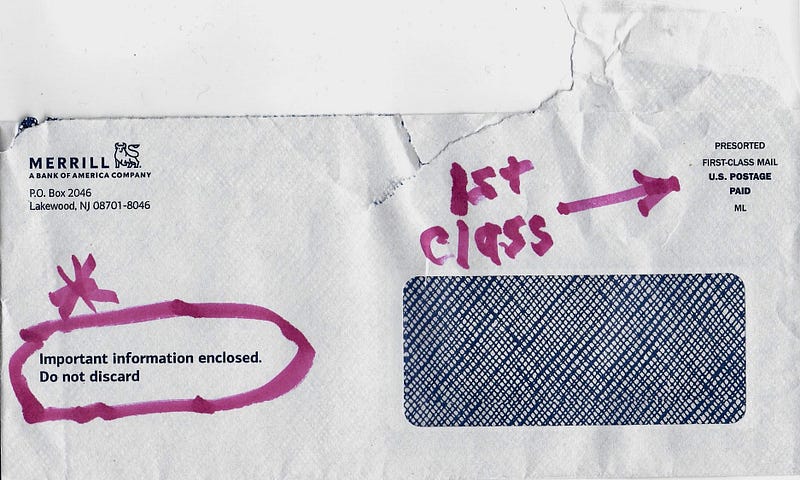
A 38.6-cent stamp for a 9-cent client. Image by author

Let’s take this into the future. As these quarterly statements stretch on for the next twenty years—that’ll be eighty statements—Merrill will spend $112.27. Think of the ongoing flurry of account activity required! Track the account. Buy reams of paper. Print the statements. Mail out this kit and kaboodle 80 times (we’ll assume the post office will still exist in 2040). All those years of time, effort, supplies, and mailing costs to keep their 9-cent customer up to speed.

Is there an insanity algorithm at Merrill? Why doesn’t some human who works there have a brainstorm?

Hey! Why not send her a check for nine cents?

Oh, I forgot. This stuff gets done by AI and robots.

And it’s possible that Merrill — in the pre-AI era — made a board-level decision to never, ever send out a paper check. This means the AI-bots will need to develop actual non-digital common sense when it comes to things like a nine-cent balance. Once that’s in place the bot might think—Hey! Let’s pitch her on the purchase of fractional stock shares.

At the time of this writing Amazon is selling for $3,282 a share—and 9 cents might buy her 1/36,467th of a share.

Facebook is selling at $263—her 9-cent nest egg might buy 1/2,924th of a share.

And Apple, at $116, would allow her to own 1/1,289th of a share.

BUT THEN THIS MAY HAPPEN: Merrill’s research bot may sleuth out that buying one tiny sliver of one share makes their clients feel like low-rent cheapskates. If so, the research bot can bump the file over to a broker bot who will shoot out this email:

Dear account holder: Your friends here at Merrill suggest you take your nine cents and invest in penny stocks. We see a real growth opportunity in Plastic Hair Implants for Baldies (Nasdaq: PHIB). A bid at today’s price of $0.015 will buy you 6 shares.

Turning my wife into a PHIB shareholder can finally end this 9-cent insanity.

Before I go this must be noted:

There has been no accumulated interest added to the nine cents Merrill is greedily hoarding. Surely by now — after these past three months have slipped by — the account should have grown by one-sixteenth of a penny! The quarterly account statement should read at least $0.090625. Where is the recognition of that withheld interest on your statement? Are you padding your bottom line with ill-gotten proceeds?

WARNING TO MERRILL: We have alerted our lawyers to this blatant violation of investor rights. Be watching for our subpoena.

If you enjoyed that truth-stranger-than-fiction read, here’s a bit of (totally unrelated) whimsy:

Humor
Satire
Stock Market
Merrill Lynch
Life Lessons
Recommended from ReadMedium