
WOMEN’S HISTORY MONTH
She Was 15, Dark-skinned and Omitted From the History Books
Claudette Colvin is an example for all of our daughters
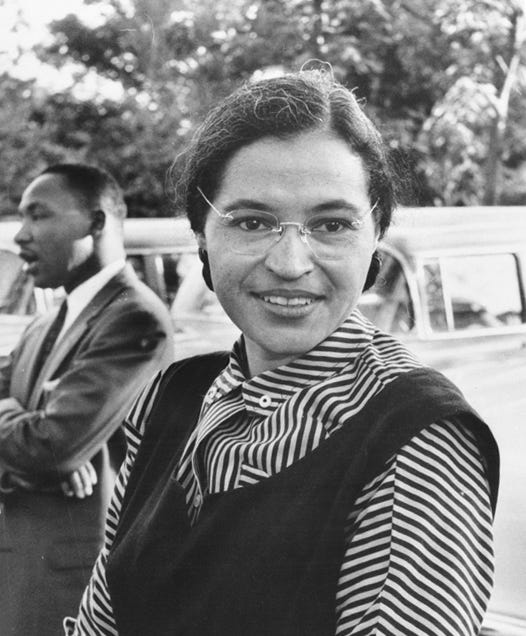
Ask almost anyone about Rosa Parks, and they are likely to tell you without pause that she was the catalyst for the Montgomery Bus Boycott after refusing to give up her seat on a public bus to a white man.
Most people learn about Parks in grade school as the light-complected, 42-year old seamstress who, after a hard day’s work in December 1955, refused to be relegated to second class citizenship when told by a white bus driver to move to the back of the bus so that a white person could take her seat.
Bus segregation was part of a host of Jim Crow laws that marginalized Black people by denying them their rights, including the right to vote, obtain paid employment, get loans, sit where they chose on buses and other opportunities. Arrest, fines, jail time, violence and death were consequences for defying such inhumane laws.
In Parks’ case, she was arrested and jailed for refusing to give up her seat. She would later become the face of the Civil Rights Movement for her courageous act.
I’ve taken public transportation via the city bus many times — to work, school, and stores. Like Parks, I’d often sit at the front or middle of the bus. I’m about the same age as Parks was at the time of the incident and I can not fathom getting from my seat and moving to the back, or standing, as was also often the case, so that a white person could sit comfortably. Yes, I’ve given up my seat to elderly people of various backgrounds, but that was my choice to do because of their physical needs and never based on race.
I’d like to think that I would have had the same courage to resist the constant dehumanization and remained seated too.
So, when I learned that nine months prior to Rosa Parks’ encounter, a 15-year-old Black girl did just that, I was enthralled and even more curious as to why Parks had made the history books, but not this young warrior princess.
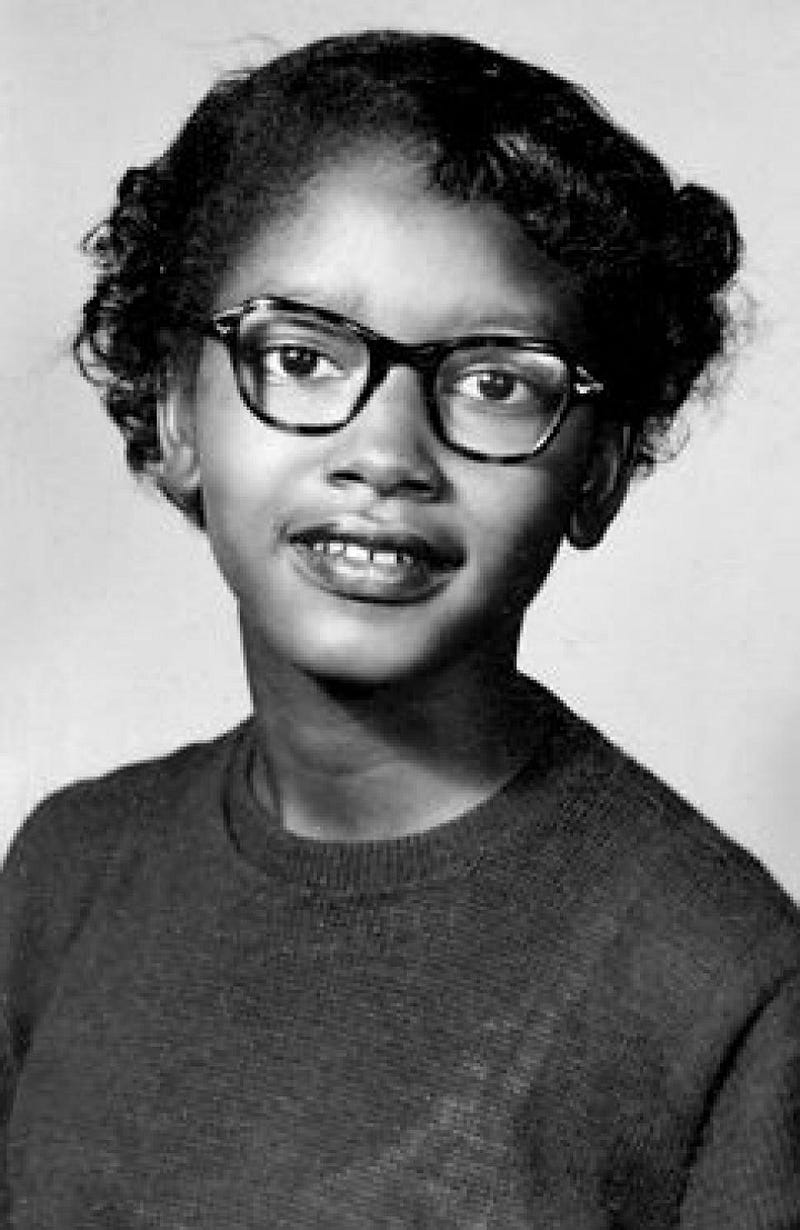
Her name was Claudette Colvin. The day was March 2, 1955. School had let out early and she and a couple of friends had hopped on the segregated Montgomery, Alabama public bus system to head home. As usual, when white people boarded, the Black passengers at the front of the bus had to move to the rear, or stand.
A young white woman got on the bus and Colvin and her friends, who were seated in a row, were told to move to the back and stand so that she could sit.
The sheer ridiculousness of racism is astounding — an entire row of Black people forced to stand so that one white woman can take a seat.
A few reluctantly stood up from their seats.
On this particular school day, however, Colvin had learned about great Black women abolitionists and, wanting to emulate their bravery in the face of racism, declared her humanity and claimed her seat.
It’s important to note that this intersectional history that was taught to Colvin about fearless freedom fighters like Harriet Tubman who escaped slavery and led dozens of other enslaved Africans to their freedom, and Sojourner Truth, who also escaped slavery and became a vocal advocate for abolition, was taught in an all Black, segregated school. In interviews decades later, Colvin remembered how deeply her Black teacher would engulf the students in their history.
That day’s lesson on the Black women abolitionists stirred her spirit.
Mustering up the courage of her ancestors, she refused, stating that she’d paid her bus fare and that it was her constitutional right to remain seated.
She would later recount:
“History had me glued to the seat. It felt as if Harriet Tubman’s hand was pushing me down on the one shoulder, and Sojourner Truth’s hand was pushing me down on the other. Learning about those two women gave me the courage to remain seated that day.”
And just as they did Tubman and Truth, whiteness enforcers — in this case two white Montgomery cops — attempted to put her in what they deemed as “her place.”
After refusing to move, the police officers knocked her books from her lap, roughed her up and violently dragged her off the bus.
She was charged with violating segregation law, disorderly conduct and assaulting a police officer. She was taken to an adult jail that consisted of a broken sink and a dirty cot.
According to the police report from that day, one of the arresting cops, T.J. Ward, claimed that Colvin “struggled off the bus and all the way to the police car and that after we got her in the police car, she kicked and scratched me on the hand, also kicked me in the stomach.”
When I read that comment, I didn’t know whether to dismiss it because of the history of lies embedded in and spewn from the institution and culture of policing, or to raise my fist in solidarity with a little Black girl who chose to stand on the shoulders of her ancestors and defy a system that constantly dehumanized and degraded her and all who looked like her at every turn.
Despite the heroic act of Colvin, neither the incident nor her bravery was lifted up in the media or the history books.
Activists and others chose to highlight the mistreatment of Black people on the public bus system via Parks’ encounter nine months later. They used the moment to create a movement of boycotting the bus system and creating a list of demands, including respectful treatment of Black bus riders; a system of first-come, first-served seating; and employment of Black bus drivers.
Fred Gray, an attorney, later sued the City of Montgomery using incidents involving Colvin and four other Black women who had similar encounters with the bus system. It’s critical that we say their names. Those women were Aurelia S. Browder, Susie McDonald, Mary Louise Smith and Jeanetta Reese.
The following year, the U.S. Supreme Court ruled that bus segregation was unconstitutional. And although history does not, we, today, should thank Colvin for that.
And although history does not, we, today, should thank Colvin for that
Some say the incident involving Parks was staged to reenact Colvin’s ordeal and bring attention to the injustice.
Some also question why the authentic and rightful defiance of a little girl against a racist system went so overlooked and seemingly unnoticed.
Decades later, Colvin would publicly express that her experience on that March day and afterward did not receive the attention it deserved because of issues people had with her age and dark skin tone. And that she became pregnant at the age of 16.
It appeared that the prevailing notion was that a dark-skinned, pregnant teen would not be considered the right face for such a just cause. Instead, a lighter skinned, older, married woman — Rosa Parks — would be chosen.
It seems as if respectability politics played more than a marginal role in the erasure of Colvin from the history books.
It seems as if we rejected Colvin the same way the racist system rejected her humanity.
Consequently, she largely, and very unfortunately, remains an untold story.
How remarkable it would be if little girls (and boys) learned at a young age the bravery and agency of a little Black girl against the insidious and fallacious white supremacist system.
How many daughters and sons have we done a disservice to by not teaching them about Colvin and her courage and will?
Colvin stood on the shoulders of Black women abolitionists during such a monumental encounter that helped changed the course of history. How dare we omit her story, her truth, her contribution and refuse today’s youth the opportunity to call on her name and stand on her shoulders in the face of adversity.
Let’s write her into the narratives through talks with our sons and daughters.
Let’s lift up her name and bravery and encourage our girls and boys to conjure up her spirit of brilliance, resistance and freedom at every turn.
For more stories honoring women, follow Fourth Wave. Have you got a story or poem that focuses on women or other disempowered groups? Submit to the Wave!


