
She Sees Dead People in ‘Shutter’
Ramona Emerson brings us a Navajo forensic photographer
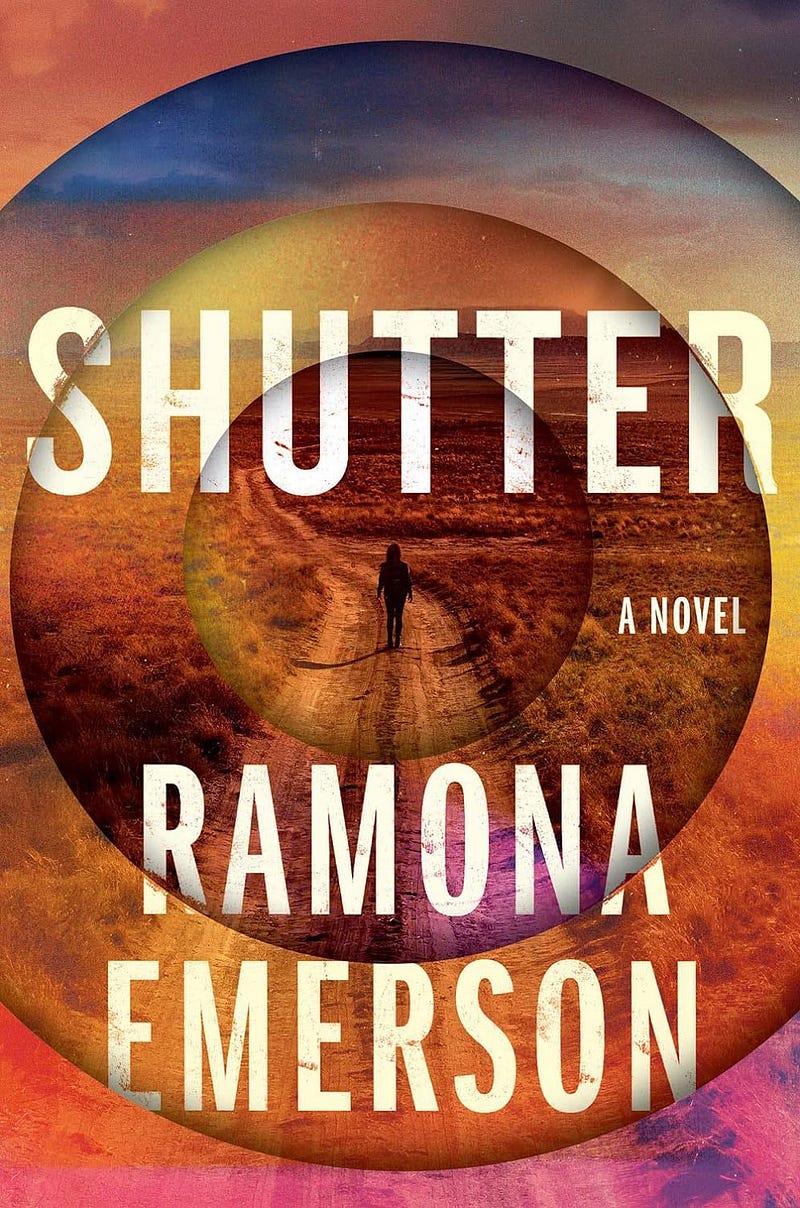
Book review: Ramona Emerson, Shutter (Soho Crime, 2022).
[Trigger warning: The crimes detailed in the novel and referred to below are unusually graphic.]
An extraordinary new writer knows the land, the people, the art, the job, and the blood and body parts she writes about.
Ramona Emerson is not exactly new at creating compelling narrative. She is a decorated filmmaker who for many years worked the job that she gives her protagonist, Rita Todacheene: forensic photographer with the Albuquerque police.
Still, it is difficult not to marvel at the cool, compelling style with which Emerson comes roaring out of the gate in her debut novel. We are dropped into a grisly scene: a New Mexico highway commandeered by a police force investigating the apparent suicide of a young woman who fell from an overpass onto the highway below and was pulverised by passing traffic before somebody called 9–1–1 to report the death.
Rita Todacheene is the photographer sent to catalogue the hundred-plus body and clothing parts numbered by yellow markers along the highway.
This person had been scattered — muscles and flesh torn by the push and pull of steel, by hot rubber and propulsion, speed and physics. The markers stretched out farther than I could see, a serpent of reflective yellow slithering into sky and tar. Too many people were on the scene, mostly cops surveying the carnage, telling stories in huddles, pulled together by whispers.
— Shutter, chapter 1, “Nikon D50 18–55mmDX”
From the start we are gripped by the need to know, not just how this woman died, but what the photographer’s work will tell us about why she died.
Also from the start, Emerson immerses us in the complicated cultural politics of New Mexico, both Albuquerque and the Navajo reservation a couple of hours away. Rita Todacheene is Diné, raised on the reservation by a grandmother who is still the mainstay of her life, and who insisted that Rita plan to make her life somewhere beyond the reservation.
Rita’s grandmother was educated at the Indian boarding school in Albuquerque. She raises her daughter, Rita’s mother, to leave the reservation as well. Anne gets pregnant by a male student who disappears. Baby Rita is no trouble at all: so little trouble that they worry about her.
I was a quiet baby. My grandmother told stories about how I would stay silent for twenty-four-hour periods, depriving her and my mother, Anne, of sleep because they wondered if I was dead. But there I would be every morning, eyes wide, looking to the sky, where there was a ray of light only I could see. I didn’t cry. I was just awake. All the time.
— Shutter, Chapter 2, “Exakta VX 1000”
Soon her mother leaves, and Rita and her grandmother become the family.
Rita sees ghosts. This is not a gift welcomed by her family or by the Diné, who fear death and signs of the dead. She is tightly held spiritually by her family and neighbors, but she is also warned, repeatedly, that she must close the door to the spirits, who can only wish her harm.
The novel moves back and forth from the current case to the past: to Rita’s childhood, youth, college years, and work with the police, not necessarily in that order. The chapters are titled with the names of cameras, lenses, and f-stops. For photographers and cinematographers, the references are familiar and help establish a kind of chronology. For those to whom these terms are unfamiliar, maybe not so much: but they immerse us in the world that Rita inhabits, and also offer clues about perspective, angle of vision, and light source.
Speaking of light source, the ghosts that present themselves to Rita appear initially, in her childhood, as bright lights. Later, during her photography curriculum at college, her instructor asks her about the light source in a particularly compelling photograph she presents in her final project, and she responds that she did “nothing to alter the light.” He doesn’t believe her but also doesn’t question her, and gives her an A.
It becomes clear that the spirits punch their way through the holes in her daily life and her vision when they need something. The victim of the horrific highway mauling is especially demanding, screaming at her and bringing trails of additional ghosts with her to line the walls and sit on chairs and benches and get in her face and make demands. Some of this would be comical if it weren’t horrifying, and that’s another piece of Emerson’s genius: to populate Rita’s life with these shadowy, ineffable figures in a palpable way, so that they throb behind our eyeballs as well as Rita’s. Hospitals are particularly nasty, overpopulated dwelling places for all sorts of formerly alive people.
Emerson also avoids the clichés of crime fiction, and not only because she writes masterful paranormal scenes. We meet the guy who hired and trained her as a forensic photographer; he is stinky, demanding, and altogether repulsive. “Spearmint gum, Windex, and pipe tobacco. The man’s smell reminded me of the parking arcade in the Old Town Hotel, where the bums slept in the elevator’s glass enclosure” (Shutter, chapter 3, “Nikon D50 18–55mmDXX Revisited”). But Samuels is also the best at what he does, and he bullies Rita into a skill level that puts her in demand for the hardest cases. The work is exhausting, and of course more so because of all those ghosts crowding around, demanding to be seen and heard, demanding that she figure out what happened to them.
Rita’s grandmother is a multidimensional figure, foundational to Rita’s life and energy. Yes, she wants Rita to leave the reservation: to live in the world outside. Emerson paints pictures of the stark poverty on the reservation.
On the reservation, nestled deep within the red canyons and forgotten communities, tattered trailers and the skeletons of long-abandoned hogans stood like teeth. Hot sand ran into every crack and hole when the winds blew. Now, only shells remained, tied together with thinly stretched chicken wire and bare logs.
— Shutter, Chapter 4, “Paper and a Box”
But her grandmother is not only cooler and more stylish than the other Diné women her age — she can also “make anything out of nothing.” So Rita does not grow up in a “tattered trailer,” but rather in the house her grandmother built years before from old shingles and stones, and then provided with water and electricity.
Despite her expectation that Rita will leave the reservation, her grandmother also grounds her in the Navajo way. When Rita is about to turn five, they go out to collect piñons. “Grandma had loaded us up with a shovel, a shabby gunny sack, a tattered cotton sheet, and a black box.” She teaches Rita to have patience, not to shake the tree: that is not the “Navajo way.”
The black box they carry to the piñon trees on the eve of Rita’s fifth birthday is not part of the harvest ritual. It is, instead, Rita’s initiation into the art that will now be passed down to a third generation.
[S]he grabbed the black box she’d brought, poking a small hole with a pen and covering it with black tape.
“What is that, Grandma?”
“I am going to make us a camera out of this box.” She turned to me and smiled. “It’s been a long time since I’ve tried this, so let’s hope it works.”
I watched in silence as she pulled out a dark blanket, draping it over herself and the box. I could hear a rustle and scrape under the wool.
— Shutter, chapter 4, “Paper and a Box”
The pinhole camera does work, and Rita discovers the magic of photography — a practice that her grandmother learned apprenticing in her years at the Indian school, taking ‘before and after’ photos of the children snatched off the reservation to have the Indian bullied out of them.
So Emerson creates this family navigating the space between the Diné world and the not-Indian world: the ugly poverty on the beautiful reservation and the ugly corruption of the urban police force.
And Rita must further navigate the space between the Diné’s reluctant belief in the dangerous spirit world and the skepticism of the not-Indian world that labels her insane and suspends her from her job when she is forced to tell the truth about what she sees.
Samuels grabbed his pipe and chewed the tip. “All this talk of ghosts and visions only clouds our path of evidence. People will think we’re having séances to get through case files. And here you are, one of my best investigators, turning into some kind of damn psychic detective.”
— Shutter, Chapter 21, “iPhone”
Rita has close friends and neighbors in the city, who come to her rescue when her pursuit of the truth in the highway case gets too hot. The ghosts don’t help her, and that’s important for the reader. This isn’t magic. They clamor for her to do what she has to do anyway. At the end, after the bad guy has been caught, Rita heals in a hospital room. She tells her grandmother and the medicine man at the end that the ghosts have gone away, but they have not.
It is horrible to lie to the people you love. I had to tell Grandma and Mr. Bitsilly that the ghosts were gone. I had no other choice.
In my hospital room, a man sat reading a book with a title I couldn’t make out. Every hour or so, his ghost would sigh and slam the book closed, then walk to the window and look out. The man did this over and over, all through the days and nights I was stuck there, like he didn’t have the memory in the soles of his feet, the callouses of maintaining that journey for the rest of his days. He never noticed me or asked me for anything.
— Shutter, Chapter 38, “Wide Open”
Shutter is the first book in a promised trilogy. I cannot wait to read on. Ramona Emerson is a brilliant writer, capturing agony, courage, evil, pain, and the passage of time with honesty and eloquence.
Soho Crime, an imprint of Soho Books, has a remarkable roster of crime writers who set their series in locales around the world. Ramona Emerson is one of their newer writers. One could do worse than to work one’s way through their catalogue, which includes Cara Black, Barbara Cleverly, Colin Cotterill, David Downing, Mick Herron, Peter Lovesey, Sujata Massey, and I’m barely scratching the surface. A lifetime of entertainment.
A couple more ventures into the paranormal and maybe-a-little-bit-paranormal:
Thanks for reading!


