
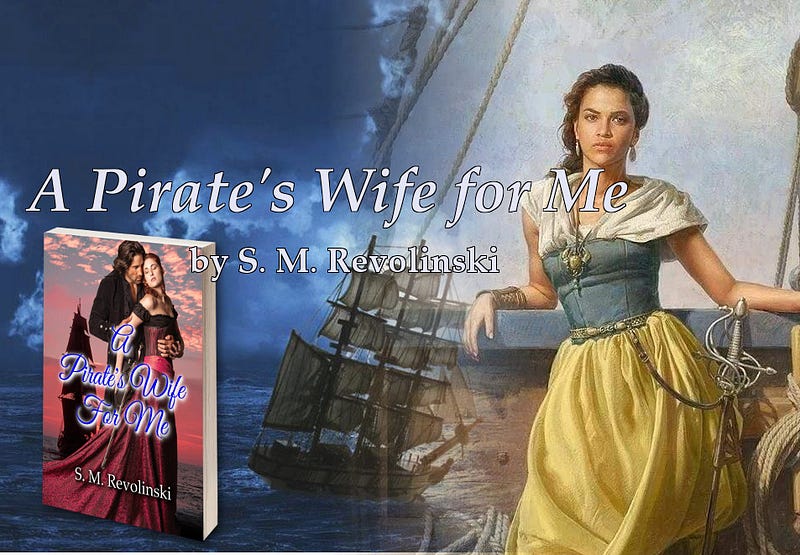
She Knew, Nothing Would Ever Be The Same
A young woman’s adventure on the high seas
Pulling her cloak tighter, Anne attempted to ward off the chill of the October evening air. However, the shivers that ran along her spine were not from the falling temperature. Anne was forced to acknowledge her own fears as she watched the coastline of Glasgow, Scotland shrink in the ship’s wake. Although she was standing on the poop deck, high above the waterline, a gust of wind caught the foam from the wave tops, and blew the spray against her face. She made no attempt to wipe away the droplets of water that beaded on her oiled, woolen cloak.
“Will we ever see home again?” Daniel asked the question that Anne had been trying so hard to ignore. Her younger brother climbed the steep staircase to the top of the aftcastle and stood beside her at the ship’s stern railing. She opened her dark green cloak and wrapped the warming cloth around the both of them. While he may have thought that her gesture was intended to comfort him, the reality of her action had been to receive his comforting embrace.
“Of course we will. Papa is a fine seaman, and he has purchased a stout ship for us. We will have many fine tales of adventure to tell our friends when we return.” Anne hoped the strain in her voice had not revealed her anxiety. However, a great uneasiness had been steadily growing in the pit of her stomach ever since the family decided to set off for the West Indies. New World — the very name of the place held the allure of a new beginning, a new life. Anne knew that from this day forward, nothing would ever be the same.
“Miss McKinnon?” Anne turned, welcoming the new distraction.
“Aye, James?” Anne acknowledged the crusty crewman standing on the main deck, at the base of the staircase. The aftcastle was the domain of the ship’s captain and officers. Other than the helmsmen, who manned the auxiliary ship’s wheel mounted in the center of the poop deck, the crew was forbidden to linger in the area. While Anne and her brother were part of the crew, they were also the Captain’s children. To save money, they had joined their father’s latest mercantile venture; therefore, they had access to the entire ship.
“One of the women has gotten sick.” On this voyage, the ship carried a cargo of manufactured goods and twenty passengers bound for Jamaica. And, one of Anne’s jobs was to care for the sick — the seasick passengers. Swallowing to keep her own bile down, Anne turned away from the fading coastline to begin her cleanup duty.
Two months earlier, her father, Douglas McKinnon, had arrived home to find his wife dead and buried. The lifelong seaman had been the sailing-master and navigator aboard a merchant ship trading Scottish wool for spices and silks in the Canary Islands. During his two month-long sea voyage, his wife, Matilda, died while giving birth. His second son, the premature newborn, died a day later. Anne and Daniel were struggling to survive as the cash in the house ran out and they did not know where their father hid his money.
“I sent word to Aunt Margaret, but have not heard back,” Anne said, speaking of her mother’s sister. Margaret had stayed in the village where the two women had been born. There, she had married a farmer in the service of the local laird. Matilda had been struck with the wanderlust and followed the romantic Douglas as he passed through the village, on his way from Edinburgh to Glasgow. Matilda’s mother had not been pleased, but her father was glad to be rid of her constant bickering about their poor lot in life. Up to this point, Douglas had been a good provider. “We were not so desperate, Papa. The neighbors were giving us their food scraps,” Anne had said, defending her handling of the tragedy.
“Aye, you managed very well. I’m so sorry that I was not home to help you.”
“I am pleased that you are safely home now.” Anne had hugged her father and kissed his cheek, avoiding his prickly beard.
Walking along the ship’s deck to the seasick passenger, Anne passed her father. He was watching the disappearing land through his telescope. With a tear in her eye, she paused to kiss his cheek once again.
Things had changed quickly following the death of her mother. Papa had been fearful of venturing to sea again, fearful that his children could not fend for themselves. Fearful of what would become of them if he were killed. Once orphaned, they might be forced into a workhouse. Yet, he knew no other way to make a living.
“I’m sorry, Anne, but it is the only way. Aunt Margaret has found you a fine suitor and that is final.” Douglas’ solution had been to marry his daughter off to a farmer, a relative of his brother-in-law. Then, he would sell the house in Glasgow and all their possessions. With the money he would purchase a modest sailing barque of his own. He would take Daniel to sea with him. “You will live with your Aunt Margaret. On your seventeenth birthday you will become engaged. A year later, you will be old enough to marry.”
“I am NOT a farmer’s wife!” Anne refused to accept her father’s plan even though she knew that this had also been Mama’s plan for her.
“Just who will you marry? You must marry someone. There is no one else to care for you while I am at sea.”
“Mama said that I’m not old enough to marry.” While, Anne knew that many girls her age were already married, she knew that her mother did not approve of marrying at such a young age. “Besides, if Daniel can sail with you, so can I. We can save more money by not hiring an extra hand. I can cook and tend to the passengers as well as any man.”
“No, that cannot be!”
“If we go as a family, then we can travel further, more profitable routes.” Anne had listened to many conversations between her mother and father. She knew that he wanted to join the ships sailing to the West Indies. She knew that there was a great deal more money to be made on these trips, but her mother did not want to be without her husband for six or more months at a time. Additionally, she had heard the stories about the pirates.
Having heard his own words being spoken by his daughter, Douglas understood that she had acquired the driving need to see beyond the horizon; the need that filled both himself and his wife. During the first two years of their marriage, before Anne had been born, Matilda had traveled with him as he traded between Glasgow and Belfast; occasionally they sailed to Dublin and Liverpool. Prior to her latest pregnancy, the two had planned to once again travel the world together after Anne was married; Daniel could have travelled with them. However, seeing his wife’s zeal for life dawn in his daughter’s eyes, Douglas had abdicated his plan marry her off; he had agreed to her plan to voyage with him to the New World.
“I’m sorry to be such a ninny,” the seasick woman said as Anne approached.
Anne finished cleaning the messy floor of the common room silently. Trying not to breathe in the rancid odor, she struggled to hold her own dinner in her stomach. “It’s no concern,” she finally responded. “It happens to most everyone on their first voyage.” However, Anne did not continue saying that the current sea conditions were tame compared with what they would experience in the Atlantic. Soon the ship would round the Isle of Arran and turn northwest. Then it would be only a few hours sailing until they passed between the last finger of the Scottish coast and Ballycastle, Ireland. By nightfall, they would be in the Atlantic with its steep rolling waves. “It’s best, ma’am, if you move about. Get up on the main deck and walk along the railing. Watch the horizon and imagine that you are dancing. The ship is your partner, leading you as it dips and sways. Keep your knees bent and find the rhythm of the sea’s music.”
Anne spoke respectfully to the paying passenger despite the fact she was her own age. The young woman had been married a scant three months. Anne watched her stumble as she began walking toward the stairs leading up to the deck. Several other passengers, green with their own illness, had heard Anne’s words and followed the woman. Anne left the bucket and rag in the passengers’ common room. She expected that she would be cleaning puke several more times before sunrise. If it wasn’t promptly cleaned, the odor would cause all of the passengers to heave.
With the money he had gathered from the sale of their possessions, Douglas had been able to purchase an old ship in need of repair. Once their house was sold, the family moved aboard the ship. They began repairing her while they lived within her. For the more difficult tasks, he hired carpenters and other skilled labors. Slowly, he acquired a crew. As the ship neared readiness for the transatlantic voyage, they made short trading trips to Ireland to make some money and to test the vessel’s seaworthiness.
Then, Douglas had posted advertising bills that he was accepting passengers seeking to travel to Jamaica. Once the ship’s hold had been filled with muskets, shot, iron plows, and other manufactured goods to trade, they set sail.
“My name is Harriet — Harriet Livingston,” the seasick woman said when Anne stepped back onto the main deck.
“I am Anne, and I am pleased to make your acquaintance.”
“Have you been to Jamaica before?” A new voice joined their conversation. Anne turned to see Mary Read.
While a member of the passengers, Mary was Anne’s cabin mate. Papa didn’t approve her — “No, we cannot accept unmarried women among the passengers,” he had said to Mary, when she had come forth to pay her fare. “Why not, Papa?” Anne had whispered. Returning her whisper, he said, “Because we have three unmarried men on the roster. All of the passengers must share the common room and there will be no accounting of her… activities.” However, Anne knew how desperately they needed the funds and Mary made their twentieth passenger. Thus, Anne offered, “She can stay with me in my cabin.” In the end, Douglas had accepted Miss Read’s money; he had needed it to buy more cargo.
“No, this is the first voyage that my father has allowed me to join him.” Anne carefully chose words that were truthful, yet she did not want to worry the two women. If they knew that this was the first transatlantic voyage for all of them, they might become as concerned as Anne was.
“You are not married?” Mary Read continued to question Anne. While cabin mates, Anne had been busy during the day and there had been no time to become acquainted with Mary. She seemed friendly enough, but Anne found the woman to be a tad frightening. She was about ten years Anne’s senior in age, and her leathery skin and tall, muscular features told her story of a hard life. Anne did not consider that the three young, unmarried male passengers would have found any reason to engage in activities with Mary. Anne had considered that the woman’s presence in her cabin would keep the men from attempting any amorous activity with her.
“No, I chose to remain with my father after my mother died.”
“I’m not married either,” Mary stated what was already known. “My husband and I were innkeepers in Holland, but he died a few months ago. I am in search of a new life. I plan on acquiring an inn or tavern in Spanish Town.”
“You should fare very well. Much of that area of Jamaica was destroyed by an earthquake twenty-four years ago. The city, I hear, is bustling with new building and growth.” This was the reason Papa chose this port for their venture.
“You do not fear the pirates?”
“I have heard that many years ago the city of Port Royal was a haven for the pirates. However, Captain Morgan freed the city from those evil influences. The earthquake was the hand of God sweeping away the residue of that Sodom of the New World.” Anne recited the words her father had given her; words to ease the fears of the passengers who had heard of the city’s criminal past.
A flurry of activity began as crew members swarmed into the rigging. Douglas had insisted that the crew communicate with hand signals instead of the usual shouting and whistles that were customary aboard ship. He did not want to concern the passengers with sporadic sounds that they didn’t understand. Anne watched the sailing-master’s signals to the crew.
“Ah, we are coming about,” Anne said loud enough to be heard by all of the passengers that gathered along the side railing. “We have gone far enough southwest, and now we are going to turn northwest. The sailors will be changing the position of the sails. Where the wind was coming from the starboard, or right, side of the ship, we will turn and the wind will shift to the port, or left, side. We will sail northwest through the night — out into the Atlantic. Then in the morning we will reverse the maneuver and sail southwest to the Azores islands. After taking on supplies, we will continue on to Jamaica.”
Anne and the passengers watched the sailors’ delicate dance high in the rigging. As though he was an orchestra conductor, the sailing-master directed the sails, attached to the two masts, to be rotated in a specific sequence while the helmsman turned the boat. For a brief moment, the ship was pointed directly west and into the prevailing wind.
“How long will the trip take?” Harriet asked, somewhat less green about the gills.
“Two months,” Anne answered. “And now, I must get to work cleaning up the dinner meal.” Anne strode across the deck to her domain — the galley. The come-about maneuver was her signal that the crew had finished eating. The passengers had eaten first, and then the crew. Now it was time for Anne to clean up the dining area. Papa had ordered that no food residue would be left unattended. There were a few rats aboard ship, and he intended to starve them.
The galley was on the same level as the main deck, but inside the forecastle. In good weather, such as they enjoyed on this day, tables were set up on the main deck for the meals. In bad weather, the food would be passed down the stairs to the passenger’s common room and to the crew’s quarters. Anne’s cabin, that she shared with Mary, was in the pantry forward of the galley. It was one of the most miserable places on the ship; the bow of the boat was where the ship’s up and down motion was at its worst.
Darkness enveloped the ship and, as the last sight of land faded astern, the passengers returned to the common area. Anne and Daniel began setting up the nocturnal screens.
Other than Mary Read, all of the passengers lived the entire voyage in the common room which measured thirty feet long and twenty-four feet wide. The room had a five and a half foot ceiling which was adequate for all but the tallest of the men. By day, it was one large room where they could gather to play card games or sit privately to read. But, at night remnants of sailcloth were hung to break the room into separate sleeping areas. Of the nineteen people sleeping in the room, the three unmarried males slept together in the forward most area, while the eight married couples each had their own sleeping area. At the aft end of the room, under the stairs that led to the main deck, a small space was permanently screened as it contained the privy. The passengers took turns emptying it.
Other than Daniel, there were no children aboard.
Anne and Daniel strung the three hammocks for the unmarried males in the forward portion and set up double width cots for the eight married couples along the sides of the room. They hoped that the passengers would soon learn to do this task themselves.
When their work was completed, Anne returned to her cabin and her hammock. Two hammocks were stretched along the length of the pantry, one atop the other. Anne had the lower one as she was required to get up during the night.
Daniel remained as the fire watch until midnight. Anne would then relieve him, allowing him to get four hours of sleep in his hammock in Papa’s cabin. The captain had the largest sleeping space, a seven by ten foot room at the extreme aft end of the aftcastle. Forward of this room was the main steering area where the helmsman manned the ship’s wheel during inclement weather. Also, there were four tiny cabins for the ship’s other officers.
The quarter-master was the first mate and in charge of the overall ship’s operation. The captain would give the orders and the quarter-master would see to their disposition. The sailing-master supervised the operation of the sails to take the ship to the destination ordered by the captain. On most small ships, he was also the navigator; however, Douglas was his own navigator aboard the Matilda. The boatswain was responsible for general ship’s maintenance while the carpenter was specifically tasked with maintaining the vast woodworking within the ship. Maintenance aboard ship was a never ending task.
At four in the morning, Daniel would resume the fire watch while Anne got four more hours of sleep. Then at eight in the morning, Daniel would return to his hammock while Anne would begin preparing breakfast. Before the first day passed, she grasped how miserable this schedule would be during the two month voyage.
THE END
This segment introduces Anne McKinnon, the female protagonist in my book A Pirate’s Wife For Me.

*****
Pirates — Romance — Adventure
As punishment for deceiving them, Anne McKinnon is taken prisoner by the pirates. “I will let you buy her back,” the pirate John Rackham offers to her father. A ransom deal is struck and her father has six months to travel to England, collect the money, and return to the Bahamas to rescue is daughter. Twirling his finger in Anne’s hair, the pirate snarls, “She will serve me, while I will wait for your return.” Working as the pirate’s cook, Anne will have to survive on her own; she has only her own wits to protect her now.
Anne knew that nothing would ever be the same when she and her father set sail from Scotland, bound for the New World. She knew that adventures awaited them on the voyage to Jamaica. However, being kidnapped, ransomed, and sold into slavery were not the adventures she had anticipated. And then, her vengeance is unleashed.
This story is one of a young woman’s coming of age as she experiences the romance and tribulations of the high seas in the early 18th century.
***
Enjoy the full story from a book seller near you. Click here for an ebook.