
Shatter
Who Drives You to the Page: lovers of myth prompt response
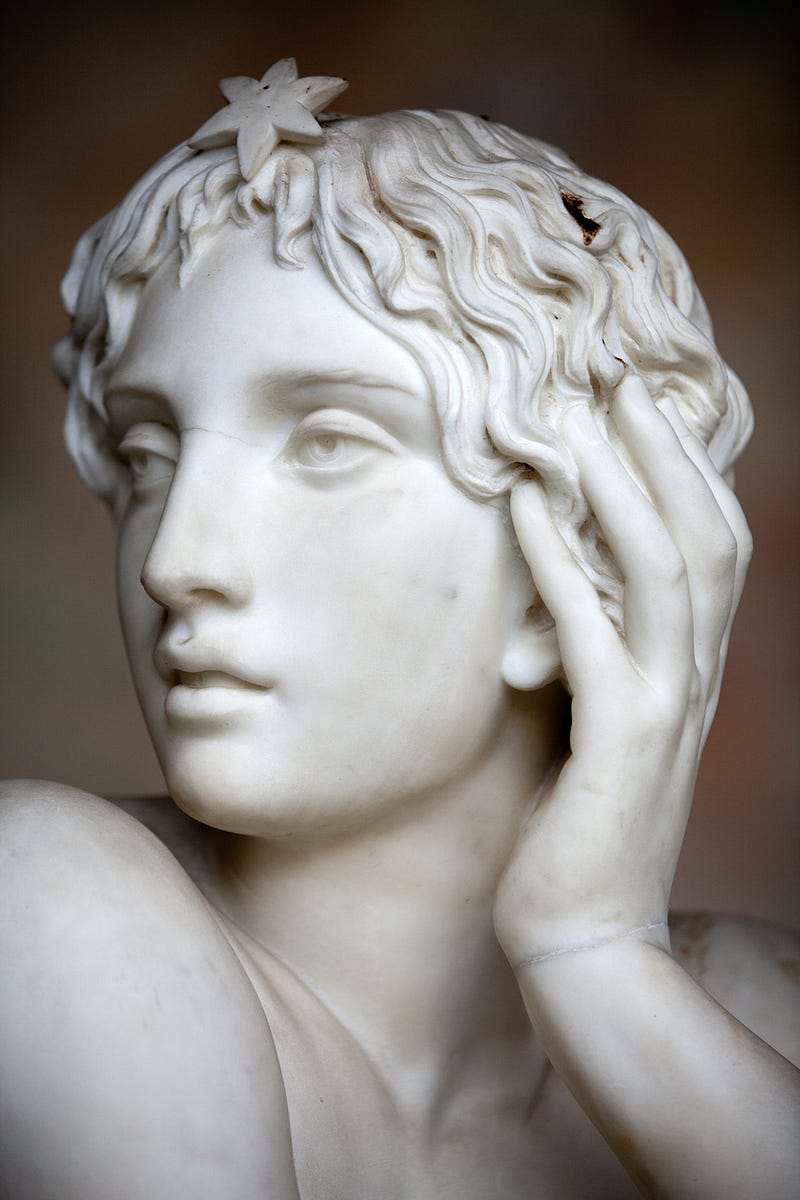
I was conceived with a hammer and chisel — grace shaped each finger, beauty sculpted my breasts and thighs, elegance carved my neck — born from a goddess’ breath — bloodless pallor became rosy blush, frozen flesh turned soft and supple as wax warmed by the sun —
I blinked and I simply was awake alive Galatea
flawless, he said, cupping my chin tilting, turning appraising
he laughed then delighted pleased with his work and I smiled I am always perfect
He calls me wife, I call him Creator —
sometimes he comes to me at night — I tell him I am tired, that my head hurts — sometimes he stays anyway…holds me, touches me…and I lay there still as stone — unfeeling — unmoving — until it is over —
I want to shatter into a thousand p i e c e s
I am always perfect
I see feathered creatures outside the window — watch them as they flit about — wish I could do that, too — could fly away from here — know he did not make them, know they are lucky — must come from somewhere else — otherwise, he would never let them out —
I ask if he can make me a pair of wings — he laughs, says he would be so lonely he would die if I ever left —
and I clench my teeth so hard my jaw aches dig crescents into the palms of my hands until they well with drops of blood swallow down a scream
I am always perfect
After that, he shuts the windows, puts bars over them — I learn how to pick them with a hairpin while he is in the studio — how to put the bolt back in place — how to make my face a smooth mask of marble —
I am adored worshipped cared for fawned and fussed over
I am given gifts of flowers and shells draped in rich robes of amethyst fit for a queen, jewels adorning my hands and throat hanging at my ears
a pretty plaything locked in a gilded cage
I am suffocating
I am trapped
I am always perfect
He gives me a daughter so I won’t be alone — I name her Paphos — heat, my little ember — and I do not think only of myself anymore —
I think of her how she deserves to taste the sun and stars and wind even if I must steal them for her for us
I feel something growing within me not another seed as Creator hopes but something wild and dangerous something that wants to break —
one day, I will take Paphos’ hand and together we will run fast and far and I won’t look back
I will not be perfect anymore
I will be free.
Eleanore Christine 2022
In response to J.D. Harms’ prompt “Who Drives You to the Page: lovers of myth.” In Ovid’s Metamorphoses, the original myth of Pygmalion and Galatea has its roots in misogyny: upon seeing the Propoetides (prostitutes) in the streets of Cyprus, Pygmalion becomes so disgusted by what he perceives to be their shamelessness and immorality that he decides to remain celibate. Instead, he sculpts a statue embodying his ideals of what the “perfect” woman is: chaste, pure, innocent, obedient. And of course, she is also so beautiful that he falls in love with his creation. Later, at the festival day of Venus, Pygmalion prays to the goddess — and for his devotion, the goddess answers his prayers in the form of “his ivory girl” coming to life, going so far as to bless their union in marriage.
A modern, feminist view of this myth brings up interesting — and troubling — questions of consent and free will, and perhaps whether Galatea is human at all or simply animated. We don’t get this introspection from the male perspective of Ovid. The original myth might be read as one of the artist and his muse, love and inspiration. I saw it as a story of obsession and possession, one in which Galatea is an object and a fantasy, existing solely for her creator’s visual and sexual pleasure. In Metamorphoses, Galatea doesn’t even speak — and so I let her have a voice and made her fully human and gave her the agency to jump down from the pedestal Pygmalion places her on.