
Shallow Copy and Deep Copy in Python

Introduction
As we all know, the = operation in Python means passing by reference. Simply put, it means giving a new name to the object. For a mutable object, such as a list, we can modify it by any of its name.
As the above example shown, B and A are both references to the list, so when we modified the list by B , the A was changed as well.
Now, there is a question: how to copy the list from A to B? In other words, how to modify B without affecting the values of A ?
It’s the best time to know the copy module in Python!

Shallow Copy
The copy module in Python helps us copy objects more flexible. Let’s look an example:
As the above example shown, we can use B = A.copy() or B = copy.copy(A) to implement the copy operation. After that, B and A are independent with each other. We can modify B without affecting A .
How it Works?
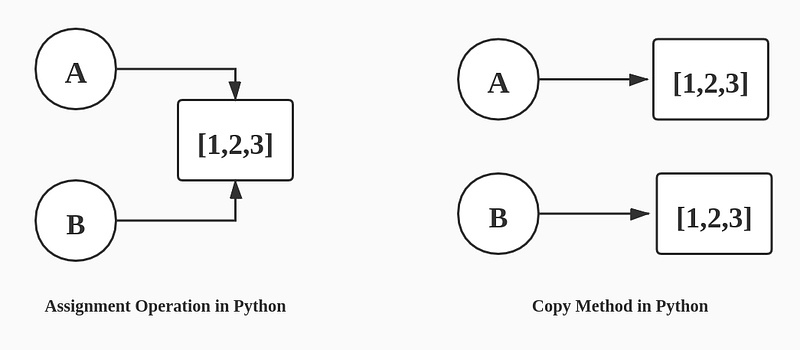
The above figure demonstrate all secrets.
The assignment statement did not really create a new list in memory address, it just created a new reference B for the list. In other words, A and B are two references for the same list. Therefore, no matter you modify A or B, you modify the same list.
The copy function really created a new list with the same value of the original list. Therefore, you can modify A or B independently.
Why does the Shallow Mean?
The B = A.copy() or B = copy.copy(A) are both shallow copy. “Shallow” means they can’t create a 100% copy of nested objects, instead it just copies the first level of the nested objects. For example:
Now, the list has two level. The above results show that the first level was copied, but the second level was still assigned by reference. When we modified B[0] , the A[0] was changed as well.
In a nutshell, the copy.copy() function only applies to the first level of a nested object. The deep levels are still assigned by reference.
This “lazy” performance can improve the efficiency of copy operations and it conforms to Python’s design philosophy. Because the copy method needs to create new lists, which costs time.
However, what can we do if we really want a totally copy operation?
Deep Copy
We can use copy.deepcopy() to copy a nested object completely no matter how many nested levels of it.
As the above example shown, no matter how we modified B , A will never be affected. Because the B is a 100% copy of A , there is no assignment by reference in a deepcopy() operation.
Note: Because a deepcopy() operation always totally copies all nested objects, it will cost lots of time if the objects are too large.
Conclusion
In order to improve the efficiency, the = operation in Python is designed to pass by reference rather than by value. If we really need to copy objects (pass by value), we should use the copy.copy() method for shallow copy or the copy.deepcopy() method for deep copy. We must be careful when using deepcopy() for large objects, cause it costs lots of time.
Thanks for reading, more Python tutorials are here:


