
Shakespeare’s Globe, A Site Of National Heritage Or A Laboratory?
Shakespeare’s Globe Theatre
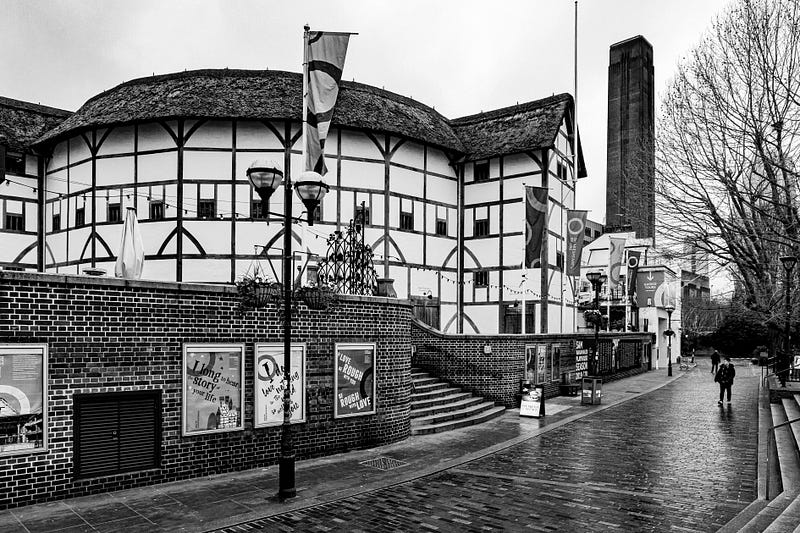
Shakespeare’s ‘New Globe Theatre’ is an admired and captivating assemblage of architectural, theatrical and academic aspiration built on the bank of the River Thames, only a few hundred yards from the site of the original Shakespeare’s Globe Theatre. Being the topic of many a scholarly debate it calls in to question issues such as authenticity, multiculturalism, theatrical experimentation and cultural dynamics. Described by Catherine Silverstone (2005, 31) as a ‘living’ theatre of emotional embodiment, the Globe seeks to educate and entertain. However, as well as dealing with Elizabethan and Jacobean theatre, original writings and international theatre companies come to the Globe to perform. Does this make the Globe simply another theatre, a laboratory for contemporary drama or is it an important part of our living history, a heritage site from which we can learn?
To start to address the question above we need to look critically at the authenticity of the Globe. W.B. Worthen explains that its creation “has been notable for the scrupulousness of its research into the location, size, and materials of the Globe.” (2002, 160) To a large extent, what was learned about the Globe was the result of well-read investigation of Tudor assembly traditions and how to formulate effective reconstructions. Therefore, the first building to be framed from wood since the Great Fire of London, the theatre is as architecturally as close to the original, as contemporary building law would allow. (Worthen, 2002, 160–161)
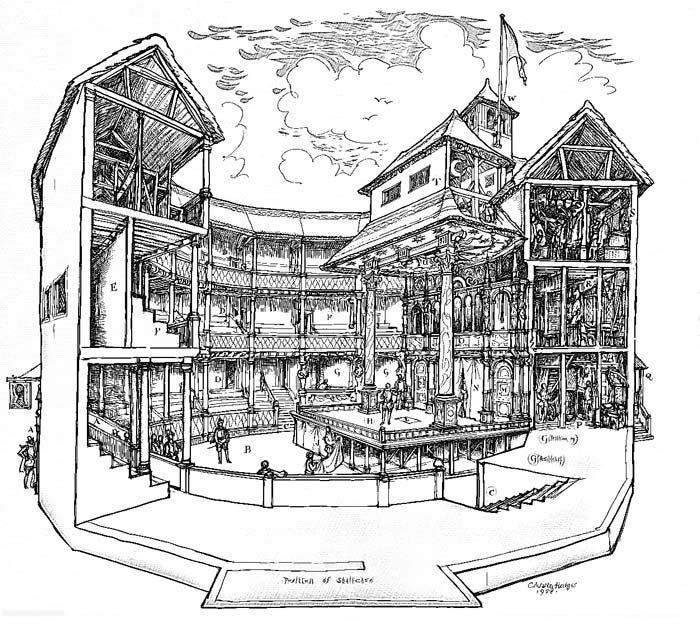
In contrast, Jonathan Bate and Eric Rasmussen make clear that “reconstructions of Elizabethan playhouses have relied heavily on” a drawing by Arendt van Buchell. (2007, 24) They then go on to explain that Buchell was an unreliable source and poor in his portrayal and consequently, there is no authentic image of the inside of a Shakespearian theatre. This suggests that any contemporary reconstruction is based on various, scholarly evidence and can only be theoretical.
Both sources agree that the original Globe would have held in excess of 3000 people as opposed to the 1600 of the reconstruction. A contemporary audience would be physically larger than that of the Shakespearian audience and the proximity between each person would have been far smaller in the Elizabethan audience. That said, for the contemporary theatre-goer, the new Globe theatre will be the closest they will come to understanding and experiencing what a theatre in Shakespeare’s time would be like.
The Globe is inextricably linked to our national identity, it attracts tourists from around the world and many see it as an important part of our culture and heritage.
The Globe is intended not merely as a place for performance of the past, a place for its audiences to conjure an imagined experience of Shakespeare’s theatre. For the Globe to achieve its experimental mission, the performances taking place there have to be contemporary as well.
Worthen, 2003, 93
In this way the Globe can serve as a link between past and present and the ongoing texts of Shakespeare’s plays are kept alive within contemporary performance and audience, both nationally and globally. Moreover, the participatory experience and close proximity to the stage, creates a sense of energy and community that many an actor from varying cultural backgrounds are keen to experience.
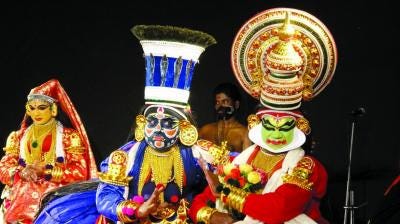
The Globe is not only a national icon but also an international meeting place for theatre around the world. In July 1999 as part of the annual Globe to Globe festival a Kathakali performance of King Lear took place performed by the Annette Leday/Keli Company. Leday not only co-directed the play but also played the part of Cordelia. Her aim was to experiment with communicating cross-culturally, bringing Kathakali to Western viewers through a recognizable medium. Leday explained in an interview that she believed the audience would be able to better relate to the foreign performance through a well-known story that was easy to comprehend:
The Mahabharata is very complicated for a Western audience. They get confused as to who is who. But, in this case, the characters are very clear. Most people knew the story or they could follow the little synopsis. I felt that they were able to appreciate the form much better than with a traditional [kathakali] play.
Leday in Daugherty, 2005, 57
However, even if the audience were previously knowledgeable to the plot of King Lear, for this performance the text was radically slashed to nine scenes and no attempt was made to imitate any of Shakespeare’s language, in fact there were no original lines in the finished text at all. Then again, in Kathakali performance, music, song and text should come together to produce a sound structure for the play and convey a unified meaning. (Daugherty, 2005)
Any intercultural work is in danger of being misinterpreted; Kathakali is a dance drama bound in religion, gender and a socio-cultural vision. For this reason a Western audience will be culturally inexperienced and will not fully grasp the cultural dynamics and spiritual purpose behind the gesture and emotion, since its ancestry is tied to its society’s knowledge, skill and social memory. In a review for the Financial Times, Ian Shuttleworth reiterates this and explains that Kathakali drama “primarily depends upon highly evolved languages of dance and gesture to convey the characters’ words and feelings.” (2008, 1) Shuttleworth believes that through bad adaptation and too many drawn out solos the Kathakali version of King Lear was unsuccessful, backed up by an audience seeming to pay little attention.
In contrast, E Menon’s review of the performance describes the experience as “poetry in motion, unrolling itself in front of a spellbound audience.” (1999, 2) Nevertheless, we must realise that this reviewer is writing from an Eastern viewpoint and is therefore well-informed in Kathakali performance, understanding the vast gestures and language. Therefore, for Menon, the bringing together of movement, music and gesture spoke a language of their own and words were superfluous. (Menon, 1999)
There will always be scholarly debates and contrasting views for any cross-cultural experimental performance at the Globe. Whether specific works are successful or not, what cannot be argued is that the Globe brings many visitors to its doors locally, nationally and globally. It could be viewed as a laboratory that experiments with different theatre forms, a contemporary cultural project, or a nostalgic adaptation. I believe that we cannot categorise it, as it is in fact all three, with the diverse repertoire performed there, it is the home of multicultural and contemporary theatre. However, the paradox of the Globe is the fact that it is also a site of national heritage where tourists revel in its evocative nostalgia. In this way the Globe keeps both Shakespeare and our heritage ‘alive’ in the heart of not only our Western culture but many cultures around the world.
Article written by Drama Llama | Educator | Writer | Academic | Consultant


